Stellar Engines And Dyson Bubbles Can Be Stable
A range of speculative space ventures envisage the use of ultra-large structures for the collection and reflection of light.
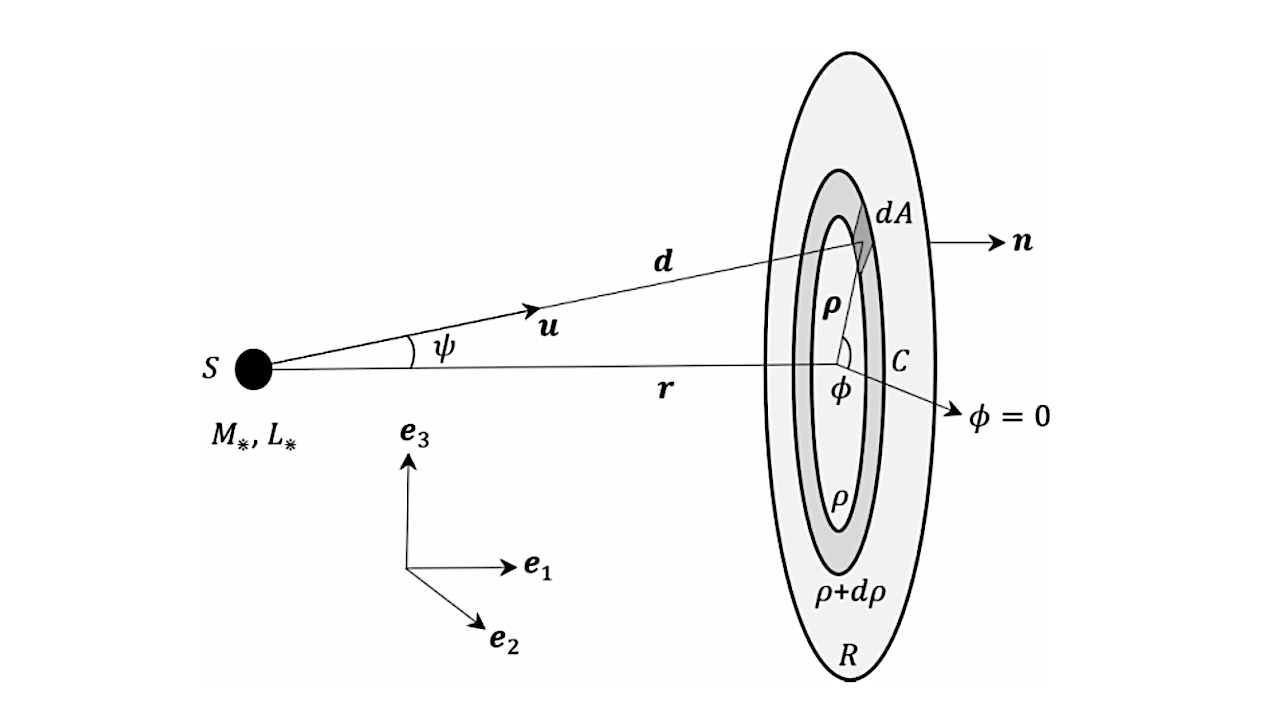
Given the length-scale of such structures they cannot be considered as point masses for the calculation of gravitational and radiation pressure forces. Using a simplified model it will be demonstrated that ultra-large reflectors in static equilibrium levitating above a central star (so-called stellar engines) are always unstable if the reflector comprises a uniform disc.
However, if the reflector has a non-uniform mass distribution, specifically a ring supporting a reflect or, a stellar engine can in principle be passively stable. Moreover, while it can be shown that static swarms of reflectors levitating above a central star (so-called Dyson bubbles) are unstable, in principle they can become passively self-stabilizing if arranged about the star as a dense cloud.
While such ventures are clearly speculative, understanding the orbital dynamics of ultra-large structures, and in particular the conditions for passive stability, can provide insights into the properties of potential technosignatures in search for extraterrestrial intelligence studies.
Colin R McInnes
Comments: Accepted for publication in MNRAS; 18 pages, 15 figures
Subjects: Solar and Stellar Astrophysics (astro-ph.SR); Instrumentation and Methods for Astrophysics (astro-ph.IM); Popular Physics (physics.pop-ph)
Cite as: arXiv:2603.00203 [astro-ph.SR] (or arXiv:2603.00203v1 [astro-ph.SR] for this version)
https://doi.org/10.48550/arXiv.2603.00203
Focus to learn more
Related DOI:
https://doi.org/10.1093/mnras/stag100
Focus to learn more
Submission history
From: Colin McInnes
[v1] Fri, 27 Feb 2026 10:37:55 UTC (2,016 KB)
https://arxiv.org/abs/2603.00203
Astrobiology, SETI, Interstellar,