A Century of Radial Velocity and Astrometric Monitoring of 70 Oph AB: New PFS Data and Constraints on Planetary Companions
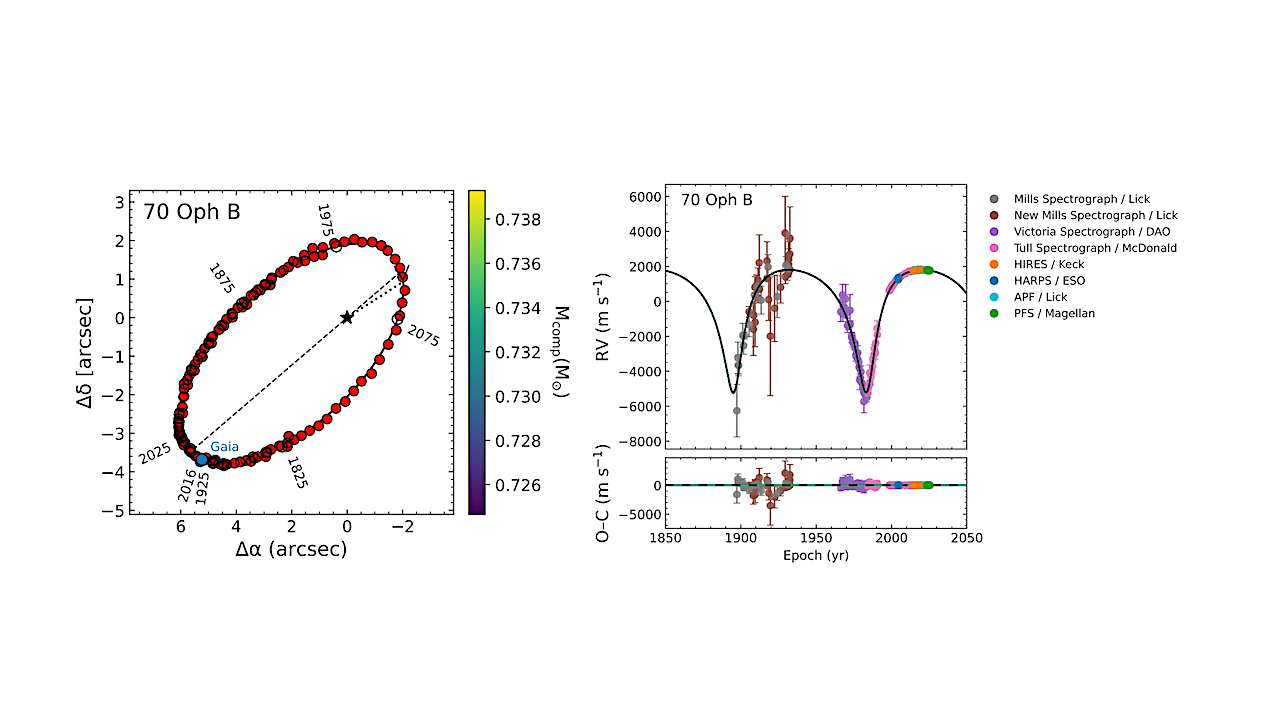
At a distance of 5.1 pc, the 70 Oph AB binary star system is one of the most favorable targets for future direct imaging and astrometry missions surveying mature, terrestrial planets.
We present new radial velocities (RVs) obtained with the Planet Finder Spectrograph (PFS) on the 6.5,m Magellan II Clay Telescope in Chile. We collected 499 measurements of 70 Oph A and 334 measurements of 70 Oph B during 2023–2025. Combining these data with decades of archival RVs and astrometry, we derive an updated orbital solution for the binary and dynamical masses of 0.88±0.004M⊙ and 0.73±0.003M⊙ for the primary and secondary components, respectively.
We find that the long-term RV variability of both components is consistent with stellar activity modulated by rotation periods, and we detect no coherent planetary signals in either component.
We place upper limits on any planets orbiting in the plane of the binary. The 27 yr RV baseline for 70 Oph A excludes Jupiter-mass planets interior to 5 au and reaches a sensitivity of 0.3MJup at 1 au or 0.5MJup at 2 au. For 70 Oph B, with PFS data we rule out planets more massive than 0.25–0.3MJup inside 0.5 au.
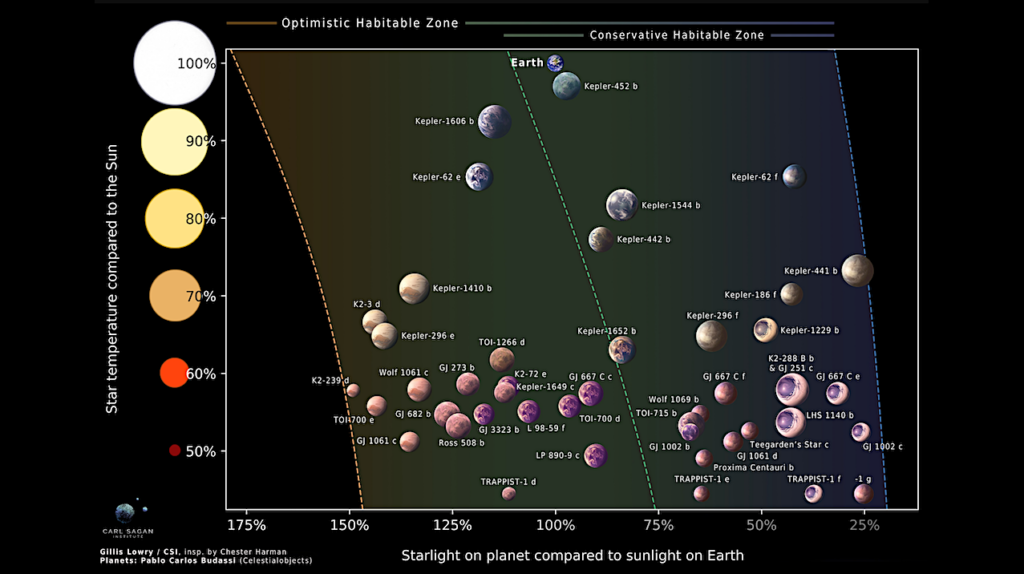
We show that stable S-type orbits around 70 Oph A extend to ∼2.5 au, covering the habitable zone. Thus, Saturn-mass planets or smaller on stable orbits in the habitable zone of 70 Oph A are allowed. Overall, our results provide important guidance for future planet searches around this stellar system.
Yiting Li, Michael R. Meyer, Skylar D’Angiolillo, Stephen R. Kane, R. Paul Butler, Stephen A. Shectman, Eric E. Mamajek, Johanna Teske, Jack Lubin, Paul Robertson, Jessie L. Christiansen, Howard Isaacson, Caleb K. Harada, Bradford Holden, William D. Cochran, Michael Endl, Jennifer Burt, Juliette Becker, Alyssa Jankowski, Peter Tuthill, Catherine A. Clark, Rachael M. Roettenbacher, Eric Nielsen, Eduardo Bendek, Armen Tokadjian, William Roberson, Kaitlin M. Kratter, Edwin Bergin, Dave Osip, Jeffrey D. Crane, Alex Davis, Gautam Vasisht
Subjects: Earth and Planetary Astrophysics (astro-ph.EP); Solar and Stellar Astrophysics (astro-ph.SR)
Cite as: arXiv:2603.20044 [astro-ph.EP] (or arXiv:2603.20044v1 [astro-ph.EP] for this version)
https://doi.org/10.48550/arXiv.2603.20044
Focus to learn more
Submission history
From: Yiting Li
[v1] Fri, 20 Mar 2026 15:29:32 UTC (2,749 KB)
https://arxiv.org/abs/2603.20044
Astrobiology,