Rotational Doppler Cartography Of Technosignatures On Unresolved Planets
The discovery of many Earth-like planets has renewed interest in whether life and technological civilizations exist elsewhere.
The Search for Extraterrestrial Intelligence (SETI) seeks evidence for technological civilizations via technosignatures across the electromagnetic spectrum. Here, focusing on artificial radio emissions with extremely narrowband signals, we model Earth as a distant, unresolved source and simulate its narrowband transmissions as observed with current and forthcoming radio facilities.
Planetary rotation induces small but coherent Doppler drifts (maximum fractional shift of order 10−6) that imprint a characteristic, time-varying pattern on the spectrum.
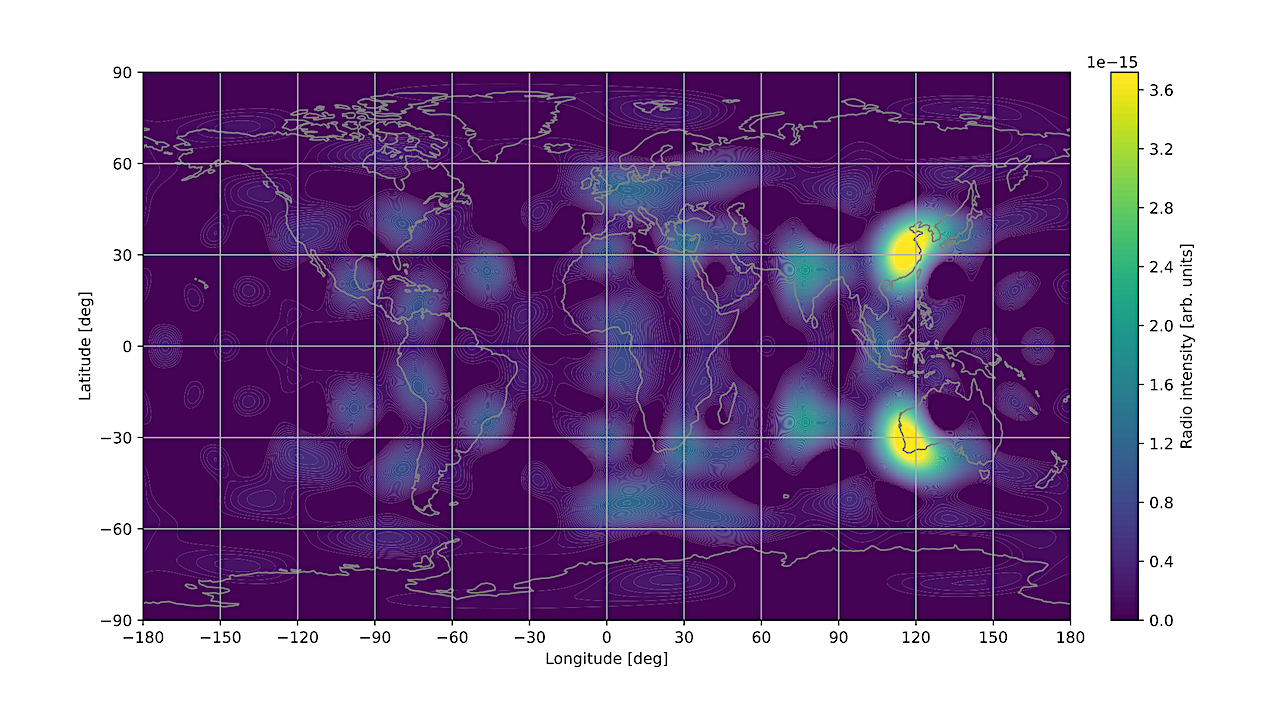
We develop a forward-inverse framework that exploits this modulation: adopting a population-weighted model for terrestrial transmitters, we compute time-resolved spectra and then apply a new inversion method that reconstructs the underlying transmitter distribution from the temporal pattern of fractional frequency offsets.
In noise-added tests, the method recovers the low-order spherical-harmonic structure of the map and retrieves major population centers despite the north-south degeneracy of unresolved observations. The recovered distribution is expected to correlate with continents, climate zones, and population density. This approach moves SETI beyond mere detection, enabling quantitative cartography of a civilization’s activity and inference of host-planet properties through sustained, time-resolved spectroscopy.
Keitaro Takahashi
Comments: 14 pages, 7 figures, accepted for publication in ApJ
Subjects: Earth and Planetary Astrophysics (astro-ph.EP); Instrumentation and Methods for Astrophysics (astro-ph.IM)
Cite as: arXiv:2603.01032 [astro-ph.EP] (or arXiv:2603.01032v1 [astro-ph.EP] for this version)
https://doi.org/10.48550/arXiv.2603.01032
Focus to learn more
Submission history
From: Keitaro Takahashi
[v1] Sun, 1 Mar 2026 10:17:53 UTC (10,871 KB)
https://arxiv.org/abs/2603.01032
Astrobiology, SETI, Technosignature, Astronomy,