The Pollux European Instrument Concept For HWO: A High-resolution Spectrograph And Spectropolarimeter From The far-UV To The near-IR
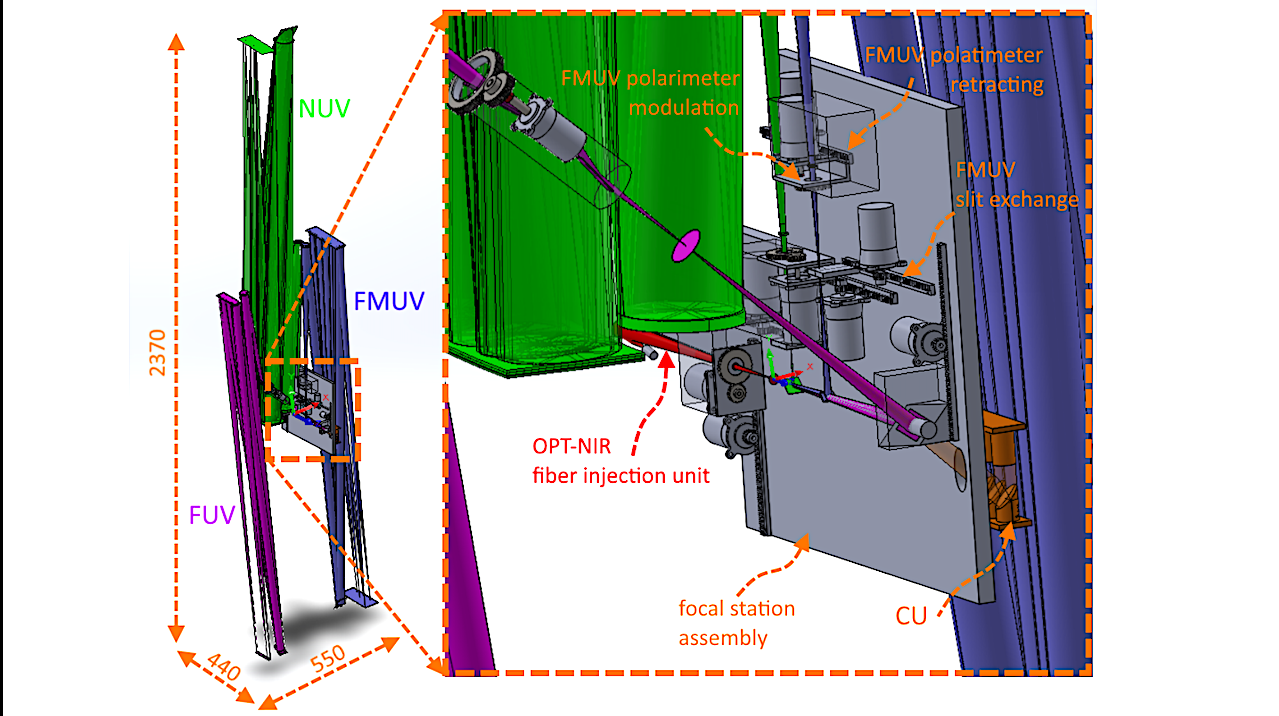
Pollux is a high-resolution spectrograph and spectropolarimeter working from 100 nm to 1.8 microns proposed for HWO by a European consortium. Pollux will allow us to study stellar and (exo)planetary systems, as well as cosmic ecosystems.
For example, Pollux will provide new insights on exoplanet formation and evolution, characterization of the atmospheres and magnetospheres of stars and planets, and star-planet interactions.
It will also allow us to resolve narrow UV emission and absorption lines, enabling us to follow the baryon cycle over cosmic time — from galaxies forming stars out of interstellar gas and grains, and planets forming in circumstellar disks, to the various forms of feedback into the interstellar and intergalactic medium — and from active galactic nuclei.
The most innovative characteristic of Pollux is its unique spectropolarimetric capability in the UV, which will open a new parameter space. Its very high spectral resolution (~70000 to ~100000) and stability over a very large wavelength range will also be a major asset.
In this paper, we summarize the main scientific drivers of Pollux and present its current design, technological challenges, and the Pollux consortium organization.
Coralie Neiner, Jean-Claude Bouret, Luca Fossati, David le Mignant, Eduard Muslimov, Ana Ines Gomez de Castro, Frédéric Marin
Comments: HWO2025 symposium held in Washington in July 2025
Subjects: Instrumentation and Methods for Astrophysics (astro-ph.IM)
Cite as: arXiv:2602.09828 [astro-ph.IM] (or arXiv:2602.09828v1 [astro-ph.IM] for this version)
https://doi.org/10.48550/arXiv.2602.09828
Focus to learn more
Submission history
From: Coralie Neiner
[v1] Tue, 10 Feb 2026 14:35:09 UTC (4,273 KB)
https://arxiv.org/abs/2602.09828
Astrobiology, Astrochemistry,