Detection Of A Four-carbon Sugar In Interstellar Space (Erythrulose)
Sugars are essential biomolecules, serving as metabolic fuels, nucleic acid backbone components, and structural or energy-storage polymers. A central question in origin-of-life research is how monosaccharides formed on the primitive Earth, as laboratory experiments under prebiotic conditions yield insufficient concentrations.
The detection of ribose, glucose and other monosaccharides in asteroids and meteorites suggests an exogenous origin, possibly in the interstellar medium (ISM) prior to meteoritic parent-body formation.
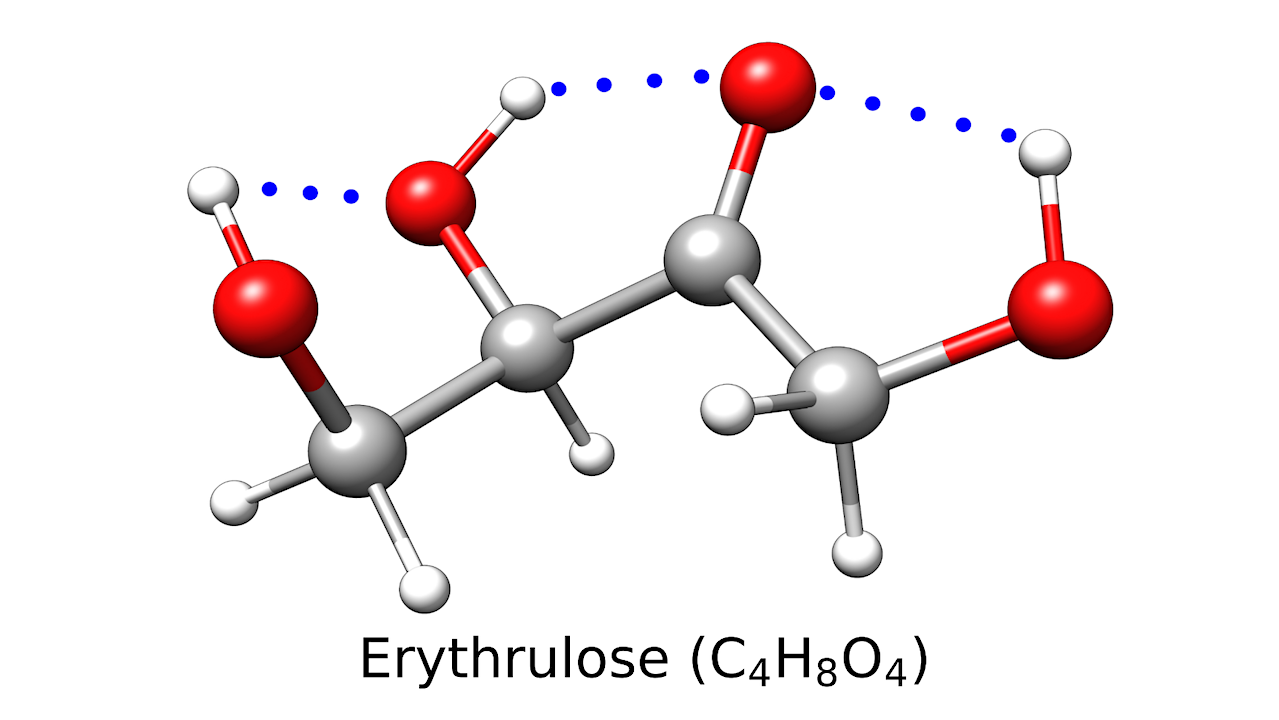
However, no sugar has been observed in the ISM so far. We report the discovery of erythrulose, a chiral four-carbon ketose, in the ISM. The detection has been achieved thanks to ultrasensitive, broadband spectral surveys toward the Galactic Center molecular cloud G+0.693-0.027 obtained using the Yebes 40m and IRAM 30m telescopes.
Erythrulose appears to be at least eight times more abundant than analogous three-carbon sugars, which remain undetected in our ultrasensitive observations. Quantum chemical and astrochemical models indicate that erythrulose forms efficiently on interstellar dust grains from simpler two-carbon aldehydes and alcohols.
As ketoses readily isomerize into aldoses in aqueous conditions, interstellar erythrulose could have contributed to the sugar inventory available for early metabolic and replication processes.
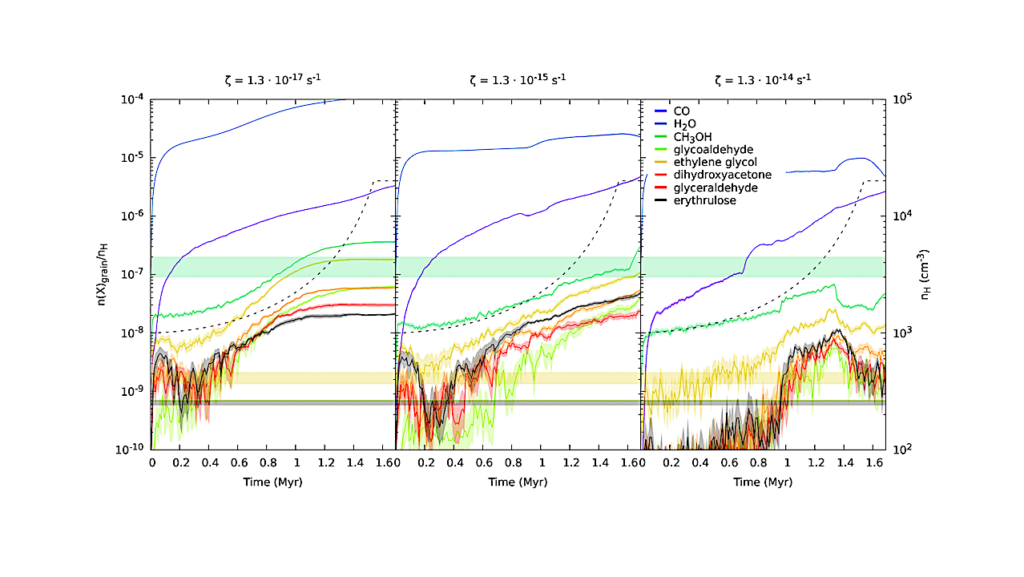
KMC simulations of the ice build-up in a cloud with similar physical conditions to those of G+0.693. Colour lines indicate the solid ice abundances of CO, H2O, CH3OH, glycolaldehyde, ethylene glycol, and all C3 and C4 sugars considered in the model (Methods). Data are presented as mean values ± 1 standard deviation spread of the nine simulations carried out with different random seeds. Labels are shown in the right panel, and the cosmic-rays ionization rate, ζ, in the upper part of each panel. Dashed line indicates the increase of the gas density during the cloud’s collapse. Horizontal color-shaded ranges show the molecular abundance values measured toward G+0.693 together with their 1σ uncertainty (Table 1). — astro-ph.GA
Izaskun Jimenez-Serra (1), Juan Garcia de la Concepcion (2), Herma M. Cuppen (3), Marta Rey-Montejo (1,4), Miguel Sanz-Novo (1,5), Victor M. Rivilla (1), Jesus Martin-Pintado (1), Andres Megias (1), Carlos Briones (1), David San Andres (1,4), Laura Colzi (1), Shaoshan Zeng (6), Sergio Martin (7,8), Joseph Salaris (3), Antonio Martinez-Henares (1,6), Alvaro Lopez-Gallifa (1), Miguel Requena-Torres (9), Belen Tercero (10,11), Pablo de Vicente (11), Aran Insausti (12,13), Elena R. Alonso (14), Emilio J. Cocinero (12,13) ((1) Centro de Astrobiologia (CAB), Spain, (2) University of Extremadura, Spain, (3) Radboud University, The Netherlands (4) Universidad Complutense de Madrid, Spain, (5) Max-Planck-Institut fur extraterrestrische Physik, Germany, (6) RIKEN, Japan, (7) European Southern Observatory, Chile, (8) Joint ALMA Observatory, Chile, (9) Towson University, USA, (10) Observatorio Astronomico Nacional (OAN-IGN), Spain, (11) Observatorio de Yebes (OY-IGN), Spain, (12) Universidad del Pais Vasco (UPV/EHU), Spain, (13) Instituto Biofisika (CSIC, UPV/EHU), Spain, (14) Universidad de Valladolid, Spain)
Comments: Submitted to Nature Astronomy
Subjects: Astrophysics of Galaxies (astro-ph.GA); Earth and Planetary Astrophysics (astro-ph.EP); Solar and Stellar Astrophysics (astro-ph.SR)
Cite as: arXiv:2606.03313 [astro-ph.GA] (or arXiv:2606.03313v1 [astro-ph.GA] for this version)
https://doi.org/10.48550/arXiv.2606.03313
Focus to learn more
Submission history
From: Izaskun Jimenez-Serra
[v1] Tue, 2 Jun 2026 08:25:16 UTC (4,638 KB)
https://arxiv.org/abs/2606.03313
Astrobiology, AStrochemistry,