Characterizing Transiting Exoplanet Atmospheres in the 2030s with the Hubble Space Telescope

The Hubble Space Telescope inaugurated the era of exoplanet atmospheric characterization. While the James Webb Space Telescope has largely taken up the mantle of infrared atmospheric characterization, Hubble’s unique short-wavelength capabilities remain unmatched.
Recent theoretical advances in exoplanet atmospheric science combined with new observing strategies, like those offered by WFC3-UVIS/G280, have opened science cases that only Hubble can address for the foreseeable future.
In this white paper, we discuss these new windows into the atmospheres of other worlds, focusing on characterization of their hydrostatic lower atmosphere, and identify the critical capabilities necessary for future observations.
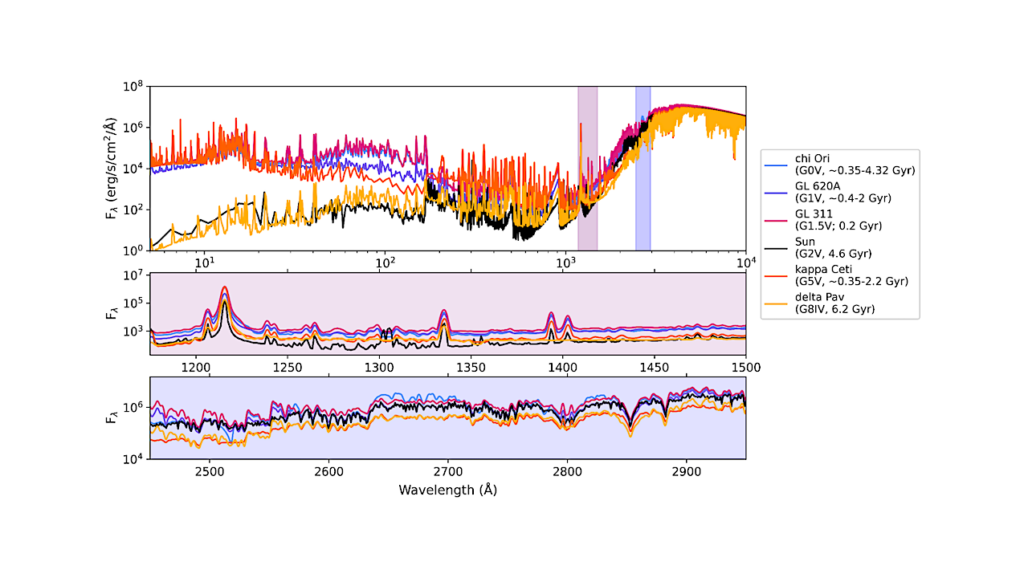
We highlight three overall science cases that will depend on the continued short-wavelength capabilities of Hubble: measuring aerosol scattering slopes, characterizing metal absorption in ultra-hot Jupiters, and understanding stellar activity with Transit Light Source effect decontamination and flare monitoring.
Throughout, we highlight useful synergies between HST and JWST. This article is a response to the call for white papers by the Space Telescope Science Institute on “Building a Roadmap for Hubble science into the 2030s.”
Joshua D. Lothringer, Hannah R. Wakeford, Robert C. Frazier, Lili Alderson, Munazza K. Alam, David K. Sing, Mei Ting Mak, Nikole K. Lewis, Lia Corrales, Eva-Maria Ahrer
Comments: 7 pages, 4 figures; this article is a response to the call for white papers by STScI on “Building a Roadmap for Hubble science into the 2030s.”
Subjects: Instrumentation and Methods for Astrophysics (astro-ph.IM); Earth and Planetary Astrophysics (astro-ph.EP)
Cite as: arXiv:2606.04144 [astro-ph.IM] (or arXiv:2606.04144v1 [astro-ph.IM] for this version)
https://doi.org/10.48550/arXiv.2606.04144
Focus to learn more
Submission history
From: Joshua Lothringer
[v1] Tue, 2 Jun 2026 19:03:11 UTC (3,168 KB)
https://arxiv.org/abs/2606.04144
Astrobiology