Low-energy Glycine Formation And Spectral Masking In Star-forming Regions
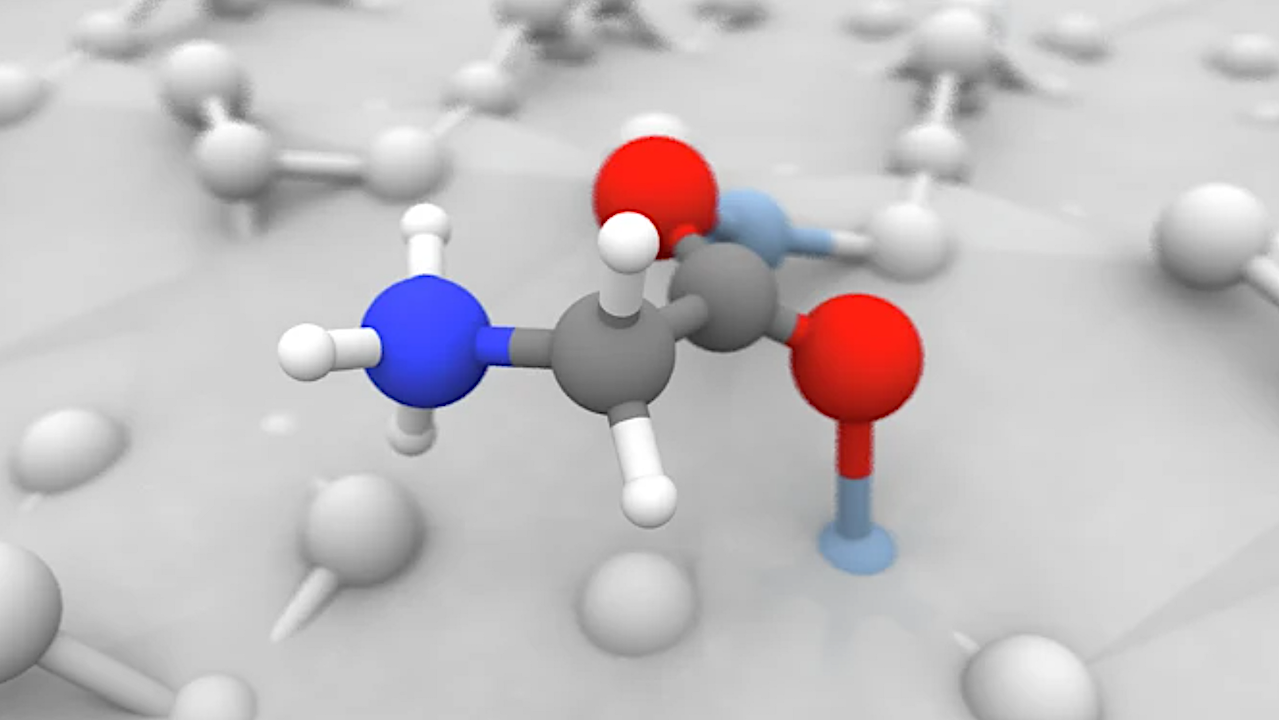
The presence of amino acids in comets and meteorites has long suggested that prebiotic molecules may have formed in space and contributed to the origins of life on Earth.
Glycine, the simplest amino acid, has been identified in several extraterrestrial environments, although its detection in the interstellar medium, including prestellar cores and protostellar regions, remains elusive. Here, we investigate a novel catalytic pathway for glycine formation on silicate grains during relatively warm (> 150 K) stages of star formation.
Using atomistic simulations, the feasibility of a Strecker-type synthesis and a direct neutral mechanism involving reactivity between formaldehyde, carbon monoxide and ammonia on forsterite surfaces, the major constituent of interstellar dust, is assessed. Results show that the Strecker pathway is limited by high activation barriers, whereas the proposed direct mechanism proceeds through low-energy surface-stabilized intermediates leading to spontaneous formation of glycine in a single-barrier exoergic process. Additionally, glycine strongly adsorbs onto the mineral surface and is unlikely to desorb under warm conditions.
A vibrational analysis reveals that glycine formed through this pathway exhibits spectrally distinct features, including suppression and shifting of characteristic bands, which may account for its persistent non-detection in astronomical observations. Glycine has been identified in several extraterrestrial environments, however, its detection in the interstellar medium remains elusive.
Here, the authors investigate a catalytic pathway for glycine formation on silicate grains during relatively warm (> 150 K) stages of star formation using atomistic simulations, proposing a mechanism involving low-energy surface-stabilized intermediates that lead to spontaneous formation of glycine in a single-barrier exoergic process.
- Low-energy glycine formation and spectral masking in star-forming regions, Communications Chemistry via PubMed (open access)
- Low-energy glycine formation and spectral masking in star-forming regions, Communications Chemistry (open access)
Astrobiology, Astronomy, Astrochemistry, Interstellar,