Detection Of CO2 Ice In The Planetary Nebula NGC 6302
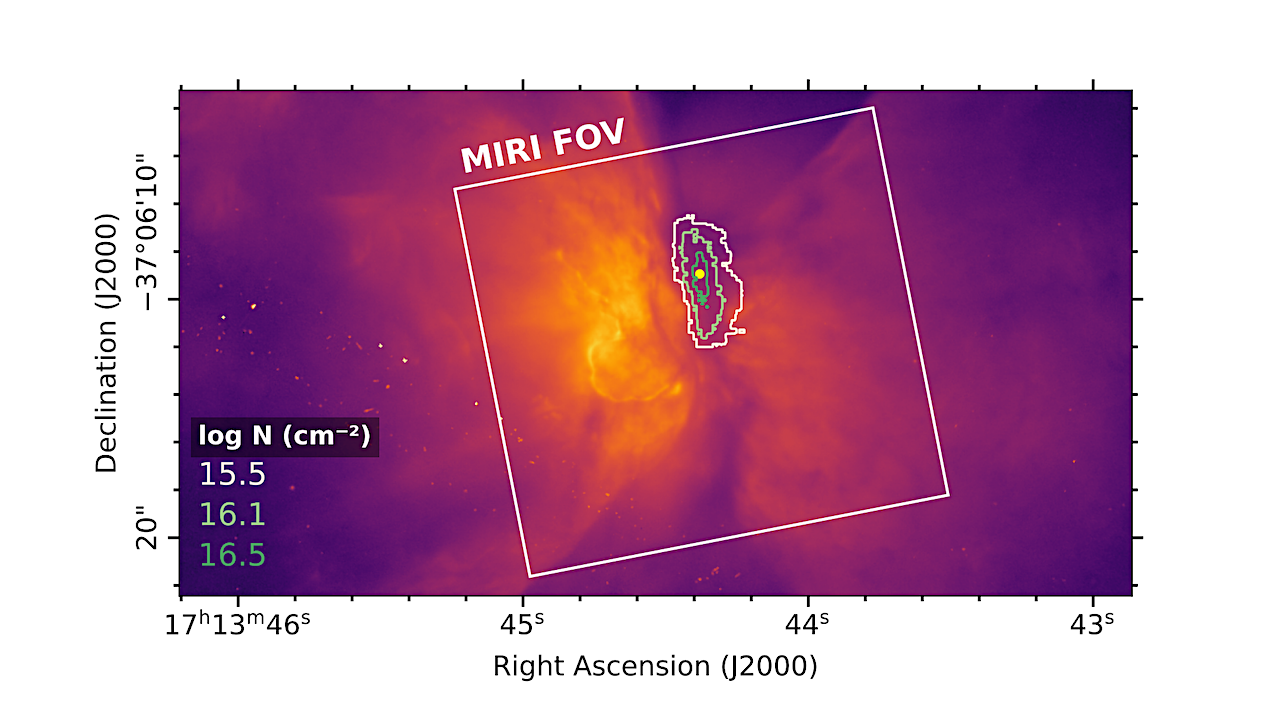
Using JWST/MIRI observations, we report the detection of CO2 ice in the dusty torus of the planetary nebula NGC 6302, an environment generally considered hostile to fragile molecular species and ices due to intense UV irradiation.
This detection accompanies cold (20-50 K) gas-phase CO2 along the same sightlines. The ice absorption profile exhibits a double-peak profile, a characteristic of pure, crystalline CO2 ice.
The CO2 gas-to-ice ratio is more than an order of magnitude higher than in young stellar objects, pointing to distinct ice formation or processing mechanisms in evolved stellar environments.
This discovery demonstrates that the dusty torus provides sufficient shielding to harbour ice chemistry, and that ice-mediated surface reactions must be incorporated into chemical models of planetary nebulae.
Charmi Bhatt (1, 2), Simon W. Cao (1), Jan Cami (1, 2), Nicholas Clark (1), Pascale Ehrenfreund (3, 4), Els Peeters (1, 2), Mikako Matsuura (5), G. C. Sloan (6, 7), Harriet L. Dinerstein (8), Patrick Kavanagh (9), Kevin Volk (6), Isabel Aleman (10), Michael J. Barlow (11), Kay Justannont (12), Kathleen E. Kraemer (13), Joel H. Kastner (14, 15, 16), Francisca Kemper (17, 18, 19), Hektor Monteiro (5, 20), Raghvendra Sahai (21), N. C. Sterling (22), Jeremy R. Walsh (23), L. B. F. M. Waters (24, 25), Albert Zijlstra (26) ((1) Department of Physics and Astronomy, University of Western Ontario, London, Ontario, Canada, (2) Institute for Earth and Space Exploration, University of Western Ontario, London, Ontario, Canada, (3) Leiden Observatory, Leiden University, Leiden, The Netherlands, (4) Space Policy Institute, George Washington University, Washington DC, USA, (5) Cardiff Hub for Astrophysics Research and Technology, School of Physics and Astronomy, Cardiff University, Cardiff, UK, (6) Space Telescope Science Institute, Baltimore, MD, USA, (7) Department of Physics and Astronomy, University of North Carolina, Chapel Hill, NC, USA, (8) Department of Astronomy, University of Texas at Austin, Austin, TX, USA, (9) Department of Physics, Maynooth University, Maynooth, Ireland, (10) Laboratorio Nacional de Astrofisica, Itajuba, MG, Brazil, (11) Department of Physics and Astronomy, University College London, London, UK, (12) Chalmers University of Technology, Onsala Space Observatory, Onsala, Sweden, (13) Institute for Scientific Research, Boston College, Chestnut Hill, MA, USA, (14) Center for Imaging Science, Rochester Institute of Technology, Rochester, NY, USA, (15) School of Physics and Astronomy, Rochester Institute of Technology, Rochester, NY, USA, (16) Laboratory for Multiwavelength Astrophysics, Rochester Institute of Technology, Rochester, NY, USA, (17) Institut de Ciencies de l’Espai (ICE, CSIC), Barcelona, Spain, (18) ICREA, Barcelona, Spain, (19) Institut d’Estudis Espacials de Catalunya (IEEC), Barcelona, Spain, (20) Instituto de Fisica e Quimica, Universidade Federal de Itajuba, Itajuba, MG, Brazil, (21) Jet Propulsion Laboratory, California Institute of Technology, Pasadena, CA, USA, (22) University of West Georgia, Carrollton, GA, USA, (23) European Southern Observatory, Garching, Germany, (24) Department of Astrophysics/IMAPP, Radboud University, Nijmegen, The Netherlands, (25) SRON Netherlands Institute for Space Research, Leiden, The Netherlands, (26) Jodrell Bank Centre for Astrophysics, Department of Physics and Astronomy, The University of Manchester, Manchester, UK)
Subjects: Astrophysics of Galaxies (astro-ph.GA)
Cite as: arXiv:2602.22366 [astro-ph.GA](or arXiv:2602.22366v1 [astro-ph.GA] for this version)
https://doi.org/10.48550/arXiv.2602.22366
Focus to learn more
Submission history
From: Charmi Bhatt
[v1] Wed, 25 Feb 2026 19:58:21 UTC (900 KB)
https://arxiv.org/abs/2602.22366
Astrobiology, Astrochemistry,