JWST-TST High Contrast: First Direct Spectroscopy of GJ 504 b Reveals Clouds And Possible Metal Enrichment
Characterizing the coldest directly imaged companions through direct spectroscopy has only recently become possible with the James Webb Space Telescope.
We present moderate-resolution (R ∼ 2,700) spectroscopic observations of the directly imaged planetary-mass companion (PMC), GJ 504 b, using the JWST/NIRSpec. As the coldest imaged PMC of the pre-JWST era GJ 504 b is too faint for ground-based spectroscopy, with only photometric observations possible. Leveraging advanced post-processing techniques with a forward modeling framework, we detect the companion at high signal-to-noise (S/N>300).
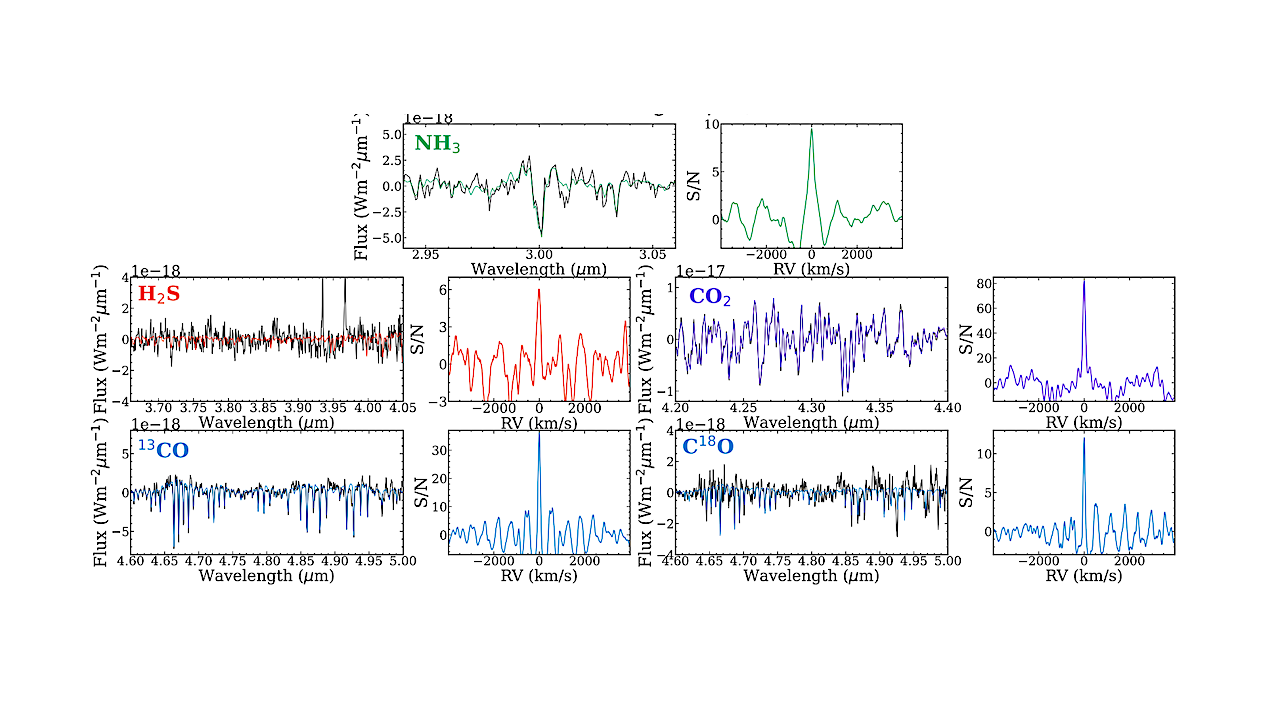
We also present the first successful PSF subtraction with angular differential imaging (ADI) in the NIRSpec point cloud, detecting GJ 504 b at S/N>10 and reaching contrast limits <10−4. The extracted 2.9–5.3 μm spectra show strong signatures of several molecular species, including H2O, 12C16O, CH4, CO2, NH3, H2S, 13C16O, and 12C18O.
Atmospheric modeling of the spectra using petitRADTRANS, yields an effective temperature = 564±4 K, surface gravity logg = 4.87+0.13−0.12, metallicity [M/H] = 0.67+0.13−0.12, C/O ratio = 0.64+0.02−0.02, interstellar 12C/13C and 16O/18O isotopologue ratios, and strong evidence of disequilibrium chemistry and salt clouds.
The retrieved parameters indicate a mass 25.2+8.4−6.0 MJup, which is in agreement with the mass range (19–27 MJup) obtained from ATMO evolutionary models, implying an age of 2.5–4.0 Gyr. Lastly, we compare the abundances of GJ 504 b to its primary, obtaining a stellar abundance of sulfur (S), super-stellar carbon (C), and possibly, oxygen (O). The observed metal enrichment tentatively supports planet-like formation, but does not entirely exclude stellar abundances for GJ 504 b.
Aneesh Baburaj, Jean-Baptiste Ruffio, Marshall Perrin, Jerry W. Xuan, William O. Balmer, Yayaati Chachan, Quinn M. Konopacky, Travis S. Barman, Mathilde Mâlin, Kielan K. W. Hoch, Emily Rickman, Kimberly Ward-Duong, Laurent Pueyo, Julien H. Girard, Isabel Rebollido, Alexis Bidot, Christine Chen, Kadin Worthen, Cicero Lu, Jens Kammerer, Roeland P. van der Marel, Nikole K. Lewis, Jeff Valenti, Sara Seager, Chris Stark, Rémi Soummer, Jay Anderson, Charles-Philippe Lajoie, Mark Clampin, C. Matt Mountain
Comments: 35 pages, 20 figures, 6 tables
Subjects: Earth and Planetary Astrophysics (astro-ph.EP); Solar and Stellar Astrophysics (astro-ph.SR)
Cite as: arXiv:2606.19228 [astro-ph.EP] (or arXiv:2606.19228v1 [astro-ph.EP] for this version)
https://doi.org/10.48550/arXiv.2606.19228
Focus to learn more
Related DOI:
https://doi.org/10.3847/1538-3881/ae6919
Focus to learn more
Submission history
From: Aneesh Baburaj
[v1] Wed, 17 Jun 2026 16:05:29 UTC (26,134 KB)
https://arxiv.org/abs/2606.19228
Astrobiology, Astrochemistry,