PAHSPECS: Polycyclic Aromatic Hydrocarbon Properties At Cosmic Noon With JWST/MIRI MRS
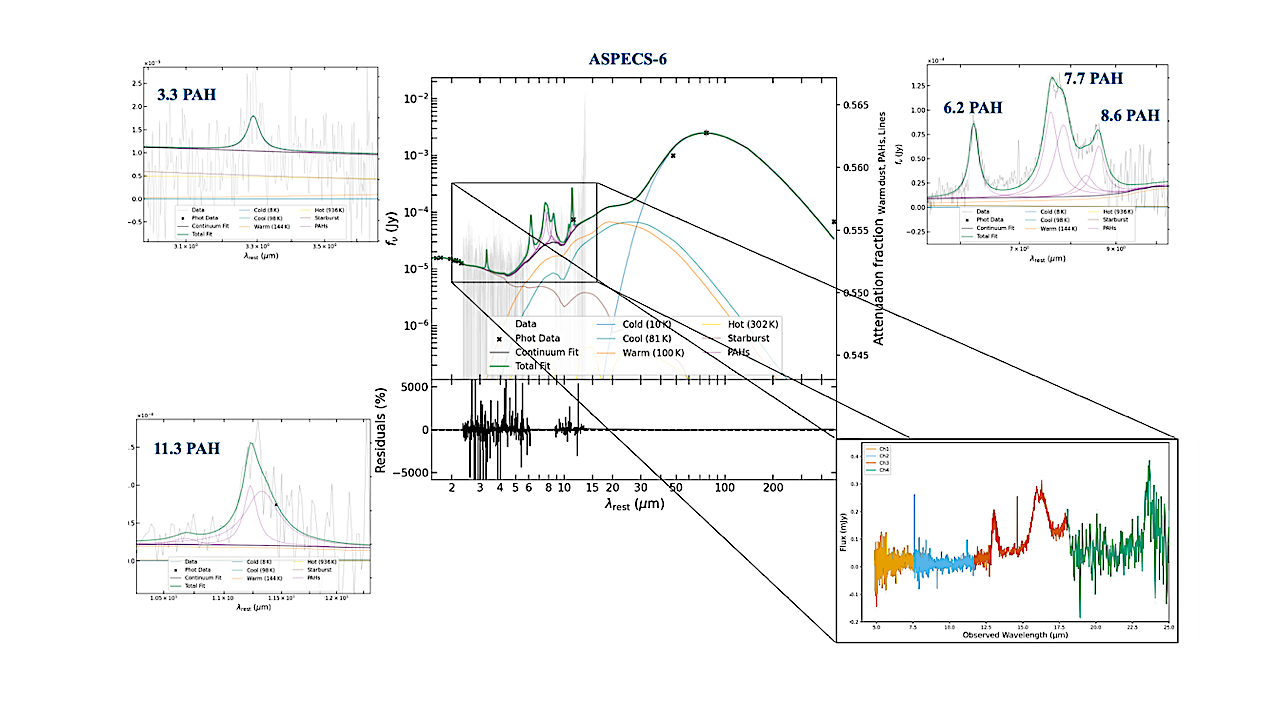
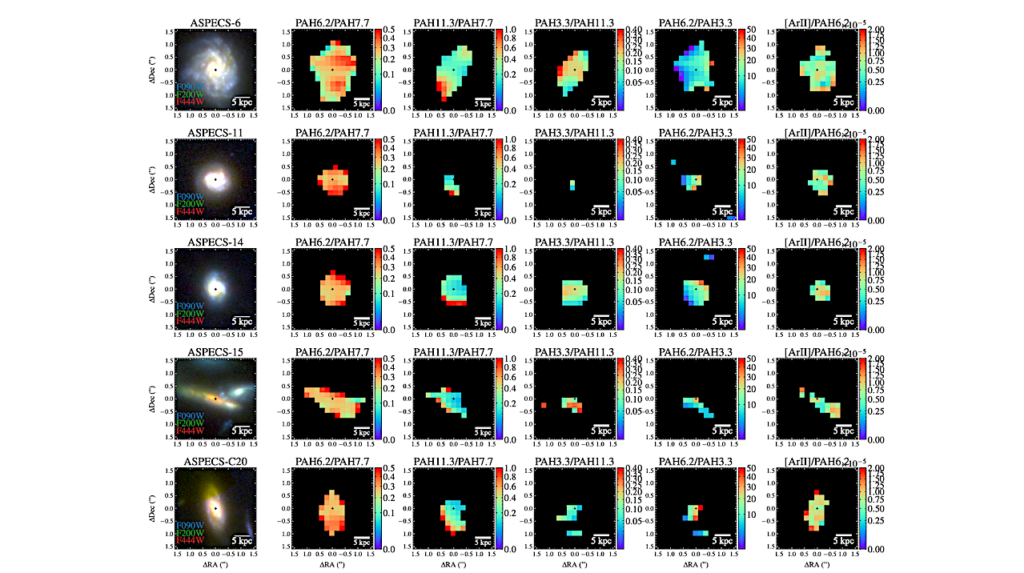
Context. Cosmic noon (z ~ 1-3) marks the peak of the cosmic star-formation rate density, when dust-obscured star formation dominated galaxy growth. Mid-infrared spectroscopy probes the interstellar medium through PAH emission, whose band ratios trace PAH charge, size, and local radiation-field conditions.
Aims. We characterize the PAH properties of five z ~ 1.1 star-forming galaxies from the PAHSPECS survey and investigate how their PAH luminosities and band ratios relate to global galaxy properties. We compare them with local luminous infrared galaxies (LIRGs) to assess whether PAH emission at cosmic noon differs from that nearby.
Methods. We analyze JWST/MIRI MRS observations of five ASPECS galaxies in the HUDF. Integrated spectra are extracted with wavelength-dependent apertures and modeled with CAFE, including ancillary photometry to constrain the dust emission. Stellar masses and SFRs are derived with Prospector.
Results. Compared to local LIRGs, most PAHSPECS sources show higher 6.2/7.7 and lower 11.3/7.7 ratios, suggesting an ionized PAH component weighted toward smaller grains. The 3.3/11.3 ratio is less constrained, since the 3.3 micron feature is detected in only two sources. Within the sample, 11.3/7.7 increases with sSFR and star-formation surface density, while 6.2/7.7 decreases with sSFR, consistent with preferential processing of small ionized PAH carriers.
ASPECS-15, the AGN-hosting source, has the lowest 6.2/7.7 ratio and highest sSFR, suggesting a reduced contribution from small PAHs, potentially due to AGN activity. The 7.7 micron luminosity follows the local L7.7-SFR relation, supporting its use as a star-formation tracer at z ~ 1. Conclusions. PAH emission at cosmic noon appears shaped by different ISM conditions than in nearby starburst galaxies, likely reflecting more intense radiation fields, while the 7.7 micron feature remains a robust SFR tracer.
Cristina Maria Lofaro, Tanio Díaz Santos, Irene Shivaei, Leindert A. Boogaard, Karin Sandstrom, Fergus R. Donnan, Manuel Aravena, Pablo G. Pérez-González, Román Fernández Aranda, Roberto Decarli, Frédéric Galliano, Hanae Inami, Göran Östlin, Gergö Popping, Paul van der Werf, Fabian Walter
Comments: Submitted to Astronomy & Astrophysics; 15 pages, 14 figures
Subjects: Astrophysics of Galaxies (astro-ph.GA)
Cite as: arXiv:2606.18230 [astro-ph.GA](or arXiv:2606.18230v1 [astro-ph.GA] for this version
https://doi.org/10.48550/arXiv.2606.18230
Focus to learn more
Submission history
From: Cristina Maria Lofaro
[v1] Tue, 16 Jun 2026 17:55:05 UTC (6,801 KB)
https://arxiv.org/abs/2606.18230
Astrobiology, Astrochemistry,