Where Not to Look: A Parametric Avoidance Model for SETI Target Selection
We present a simple, rule-based filter for SETI target selection that flags stars unlikely to host complex life and produces an audit-ready exclusion catalog.
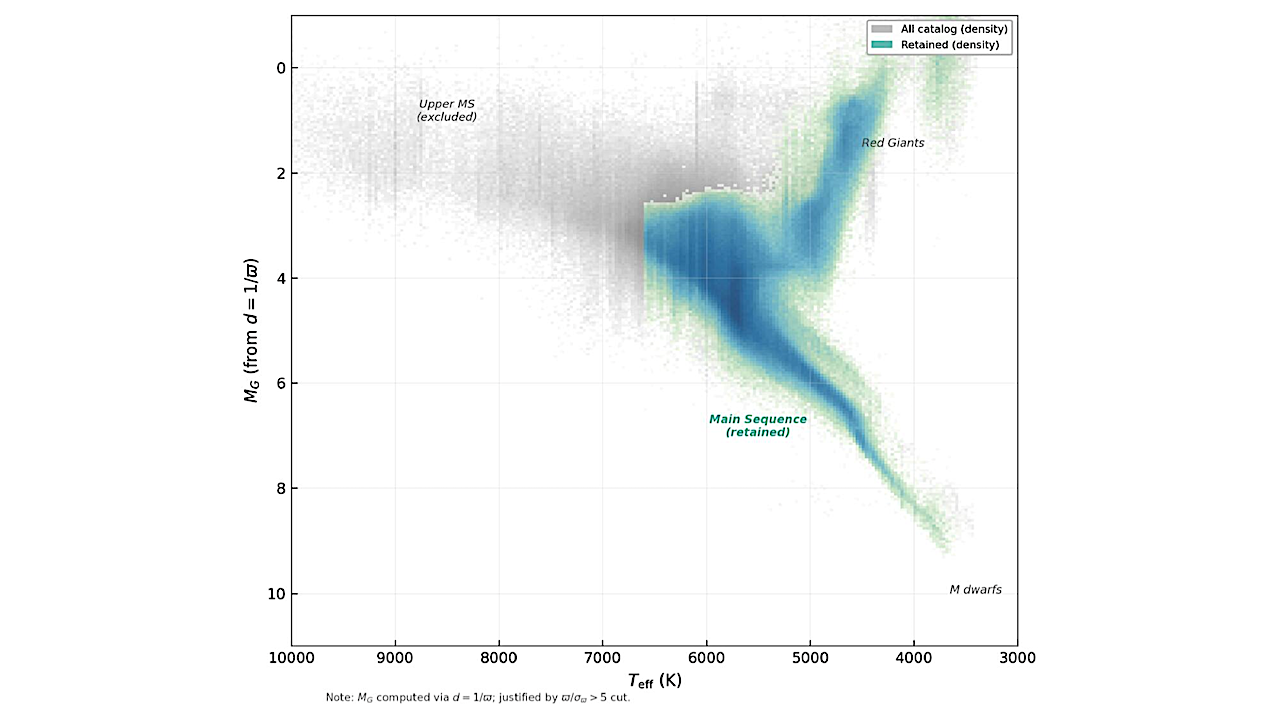
Using seven stellar parameters, including age, metallicity, and multiplicity, the model excludes roughly half of a 1.74 million-star Gaia DR3 sample, retaining 777,835 high-priority targets, mainly G and K dwarfs. Age and metallicity dominate the rejections. Importantly, using Gaia’s age upper bounds instead of point estimates saves 355,086 stars from exclusion.
A comparison of empirical and synthetic proxies shows that while the overall exclusion rate is robust, individual target assignments change significantly; for instance, the commonly used RUWE indicator flags 2.7× more binaries than Gaia’s own non-single-star flag.
Cross-matching with the Breakthrough Listen target list reveals a 56.5% exclusion rate, highlighting the complementary nature of habitability-driven and proximity-driven surveys. The catalog, pipeline, and a generalized community tool are publicly available.
Where Not to Look: A Parametric Avoidance Model for SETI Target Selection, Publications of the Astronomical Society of the Pacific
Astrobiology, SETI.