Super-Earths And Mini-Neptunes Follow Different Orbital Period-eccentricity Relations
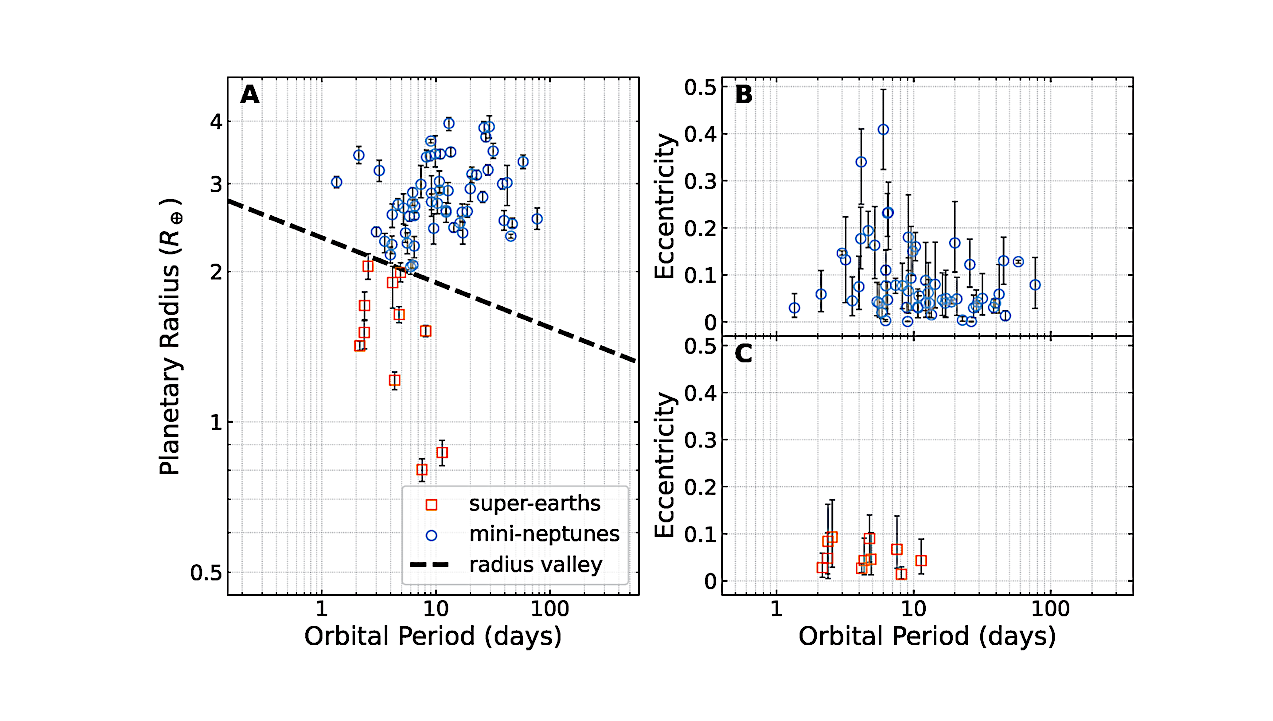
Many exoplanets have been observed with radius sizes between that of Earth and that of Neptune and are thus classified into two groups: super-earths (SEs) and mini-neptunes (MNs).
There are no SEs and MNs in the Solar System, and the mechanisms responsible for their formation and evolution are debated.
We investigate the relationships between the orbital period and eccentricity of SEs and MNs using both ensemble analyses and individual measurements.
We found that MNs follow an anti-correlation between orbital period and eccentricity, but SEs follow a different relation, possibly in the opposite direction.
These trends imply that MNs and SEs are dynamically distinct populations. We suggest that SEs have been more strongly influenced by violent processes such as gravitational scattering and giant impacts, whereas MNs predominantly experienced quiescent secular evolution.
Ke-Ting Shin, Dong-Sheng An, Ji-Wei Xie, Ji-Lin Zhou, Fei Dai
Comments: This is the author’s version of the work. It is posted here by permission of the AAAS for personal use, not for redistribution. The definitive version was published in Science on June 11th, 2026
Subjects: Earth and Planetary Astrophysics (astro-ph.EP)
Cite as: arXiv:2606.18410 [astro-ph.EP] (or arXiv:2606.18410v1 [astro-ph.EP] for this version)
https://doi.org/10.48550/arXiv.2606.18410
Focus to learn more
Journal reference: Science 392,1167-1170(2026)
Related DOI:
https://doi.org/10.1126/science.adu3916
Focus to learn more
Submission history
From: Ke-Ting Shin
[v1] Tue, 16 Jun 2026 19:04:42 UTC (11,564 KB)
https://arxiv.org/abs/2606.18410
Astrobiology,