Modeling Doppler Shifts In Radial-Velocity Data With Deep Learning Toward Earth-mass Exoplanet Detection
Detecting the tiny Doppler shifts induced by Earth-mass planets in stellar radial-velocity measurements remains extremely challenging due to stellar activity. Many deep-learning methods performing well on simulated data remain difficult to apply reliably on real stellar spectra.
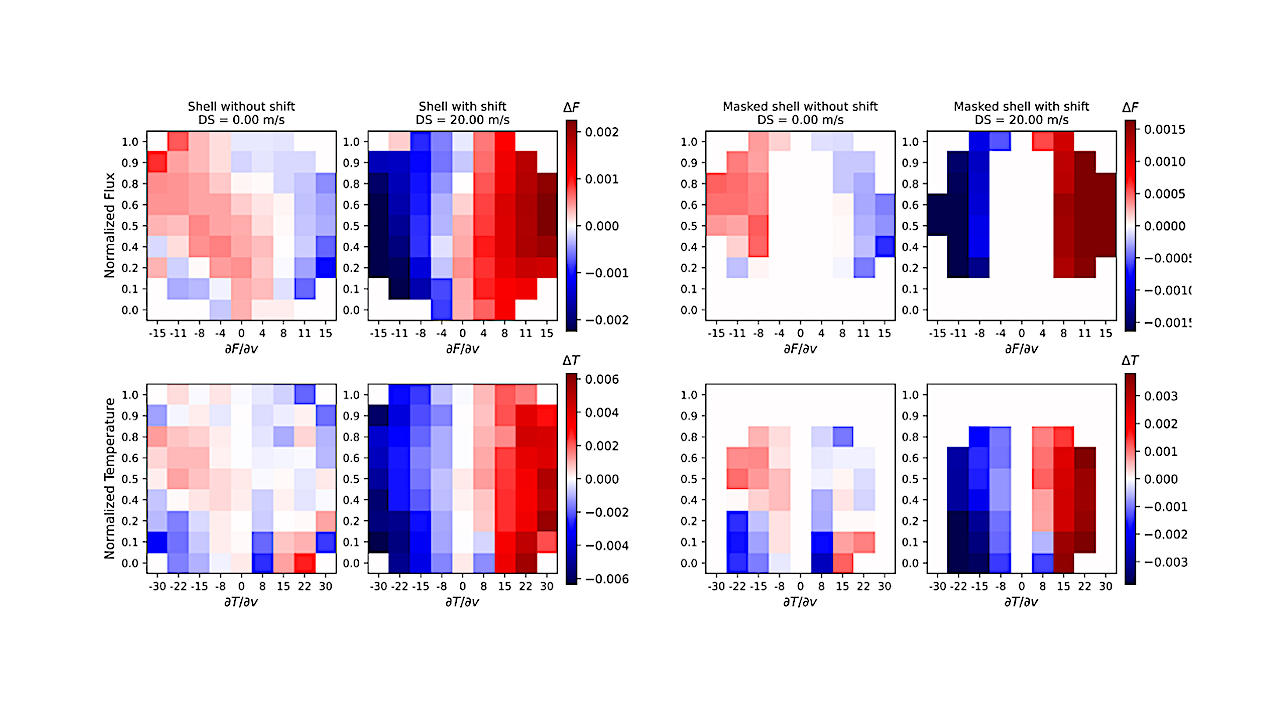
The aim of this work is to develop a deep-learning framework that generalizes to real, unseen spectra and improves the detectability of Earth-mass planets in radial-velocity data. We train artificial neural networks on HARPS-N solar spectra with injected planetary signals, using physics-motivated spectral representations based on flux and line-formation temperature, together with their velocity gradients.
Two training strategies are explored: hold-out testing and cross-validation. Model robustness is enhanced through genetic-algorithm-based hyperparameter optimization, and predictive uncertainty is quantified using Monte Carlo dropout.
Our most precise neural network model reliably retrieves, under the cross-validation strategy, the amplitudes, phases, and orbital periods of planetary signals with amplitudes greater than or equal to 25 cm/s and periods between 10 and 550 days.
In addition, in all cases tested here, the successfully recovered signals correspond to the most significant peaks in the periodograms of the Doppler-shift predictions. Temperature-based spectral-shell representations consistently outperform flux-based shells. We also release doppleriann, a Python package implementing the proposed framework.
Our results demonstrate that combining physically motivated spectral representations with deep learning provides a promising pathway toward the detection of Earth-mass planets in radial-velocity data from real observations, supported by a modeling framework that is both physically grounded and statistically rigorous, incorporating uncertainty quantification and optimized training strategies.
Isidro Gómez-Vargas, Xavier Dumusque, Yinan Zhao, Khaled Al Moulla, Michael Cretignier
Comments: 20 pages, 14 figures. Accepted for publication in Astronomy & Astrophysics
Subjects: Instrumentation and Methods for Astrophysics (astro-ph.IM); Earth and Planetary Astrophysics (astro-ph.EP); Machine Learning (cs.LG)
Cite as: arXiv:2606.18464 [astro-ph.IM] (or arXiv:2606.18464v1 [astro-ph.IM] for this version)
https://doi.org/10.48550/arXiv.2606.18464
Focus to learn more
Submission history
From: Isidro Gómez-Vargas
[v1] Tue, 16 Jun 2026 20:16:16 UTC (5,164 KB)
https://arxiv.org/abs/2606.18464
Astrobiology,