Ultraviolet Radiation Effects on the Optical Properties of Water-Dominated Exoplanet Hazes
Temperate sub-Neptune and terrestrial exoplanets could contain large inventories of water in various phases, such as water-dominated atmospheres or even oceans. Observations have shown that many exoplanets, including water worlds, likely contain photochemically-generated hazes.
Haze particles are a key source of organic matter and may impact the evolution or origin of life; their optical properties are imperative for interpreting observations through theoretical atmospheric modeling.
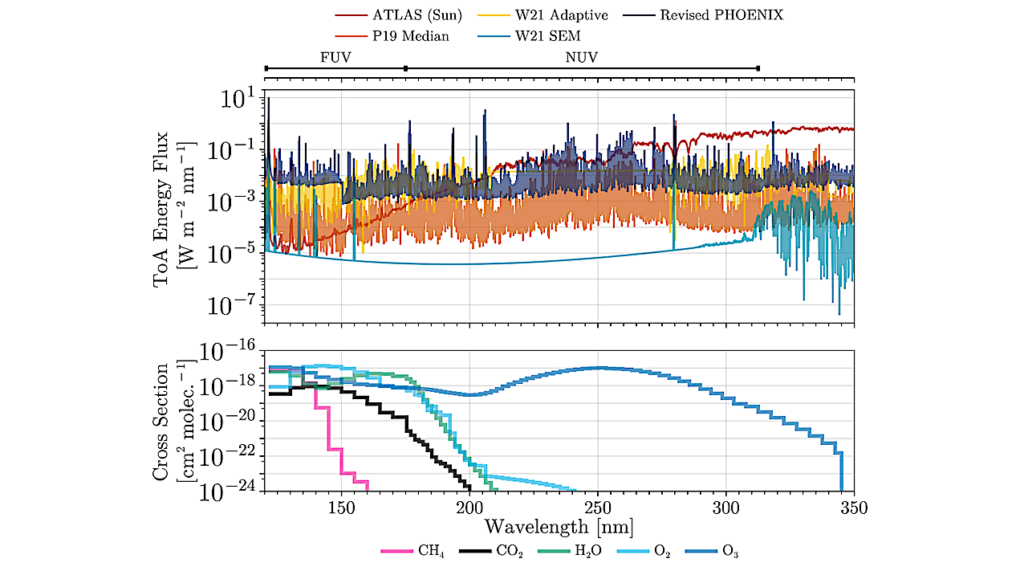
Modelers have thus far assumed haze optical properties that may not represent hazes under sub-Neptune and terrestrial atmospheric conditions. Often orbiting close to M-dwarf stars, these planets receive large amounts of radiation, especially during flaring events, which may accelerate atmospheric escape and affect atmospheric compositions.
Here, we present optical constants of experimentally-generated sub-Neptune haze analogs before and after UV irradiation across a broad wavelength range (0.5 to 8 mum). We find that UV-irradiation alters haze optical constants which become generally more absorbing in this wavelength range, which we hypothesize is due to our sample containing more oxygen-rich absorbing bands post irradiation.
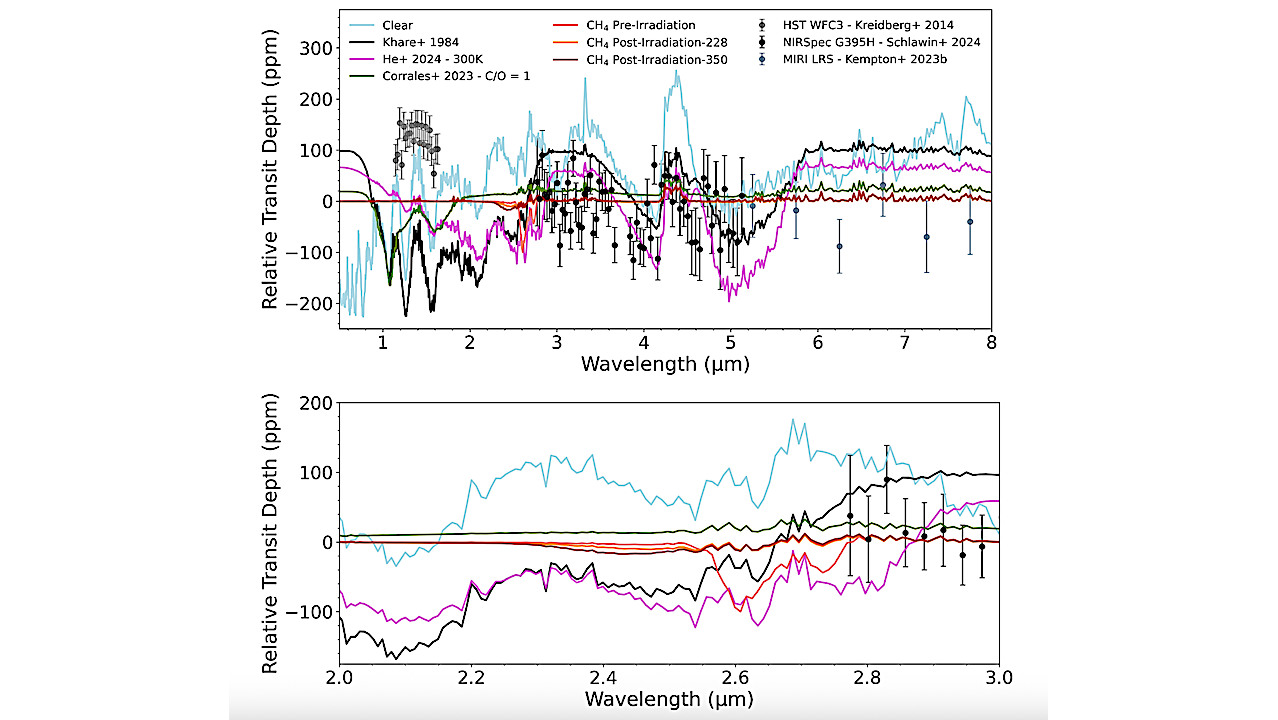
We use Virga and PICASO to simulate transmission spectra of potentially hazy water-dominated planets GJ 1214b and LHS 1140b, accounting for irradiated haze layers in their atmospheres. For our GJ 1214b CH4-rich haze modeled case, we see a difference in the N-H feature at 2.6 mum in the resulting transmission spectrum between irradiated and unaltered haze that should be observable within current JWST capabilities. Broadly, we demonstrate the importance of using more representative optical constants, as they have an impact on current and future atmospheric composition interpretations.
Lori Huseby, Sarah E. Moran, Tiffany Kataria, Mark S. Marley, Chao He, Cara Pesciotta, Sarah M. Hörst, Neil Pearson, Vishnu Reddy, Nikole K. Lewis, Véronique Vuitton
Comments: 16 pages, 9 figures, Accepted for publication in ApJ
Subjects: Earth and Planetary Astrophysics (astro-ph.EP)
Cite as: arXiv:2606.06691 [astro-ph.EP](or arXiv:2606.06691v1 [astro-ph.EP] for this version)
https://doi.org/10.48550/arXiv.2606.06691
Focus to learn more
Related DOI:
https://doi.org/10.3847/1538-4357/ae6cdb
Focus to learn more
Submission history
From: Lori Huseby
[v1] Thu, 4 Jun 2026 20:13:33 UTC (6,546 KB)
https://arxiv.org/abs/2606.06691
Astrobiology, Astrochemistry, Exoplanet,