Ultraviolet-Driven Atmospheric Degeneracies Challenge Conventional Biosignature Frameworks for Terrestrial Planets with Ultracool M Dwarf Hosts: An Archean-Analog TRAPPIST-1 e Case Study
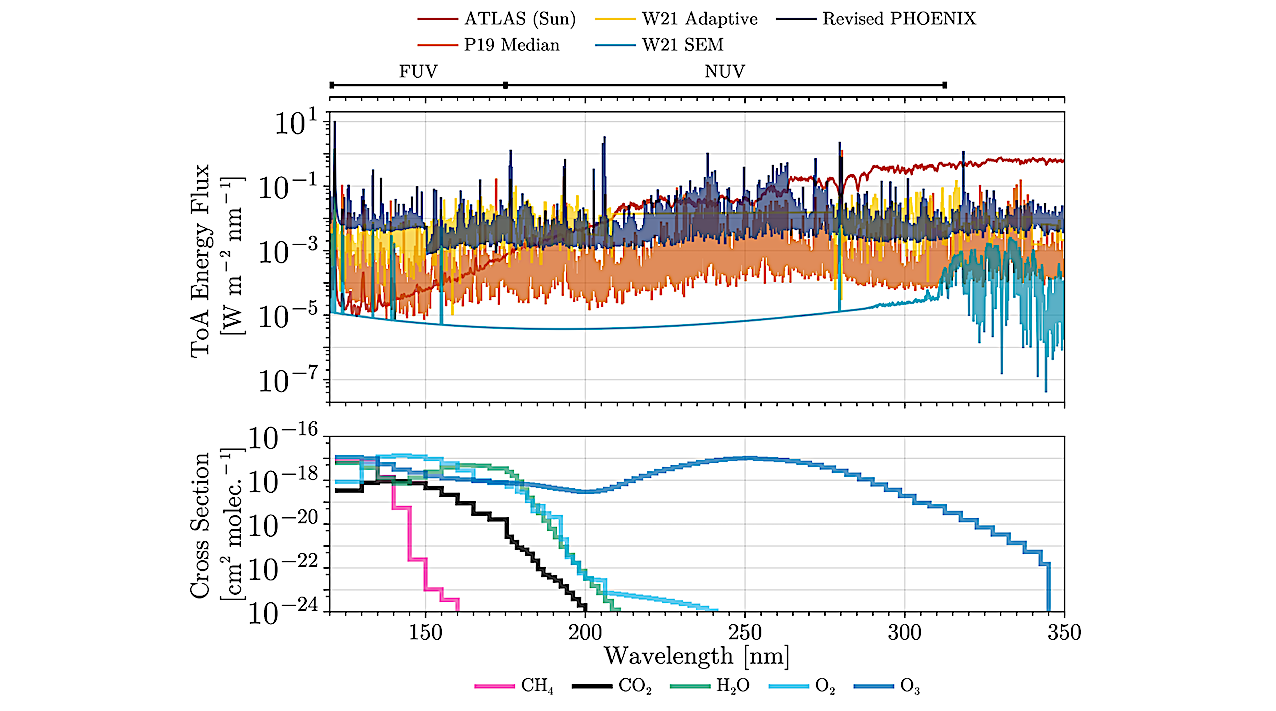
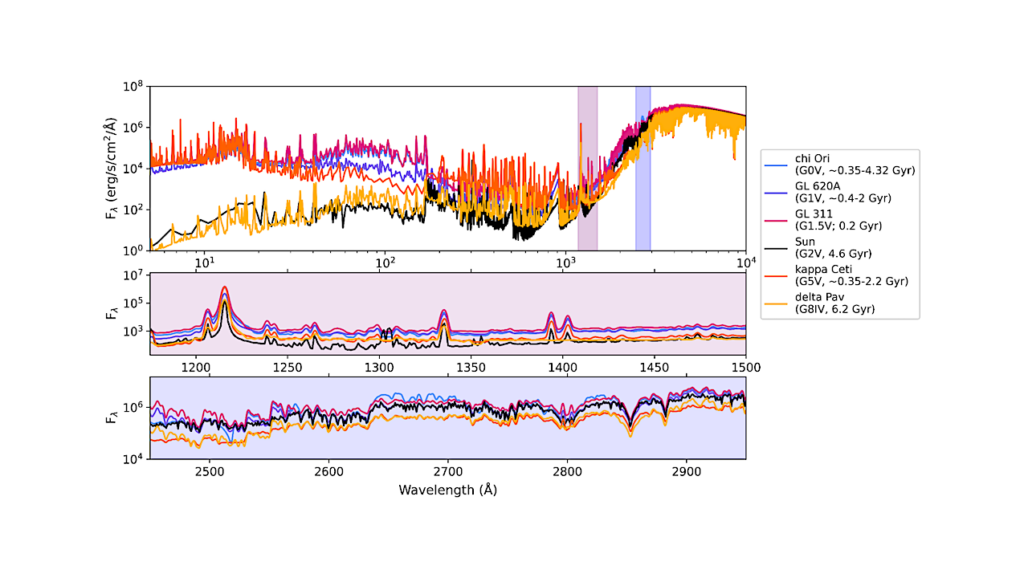
The ultraviolet (UV) spectrum of a host star strongly shapes the atmospheric composition and potential biosignatures of its planets. This relationship may be especially important for the planets orbiting TRAPPIST-1, an M8V star with substantially different published UV spectral energy distributions (SEDs).
Using a one-dimensional photochemical model, we quantify how these SED uncertainties affect Archean Earth-like atmospheric analogs on TRAPPIST-1 e with and without biospheres. We emphasize Earth’s Archean epoch because it represents a planet in transition from primarily abiotic to biotic controls on atmospheric composition.
Different stellar spectra produce order-of-magnitude variations in the predicted abundances of CH4, CO, O2, and O3, thereby generating photochemical degeneracies that complicate the interpretation of potential biosignatures.
For one TRAPPIST-1 UV reconstruction, a modeled atmosphere with abiotic deposition velocities and volcanic CH4 input can sustain simultaneous spectrally discernible CH4 and O3, yielding a potential false-positive disequilibrium biosignature.
For all SEDs tested, surface deposition consistent with microbially-mediated CO consumption allows substantial O2 and O3 accumulation even without oxygenic photosynthesis, implying that oxygen-rich atmospheres around ultracool M dwarfs may not uniquely trace oxygenic ecosystems. Across our models, CO remains a powerful discriminator between abiotic and biotic surface boundary assumptions.
Overall, we show that the abundances of co-occurring CH4, CO, and O3 can vary by orders of magnitude, depending on the assumed UV SED, creating ambiguities in interpreting atmospheric biosignatures, though observability may be challenging with current capabilities. Reducing UV spectral uncertainties is therefore essential for assessing surface-to-atmosphere interactions of temperate exoplanets around ultracool M dwarfs.
Evan L. Sneed, Edward W. Schwieterman, Sarah R. Peacock, Nicholas F. Wogan, Timothy W. Lyons
Comments: 23 pages, 7 figures, 1 table. Submitted to AAS Journals. Comments welcome
Subjects: Earth and Planetary Astrophysics (astro-ph.EP); Solar and Stellar Astrophysics (astro-ph.SR)
Cite as: arXiv:2606.05451 [astro-ph.EP] (or arXiv:2606.05451v1 [astro-ph.EP] for this version)
https://doi.org/10.48550/arXiv.2606.05451
Focus to learn more
Submission history
From: Evan Sneed
[v1] Wed, 3 Jun 2026 21:15:43 UTC (697 KB)
https://arxiv.org/abs/2606.05451
Astrobiology, Astrogeology,