An 800-Million-Year-Old Impact Shower on the Terrestrial Planets from the Breakup of the Eulalia Parent Body
Multiple studies have proposed a substantial surge in large lunar impacts approximately 800 million years ago (Ma).
Some are based on analyses of the ages of large lunar craters, such as the 93 km Copernicus crater. Others focus on the age distributions of impact glasses returned by lunar missions. A key challenge has been identifying and testing a plausible source for this putative impact spike.
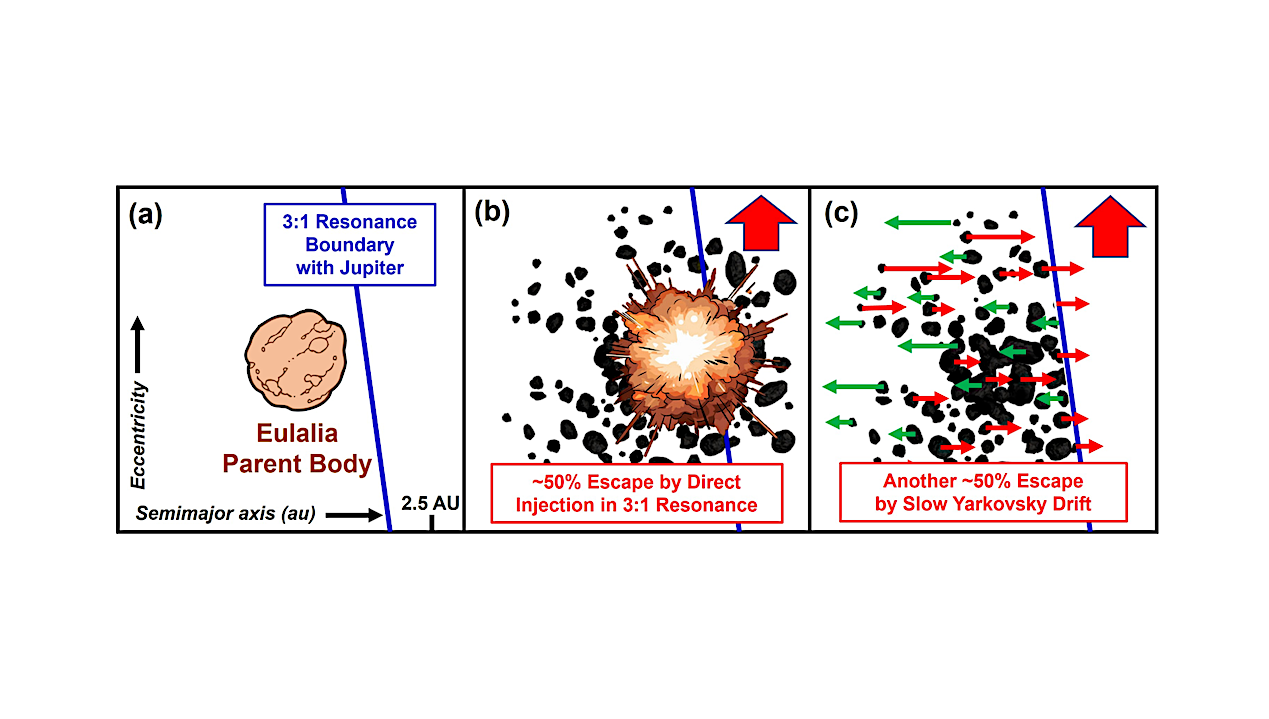
Here we use collisional and dynamical models to link this event to the formation of the Eulalia asteroid family, whose primitive carbonaceous chondrite-like parent body disrupted ∼800 Ma near the 3:1 mean motion resonance with Jupiter (J3:1). Our simulations indicate that approximately three-quarters of the family’s fragments eventually entered the J3:1 over a ∼150-million year interval.
While some fragments were injected into the resonance immediately after the disruption, others migrated more gradually via non-gravitational (Yarkovsky) thermal forces. Once in the J3:1, the fragments were dynamically transported into the planet-crossing region, leading to an elevated rate of bombardment on the Moon and terrestrial planets. Our results demonstrate that the Eulalia breakup can plausibly account for the observed lunar craters formed near 800 Ma.
Intriguingly, this event may also have had widespread repercussions across the inner Solar System. On Earth, its timing coincides with significant shifts in the biosphere, possibly linked to large impacts. On Mars, these impacts might have triggered a pulse of volcanic activity. Together, they showcase how certain catastrophic collisions in the main belt can have far-reaching consequences for the history of the terrestrial planets.
William F. Bottke, David Vokrouhlický, Melissa Dykhuis, Nicolle Zellner
Comments: 42 pages, 15 figures, 1 table accepted for publication in The Planetary Science Journal
Subjects: Earth and Planetary Astrophysics (astro-ph.EP)
Cite as: arXiv:2606.05036 [astro-ph.EP](or arXiv:2606.05036v1 [astro-ph.EP] for this version)
https://doi.org/10.48550/arXiv.2606.05036
Focus to learn more
Submission history
From: David Vokrouhlicky
[v1] Wed, 3 Jun 2026 16:00:20 UTC (4,094 KB)
https://arxiv.org/abs/2606.05036
Astrobiology, Astrogeology,