Biocidal Conditions in Low-Mars-Orbit Can Inactivate Bioburden on External Mars Spacecraft Surfaces and Dust Particles Within a Few Sols
Mars Sample Return Program planning includes a series of spacecraft staged both on the Martian surface and in low-Mars-orbit (LMO).
During the transfer of samples into orbit, external spacecraft surfaces might be exposed to Mars dust carried on the sample container exterior and possibly extant microbiota (if present).
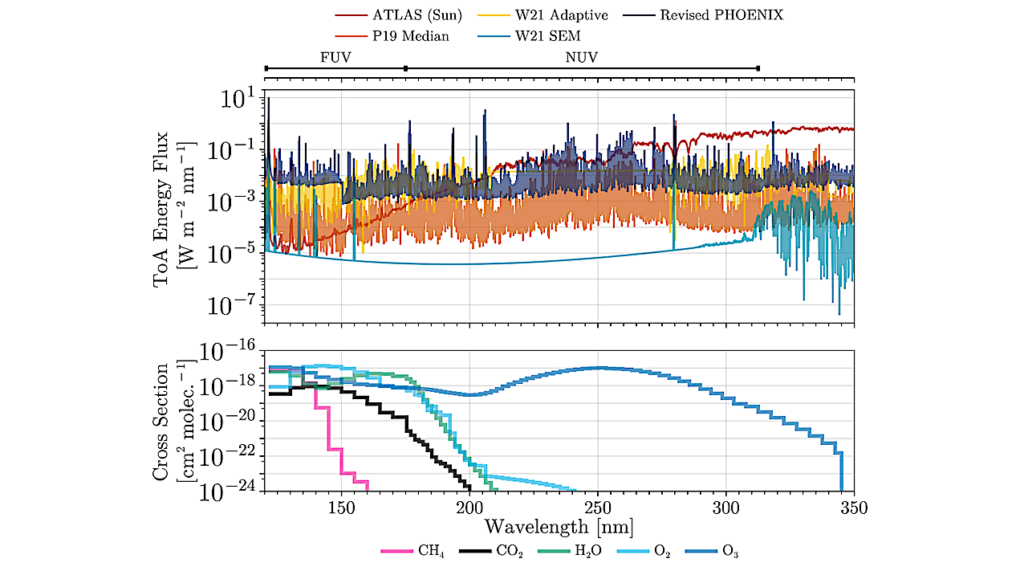
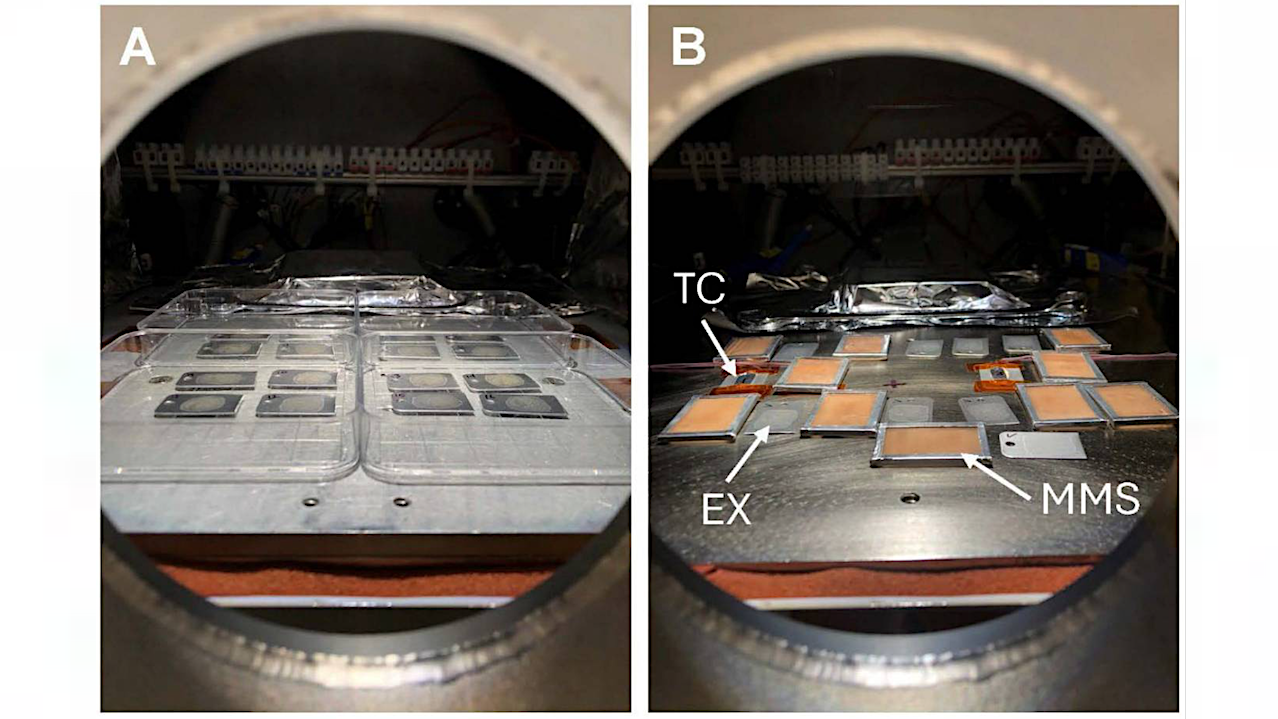
This study was designed to characterize the synergistic effects of LMO ultraviolet irradiation, vacuum, and solar heating on the survival of two UV-resistant and heat-tolerant bacteria, one yeast, and one fungus.
The species tested were Bacillus pumilus SAFR-032 spores, Geobacillus stearothermophilus ATCC 12980 spores, Naganishia onofrii DBVPG 5303 cells, and Aspergillus fumigatus ISSFT-021-30 spores, respectively. Spores of A. fumigatus ISSFT-021-30 and B. pumilus were also exposed to LMO conditions with and without a Mojave Mars Simulant (MMS) dust layer.
Based on the data, the time required to reach the desired Sterility Assurance Level (SAL; dose-defined to yield a -12 log reduction) was 2.0 h for A. fumigatus ISSFT-021-30 and 76.6 min for B. pumilus SAFR-032 if exposed directly to the solar UV beam under LMO conditions. With the MMS present, predicted times to reach one SAL were extended to 22 h and 1.72 h, respectively. Analysis of UV transmittance through cell stacks of up to 12 µm thick was performed for A. fumigatus ISSFT-021-30. Results indicated that ~4-5% of UVC photons can penetrate through 12 µm stacked aggregates of spores.
These findings indicate that (1) the LMO environment can be used to attain the mandated levels of spacecraft surface bioburden reductions and (2) dust shielding and microbial aggregation attenuate UV irradiation, leading to extended orbital residence times to achieve mandated bioburden reductions.
- Biocidal Conditions in Low-Mars-Orbit Can Inactivate Bioburden on External Mars Spacecraft Surfaces and Dust Particles Within a Few Sols, Microorganisms via PubMed (open access)
- Biocidal Conditions in Low-Mars-Orbit Can Inactivate Bioburden on External Mars Spacecraft Surfaces and Dust Particles Within a Few Sols, Microorganisms (open access) Schuerger AC, Schwendner P, Guan L, Mennella J, Heinz N, Mikellides I, Clement BG. Microorganisms. 2026 May 20;14(5):1158. doi: 10.3390/microorganisms14051158. PMID: 42197543
Astrobiology,