Simple Cyanides and Formylium Ions Isotopologues in Early Star-forming Molecular Cores
Understanding the chemistry related to the early stages of star formation is of great importance, as it is linked to the beginnings of the most complex chemistry in the interstellar medium.
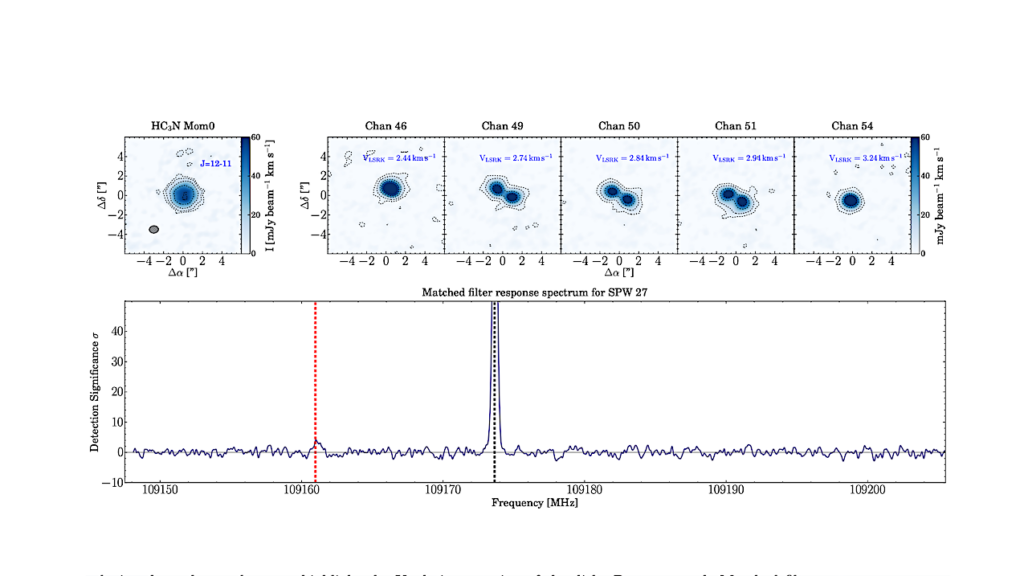
In this context, we investigate the chemical behaviour of simple cyano-bearing molecules and formylium ions isotopologues in a sample of massive infrared-quiet molecular cores. Using archive ALMA Band 7 data of 37 early molecular cores embedded in ATLASGAL clumps, we obtain abundances of HC3N, H13CN, HN13C, H13CO+, and HC17O+.
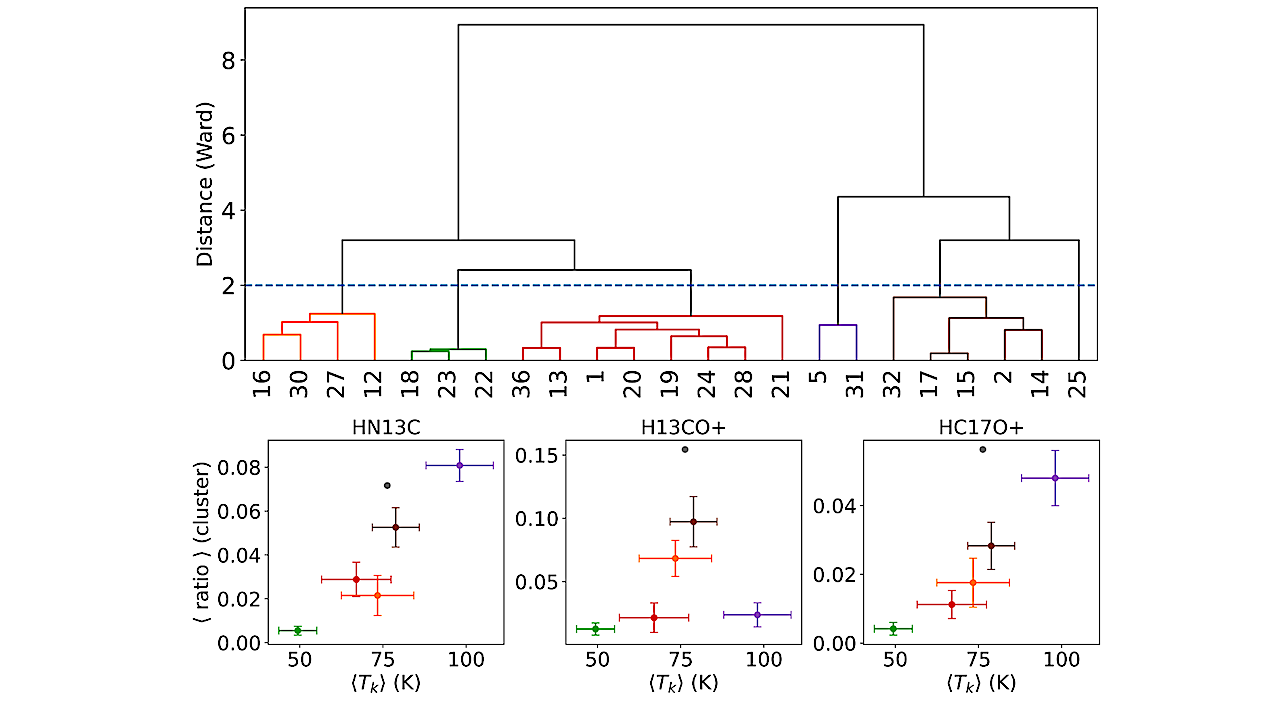
We used various statistical methods, including hierarchical clustering, to analyse the correlations between molecular abundances, ratios and temperature. We find that HN13C, H13CO+, and HC17O+ abundances correlate positively with kinetic temperature, suggesting temperature-driven chemical regulation in young massive cores.
A similar trend is observed for H13CN, although the limited number of detections prevents a definitive conclusion. HC3N abundances show no dependence on temperature within the 40-100 K range, suggesting a chemical steady state between gas-phase production and grain-surface depletion.
Similarly, the H13CN/HN13C ratio, measured in only six regions, suggests no correlation with temperature, differing from findings at lower temperatures. Using a hierarchical clustering method based on abundance ratios, novel in astrochemistry, we identified chemically distinct core groups that align with thermal conditions.
Additionally, we provide HC17O+ detections for 28 cores-a significant expansion of existing literature-and find evidence that H13CO+ transitions may have higher optical depths than commonly assumed. These results are important because characterizing the chemical state of early star-forming stages is essential for understanding the onset of the most complex chemistry.
R. D. Taboada, S. Paron, N. C. Martinez, M. E. Ortega
Comments: accepted in A&A (june 4, 2026)
Subjects: Astrophysics of Galaxies (astro-ph.GA)
Cite as: arXiv:2606.07343 [astro-ph.GA] (or arXiv:2606.07343v1 [astro-ph.GA] for this version)
https://doi.org/10.48550/arXiv.2606.07343
Focus to learn more
Submission history
From: Sergio Paron
[v1] Fri, 5 Jun 2026 14:54:13 UTC (285 KB)
https://arxiv.org/abs/2606.07343
Astrobiology, Astrochemistry,