Upper Limits On Exosatellites Around β Pictoris b
β Pictoris b is one of the closest known directly-imaged gas giant exoplanets with an orbit that is almost edge-on to our line of sight, making it an ideal target for radial velocity monitoring to search for massive exomoons.
We measure the radial velocity of β Pictoris b over several epochs between October 2024 and March 2025 by using the cross-correlation of a template spectrum with absorption lines in the planet’s atmosphere, giving a mean precision of 160 m s−1.
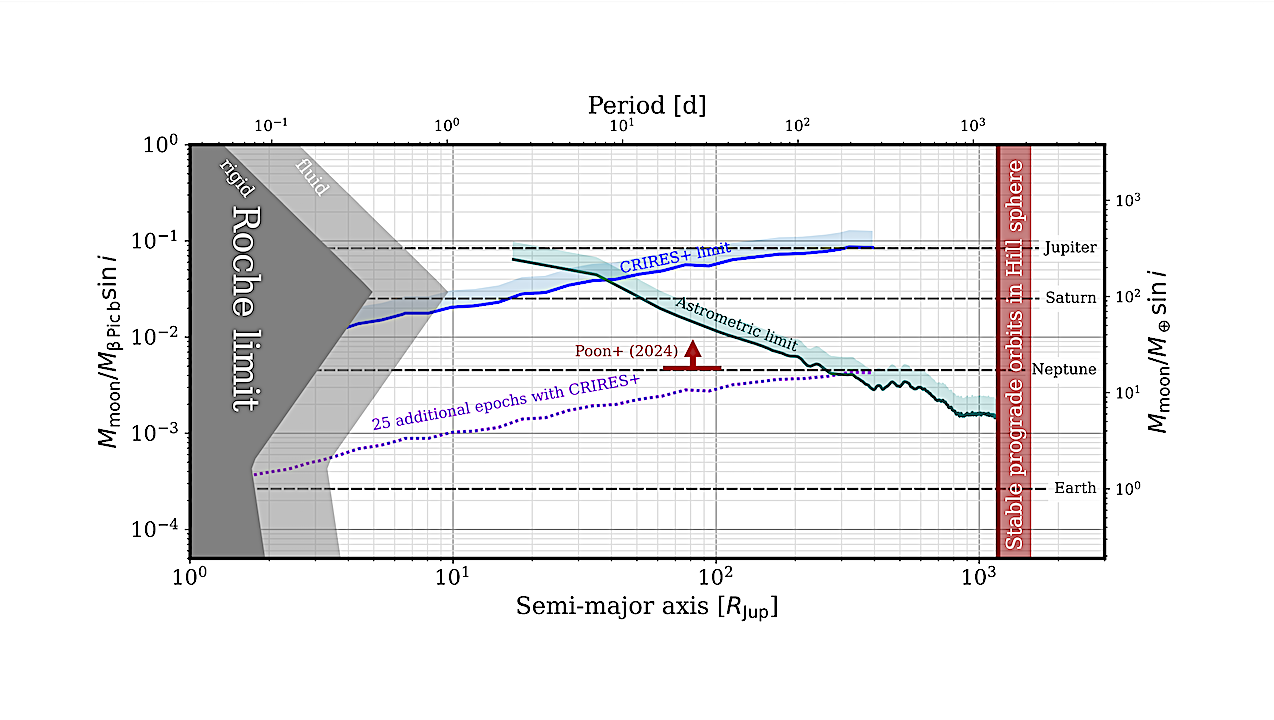
The resultant set of radial velocities is analysed with a periodogram to search for candidate RV signals indicating a massive exomoon. Although we do not detect an exomoon signal in our data, our detection limits for a single moon are 80 Earth masses at P=1 day and 1 Jupiter at P=200 days, comparable to RV exomoon searches around other substellar companions.
The RV limit is comparable with the astrometric exomoon limit at a period of 7 days and a mass of 150 Earth masses, where for longer periods the astrometric searches have lower mass limits. With an additional observing season, CRIRES+ can detect a planet/moon mass ratio of 10−3 (4 Earth masses) with a period of up to one day, and can detect a Neptune-mass moon at hundreds of Jupiter radii.
M.A. Kenworthy, R. Landman, A. Vanderburg, J.E. Rodriguez, J.L. Birkby, I. Macias, D. González Picos, S.A. Jenkins, E. Kleisioti, T. Stolker, I. Koutalios
Comments: 6 pages, 7 figures, 1 table, accepted for publication in MNRAS. This paper is in a reproducible workflow repository at this https URL
Subjects: Earth and Planetary Astrophysics (astro-ph.EP); Solar and Stellar Astrophysics (astro-ph.SR)
Cite as: arXiv:2606.04685 [astro-ph.EP](or arXiv:2606.04685v1 [astro-ph.EP] for this version)
https://doi.org/10.48550/arXiv.2606.04685
Focus to learn more
Submission history
From: Matthew A. Kenworthy
[v1] Wed, 3 Jun 2026 10:05:29 UTC (1,715 KB)
https://arxiv.org/abs/2606.04685
Astrobiology,