GJ 3929 b as the First Complete Rocky Worlds DDT Data Set
Despite their large abundance, it is still unknown whether and under what conditions rocky planets around M dwarf stars can host atmospheres.
This open question motivated the on-going Rocky Worlds DDT survey focused on searching for atmospheres on relatively low-temperature rocky exoplanets by systematically probing for the presence of day-night heat redistribution and CO2 absorption through JWST/MIRI 15 μm eclipse observations.
Here we present the analysis of the first full data set from this survey, consisting of four observations of the warm Earth-size exoplanet GJ 3929 b, with a planetary mass of 1.75+0.44-0.45 M⊕ and instellation flux of 17.3+/-0.7 S⊕.
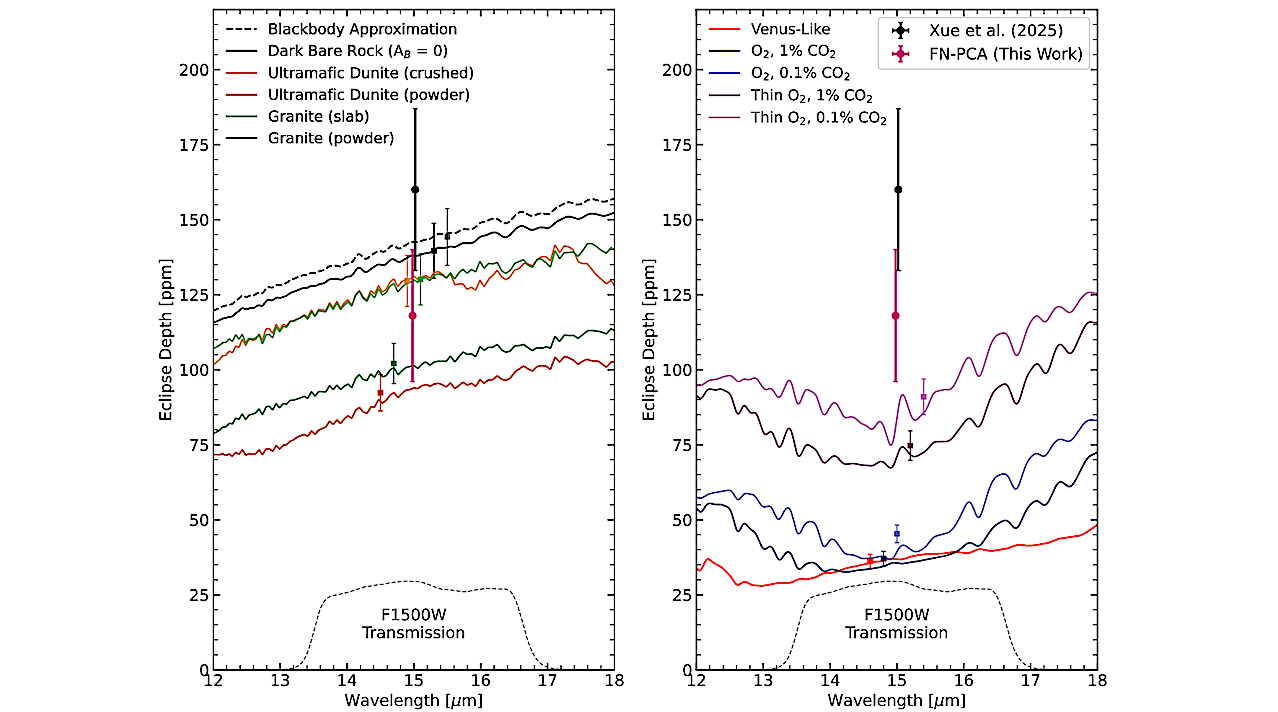
In our analysis, we include two previously unpublished eclipse observations and find an overall eclipse depth of 118+/-22 ppm and a dayside surface brightness temperature of 641+59-64 K. This is marginally lower than the eclipse depth of 160+26-27 ppm previously reported based on only the first two observations. While the full data set remains consistent with bare rock scenarios, it also leaves more room for thin atmosphere scenarios.
Only thick CO2 atmospheres without thermal inversion remain ruled out at greater than 3σ. We also continue with lessons-learned in robustly analyzing these kind of high-precision JWST/MIRI 15 μm eclipse observations. Notably, we find that the Frame Normalized Principal Component Analysis (FN-PCA) method appears more robust against the choice of extraction aperture size, which otherwise can have a significant impact on the inferred eclipse depth and scientific conclusions when using a standard polynomial baseline detrending method.
Nicholas J. Connors, Christopher Monaghan, Bjorn Benneke, Lisa Dang, Pierre-Alexis Roy
Comments: 20 pages, 9 figures + 5 in Appendix, submitted to The Astrophysical Journal Letters. This version addresses all comments from the first review by the referee
Subjects: Earth and Planetary Astrophysics (astro-ph.EP)
Cite as: arXiv:2606.07511 [astro-ph.EP] (or arXiv:2606.07511v1 [astro-ph.EP] for this version)
https://doi.org/10.48550/arXiv.2606.07511
Focus to learn more
Submission history
From: Nicholas Connors
[v1] Fri, 5 Jun 2026 17:59:10 UTC (4,530 KB)
https://arxiv.org/abs/2606.07511
Astrobiology,