Modelling The Long-term Impacts Of Artificial Warming On The Martian Water Cycle And Surface Ice Distribution
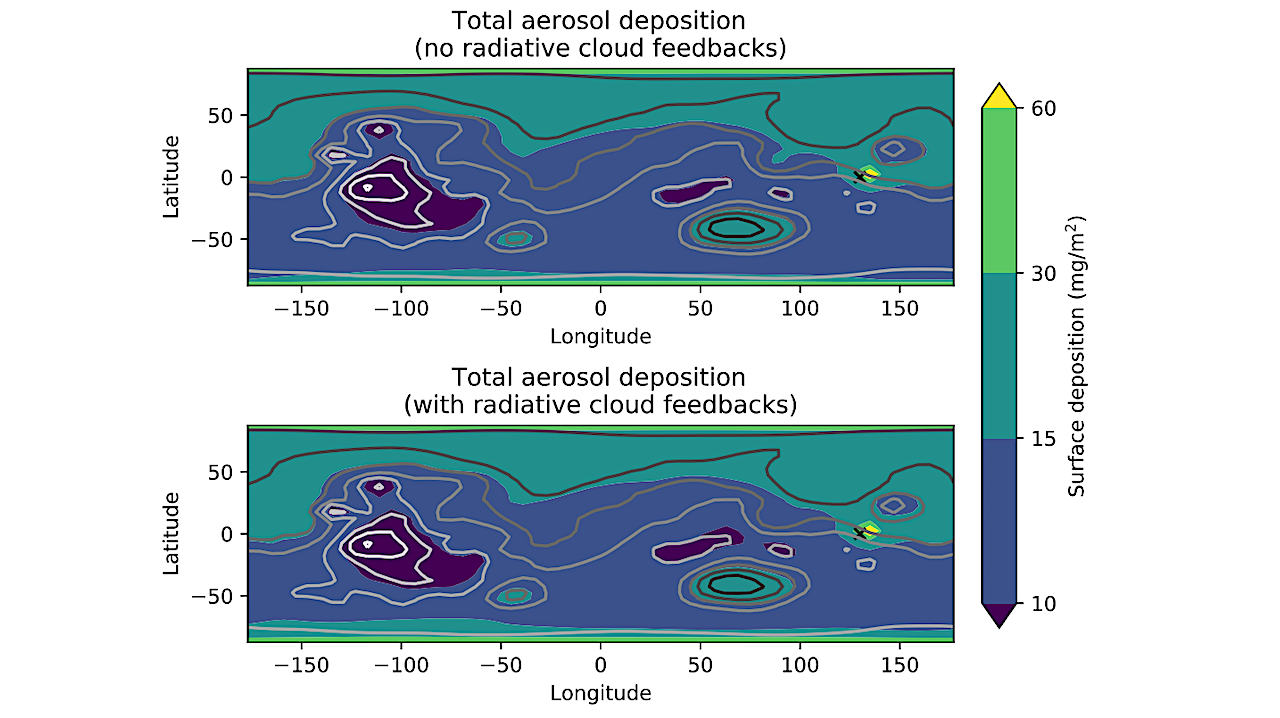
Recent papers by Ansari et al. (2024, Science Advances 10, eadn4650) and Richardson et al. (2025, arXiv eprint 2504.01455) have suggested that global warming of the Martian surface (‘terraforming’) by 35 K to sustain local habitats above the melting point of water could be achieved through the injection of engineered aerosols into the Martian atmosphere.
Using the MarsWRF 3D Global Climate Model, we investigate how artificial warming of Mars through engineered aerosol release would affect the planetary water cycle and the distribution of the major surface ice reservoirs. Within our model framework, every 20 K of global warming induces a tenfold increase in atmospheric water vapour content due to sublimation of H2O ice from the North Polar Cap.
This increases the potency of cloud radiative feedbacks which induces nighttime warming (~5-10 K) at low latitudes, but daytime cooling (up to 40 K) in the winter midlatitudes. Water is transferred from the edge of the North Polar Cap to the South Polar Cap and there is minor destabilisation of shallow northern midlatitude subsurface ice. As a result, seasonal sublimation of H2O ice from the South Pole has an increased impact on the global water cycle.
These changes persist on Mars at least decades after loading of the atmosphere with engineered aerosols ceases. Our model is limited by the gaps in our knowledge of present-day Martian weather and climate, and of the microphysics and radiative properties of candidate warming agents. Much more data is therefore needed before warming Mars could become feasible.
Ashwin S. Braude, Edwin S. Kite, Mark I. Richardson, Alexandre Kling, Michael A. Mischna
Subjects: Earth and Planetary Astrophysics (astro-ph.EP); Atmospheric and Oceanic Physics (physics.ao-ph); Geophysics (physics.geo-ph)
Cite as: arXiv:2603.01539 [astro-ph.EP] (or arXiv:2603.01539v1 [astro-ph.EP] for this version)
https://doi.org/10.48550/arXiv.2603.01539
Focus to learn more
Submission history
From: Ashwin Braude
[v1] Mon, 2 Mar 2026 07:12:12 UTC (6,948 KB)
https://arxiv.org/abs/2603.01539
Astrobiology,