Posted inAnalog Studies, Atmospheres, Climate, Weather, Biochemistry & Organic Chemistry, Biogeochemical Cycles & Geobiology, Biophysics, Biosignatures & Paleobiology, Cryobiology, Extremeophiles and Extreme Environments, Genomics, Proteomics, Bioinformatics, Habitable Zones, Icy Worlds, Microbiology & Virology, Microgravity, Missions & Hardware, Panspermia, Planetary Protection & Biosafety, Space Stations, Status Report, Tricorders & Sensors

ISS Astrobiology Research: Photochemical Evolution of Alanine in Association with the Martian Soil Analog Montmorillonite

The Photochemistry on the Space Station (PSS) experiment was part of the European Space Agency’s EXPOSE-R2 mission and was conducted on the International Space Station from 2014 to 2016. The […]

Posted inBiochemistry & Organic Chemistry, Biogeochemical Cycles & Geobiology, Biosignatures & Paleobiology, Fossils & Paleontology, Origin & Evolution of Life, Status Report

The Nature Of LUCA – The Last Universal Common Ancestor – and its Impact on the Early Earth System

The nature of the last universal common ancestor (LUCA), its age and its impact on the Earth system have been the subject of vigorous debate across diverse disciplines, often based […]

Posted inAI - Data - Apps - Cybernetics, Astrochemistry, Astronomy & Telescopes, Atmospheres, Climate, Weather, Exoplanets, -moons, -comets, Status Report

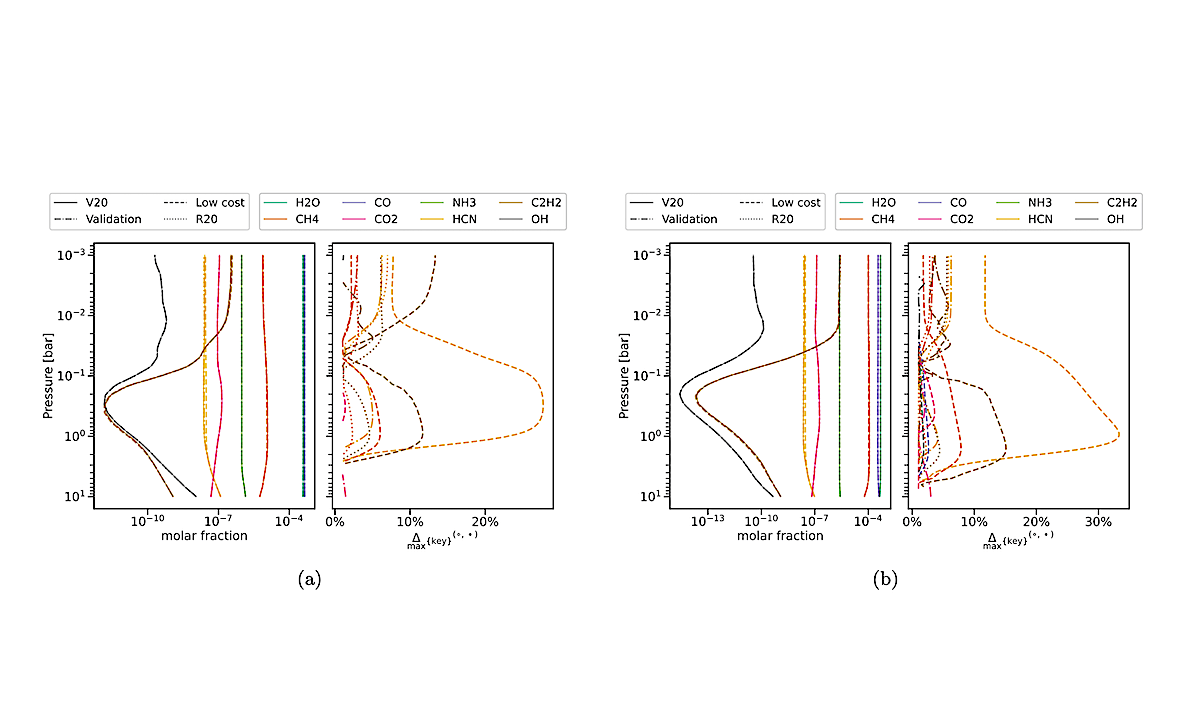
DARWEN: Data-driven Algorithm for Reduction of Wide Exoplanetary Networks

Exoplanet atmospheric modeling is advancing from chemically diverse one-dimensional (1D) models to three-dimensional (3D) global circulation models (GCMs), which are crucial for interpreting observations from facilities like the James Webb […]

Posted inAstronomy & Telescopes, Atmospheres, Climate, Weather, Exoplanets, -moons, -comets, Habitable Zones, Imaging & Spectroscopy, Missions & Hardware, Radiation, Space Weather & Heliophysics, Status Report, Stellar Cartography

Preparing For The Early eVolution Explorer

Ultraviolet flare emission can drive photochemistry in exoplanet atmospheres and even serve as the primary source of uncertainty in atmospheric retrievals. Additionally, flare energy budgets are not well-understood due to […]

Posted inAstrogeology, Biogeochemical Cycles & Geobiology, Biosignatures & Paleobiology, Gaia - Planetary Perspectives, Habitable Zones, Origin & Evolution of Life, Status Report

Building and Maintaining a Habitable World and the Early Conditions that Could Favor Life’s Beginnings on Earth and Beyond

The Hadean, once thought to be uninhabitable and tumultuous, has more recently been recontextualized as a clement time in which oceans, land, and life likely appeared on Earth. This non-exhaustive […]

Posted inAstrochemistry, Astronomy & Telescopes, Atmospheres, Climate, Weather, Biosignatures & Paleobiology, Exoplanets, -moons, -comets, Gas Giants, Jupiter, Saturn, Status Report, Water/Hycean Worlds & Oceanography

A Photochemical PHO Network For Hydrogen-dominated Exoplanet Atmospheres

Due to the detection of phosphine PH3 in the Solar System gas giants Jupiter and Saturn, PH3 has long been suggested to be detectable in exosolar substellar atmospheres too. However, […]

Posted inAstrochemistry, Astrogeology, Biochemistry & Organic Chemistry, Biogeochemical Cycles & Geobiology, Biophysics, Biosignatures & Paleobiology, Exoplanets, -moons, -comets, Habitable Zones, Imaging & Spectroscopy, Interstellar, Meteorites & Asteroids, Press Release

Astronomers Clarify How Organic Macromolecules Are Formed

An international team of researchers led by the University of Bern has used observation-based computer modelling to find an explanation for how macromolecules can form in a short time in […]

Posted inAstrochemistry, Astrogeology, Atmospheres, Climate, Weather, Biogeochemical Cycles & Geobiology, Biophysics, Biosignatures & Paleobiology, Imaging & Spectroscopy, Status Report, Titan

The D/H Ratio in Titan’s Acetylene From High Spectral Resolution IRTF/TEXES Observations

We report observations of deuterated acetylene (C2HD) at 19.3 μm (519 cm−1) with the Texas Echelon Cross Echelle Spectrograph on the NASA Infrared Telescope Facility in July 2017.

Gift this article