Preparing for the Early eVolution Explorer: Detecting the Primordial, Transiting Exoplanet Population
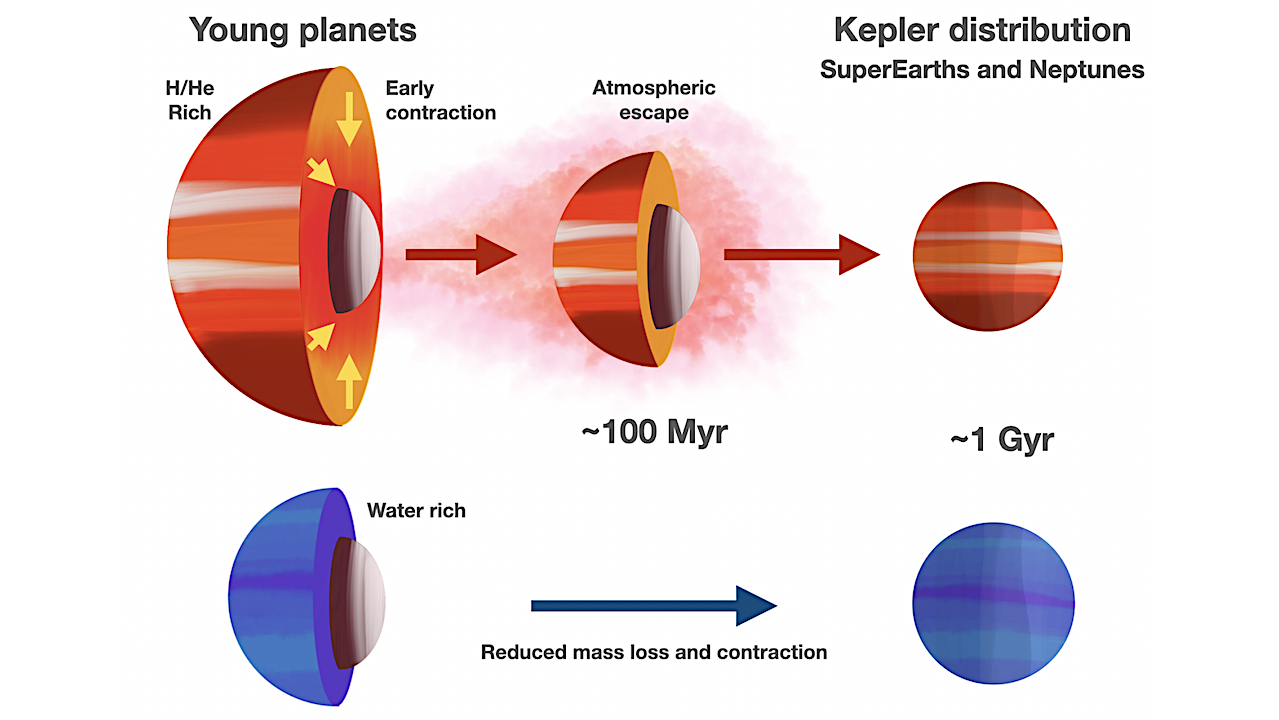
The close-in small planet population may be formed either with hydrogen/helium dominated envelopes or with water-rich interiors. Both scenarios reproduce the present day planet population in mass, radius, and periods, and are difficult to differentiate with the mature planet demographic.
Hydrogen/Helium ‘gas-dwarfs’ have low mean molecular weight atmospheres, while ‘water-worlds’ have envelopes that are significantly heavier, and as such these two scenarios have different evolution tracks that diverge in the first ~50 Myr of their evolution.
We show that a low Earth orbit multi-band photometric survey mission, within the scope of the NASA Small Explorers Program (SMEX), can determine the frequency of young close-in planets at the 5% level and definitively differentiate between the competing ‘gas-dwarf’ and ‘water-world’ hypotheses.
We simulate a 2.5 year mission capable of simultaneous multi-band near-ultraviolet (NUV), optical, and near infrared (NIR) wide field photometry. Such a mission would perform a photometric survey of 30 different stare-fields selected to probe the young star population. The mission will yield ~100 transiting planets in young star clusters and associations with ages <50 Myr. In comparison, only 20 such planets are known from K2 and TESS today.
George Zhou, James G. Rogers, Jennifer A. Burt, Eve J. Lee, Sydney Vach, Ann Marie Cody, Mark Swain, Neal J. Turner, Andrew W. Mann, Madyson G. Barber, Eric Gaidos, Ward Howard, Laura Venuti, Damon F. Landau, Valerie Scott, Alan Didion, David Makowski, Jamie Nastal, Evgenya L. Shkolnik, Meredith A. MacGregor
Comments: Accepted for publication in AJ
Subjects: Earth and Planetary Astrophysics (astro-ph.EP); Instrumentation and Methods for Astrophysics (astro-ph.IM); Solar and Stellar Astrophysics (astro-ph.SR)
Cite as: arXiv:2606.04283 [astro-ph.EP] (or arXiv:2606.04283v1 [astro-ph.EP] for this version)
https://doi.org/10.48550/arXiv.2606.04283
Focus to learn more
Submission history
From: George Zhou
[v1] Tue, 2 Jun 2026 23:18:04 UTC (3,260 KB)
https://arxiv.org/abs/2606.04283
Astrobiology,