Interstellar Formation of Thioethanal (CH3CHS). Gas-Phase and Ice-Surface Mechanisms involving Secondary Sulfur Products
The formation pathways of sulfur-bearing species in the interstellar medium are crucial to understand astrochemical processes in cold molecular clouds and to gain new insights about the sulfur budget in these regions.
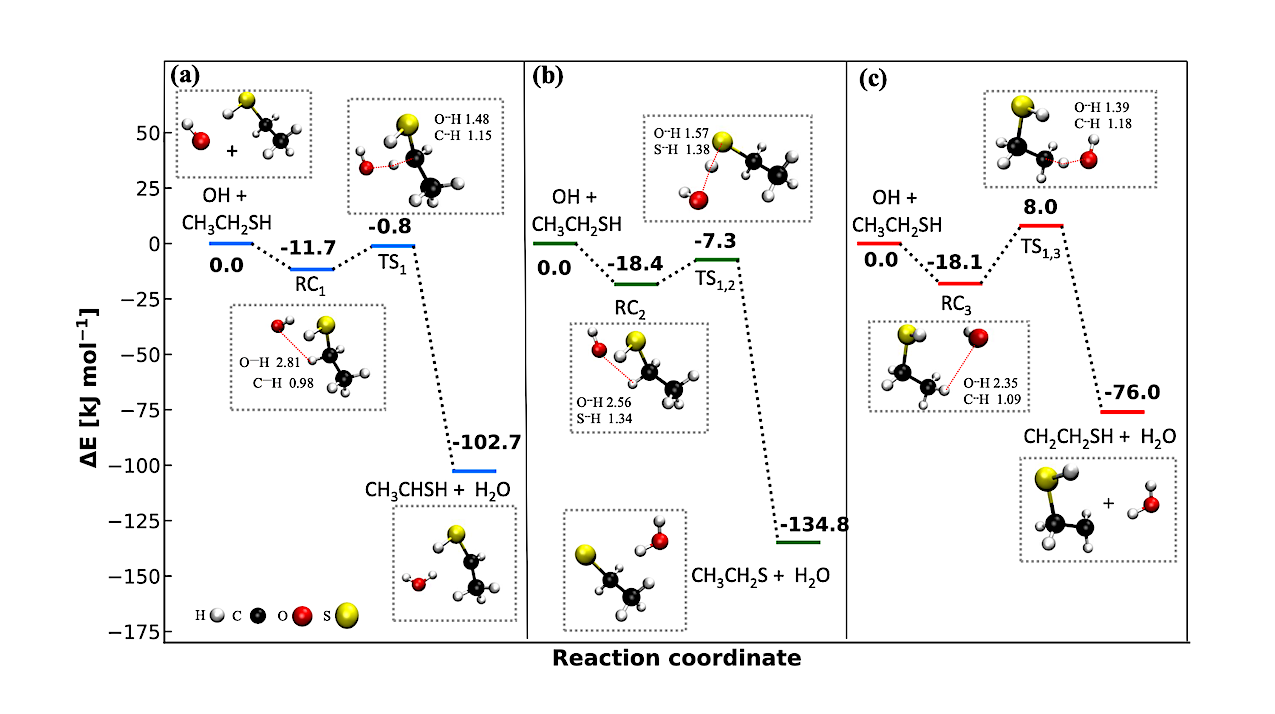
We aim to explore the recently detected, thioethanal (CH3CHS) formation mechanisms from thioethanol (CH3CH2SH) as a precursor in addition to secondary sulfur products. The electronic structure methods and density functional theory for both gas-phase and ice-grain surface environments is employed.
To mimic interstellar ice-mantles, we use medium (W6) and large amorphized (W22) water clusters as implemented in Binding Energy Evaluation protocol. A barrierless formation mechanism for CH3CHS under low-temperature interstellar conditions is identified, in the gas phase. Surface environments modulate activation barriers in a site-specific manner, elucidated through both Langmuir-Hinshelwood and Eley-Rideal initiated surface reaction pathways.
Compared to oxygen analogs, sulfur chemistry enables alternate pathways due to weaker S-H bonding, with a competing route forming ethane-1,1-di-thiol (CH3CH(SH)SH), on the ice-grain surface, potentially reducing CH3CHS yields. The first accurate binding energy for thioethanol on water ice is also reported, confirming its greater volatility than ethanol.
The proposed mechanism offers a tentative hypothesis for the apparent mutual exclusive detections of the CH3CH2SH and CH3CHS in TMC-1, Orion, and Sgr B2(N), that further requires validation through quantitative astrochemical modeling and also to distinguish this chemical differentiation from observational sensitivity limitations. These qualitative findings highlight the multifaceted chemical behavior of sulfur-bearing organics in the interstellar medium and support CH3CH(SH)SH as promising astro-chemical targets.
N. Rani, S. Vogt-Geisse, S. Bovino
Comments: Revised version submitted to A&A
Subjects: Astrophysics of Galaxies (astro-ph.GA); Solar and Stellar Astrophysics (astro-ph.SR)
Cite as: arXiv:2602.17551 [astro-ph.GA](or arXiv:2602.17551v1 [astro-ph.GA] for this version)
https://doi.org/10.48550/arXiv.2602.17551
Focus to learn more
Submission history
From: Namrata Rani
[v1] Thu, 19 Feb 2026 17:05:52 UTC (5,247 KB)
https://arxiv.org/abs/2602.17551
Astrobiology, Astrochemistry,