Formation and Survival of Complex Organic Molecules in the Jovian Circumplanetary Disk
Europa, Ganymede, and Callisto are key targets in the search for habitability due to the potential presence of subsurface oceans. Detecting complex organic molecules (COMs), essential for prebiotic chemistry, is crucial to assessing their potential.
Though COMs remain undetected on these moons, ESA’s JUICE and NASA’s Europa Clipper missions aim to fill this gap with their science payloads. This study explores the formation and transport of COMs within Jupiter’s circumplanetary disk (CPD), a critical environment for the formation of the Galilean moons.
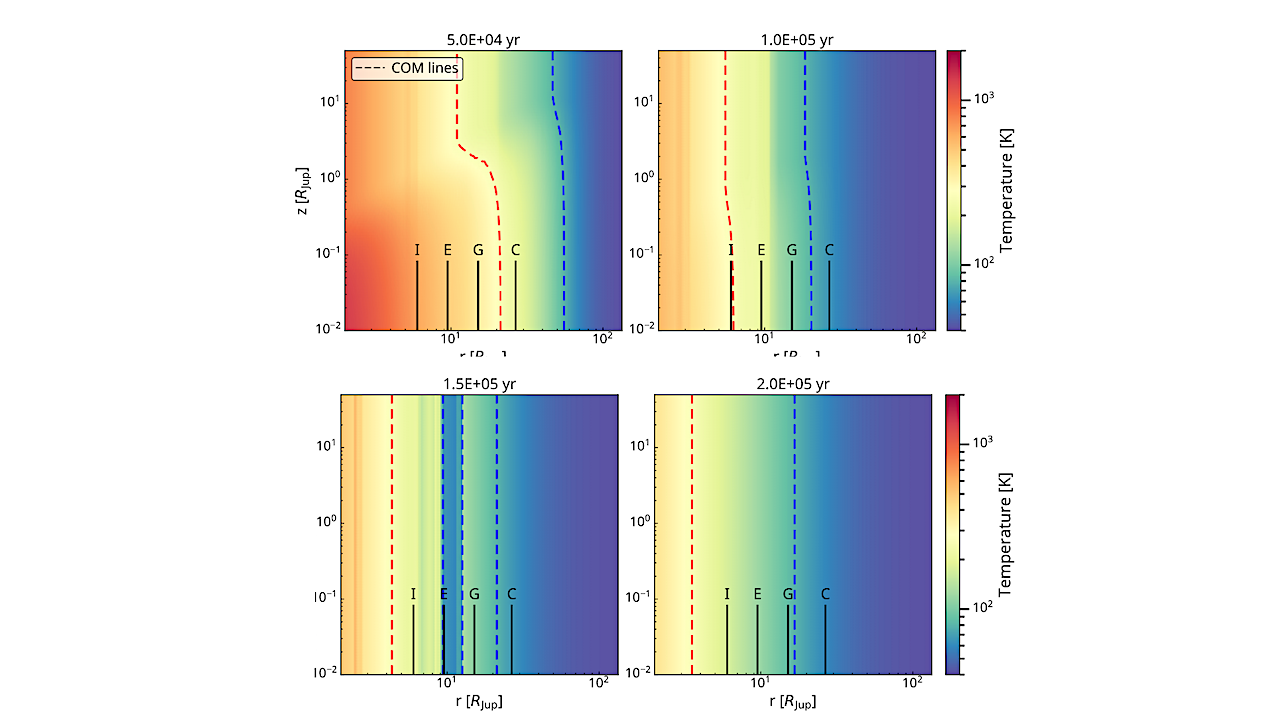
Using a time-dependent model that couples the evolving CPD structure with the dynamics of icy particles of varying sizes and release times, we assess two primary COM formation pathways: thermal processing of ices and UV photochemistry.
The results indicate that heating, particularly of NH3:CO2 ices, occurs efficiently before substantial irradiation, making it the dominant pathway for COM formation in the Jovian CPD. However, the relative efficiencies of these two processes are governed by particle density, disk viscosity, accretion rate, and UV flux, which collectively determine drift timescales and exposure to favorable thermodynamic environments.
Existing models indicate that Europa’s accretion was relatively cold and prolonged, possibly allowing some COMs to survive incorporation, whereas Ganymede and Callisto likely formed under even cooler conditions conducive to preserving COM-rich material. These results highlight the potential inheritance of complex organics by the Galilean moons and offer a framework for interpreting upcoming compositional data from JUICE and Europa Clipper.
Olivier Mousis, Clément Petetin, Tom Benest Couzinou, Antoine Schneeberger, Yannis Bennacer
Comments: The Planetary Science Journal, in press
Subjects: Earth and Planetary Astrophysics (astro-ph.EP); Atomic and Molecular Clusters (physics.atm-clus)
Cite as: arXiv:2602.14334 [astro-ph.EP] (or arXiv:2602.14334v1 [astro-ph.EP] for this version)
https://doi.org/10.48550/arXiv.2602.14334
Focus to learn more
Submission history
From: Olivier Mousis
[v1] Sun, 15 Feb 2026 23:04:26 UTC (1,424 KB)
https://arxiv.org/abs/2602.14334
Astrobiology, Astrogeology, Astrochemistry,