Hydration Features on Near-Earth Objects: Integrating New Data with Prior Results
Near-Earth objects (NEOs) are excellent laboratories for testing processes that affect airless bodies, as well as informing us about solar system history.
Though most NEOs are nominally anhydrous because they formed inside the solar system frost line and their surface temperatures are high enough to remove volatiles, a 3 μm feature typically indicative of OH/H2O has been identified on several such bodies. Possible sources for OH/H2O on these bodies include carbonaceous chondrite impactors or interactions with protons implanted by solar wind.
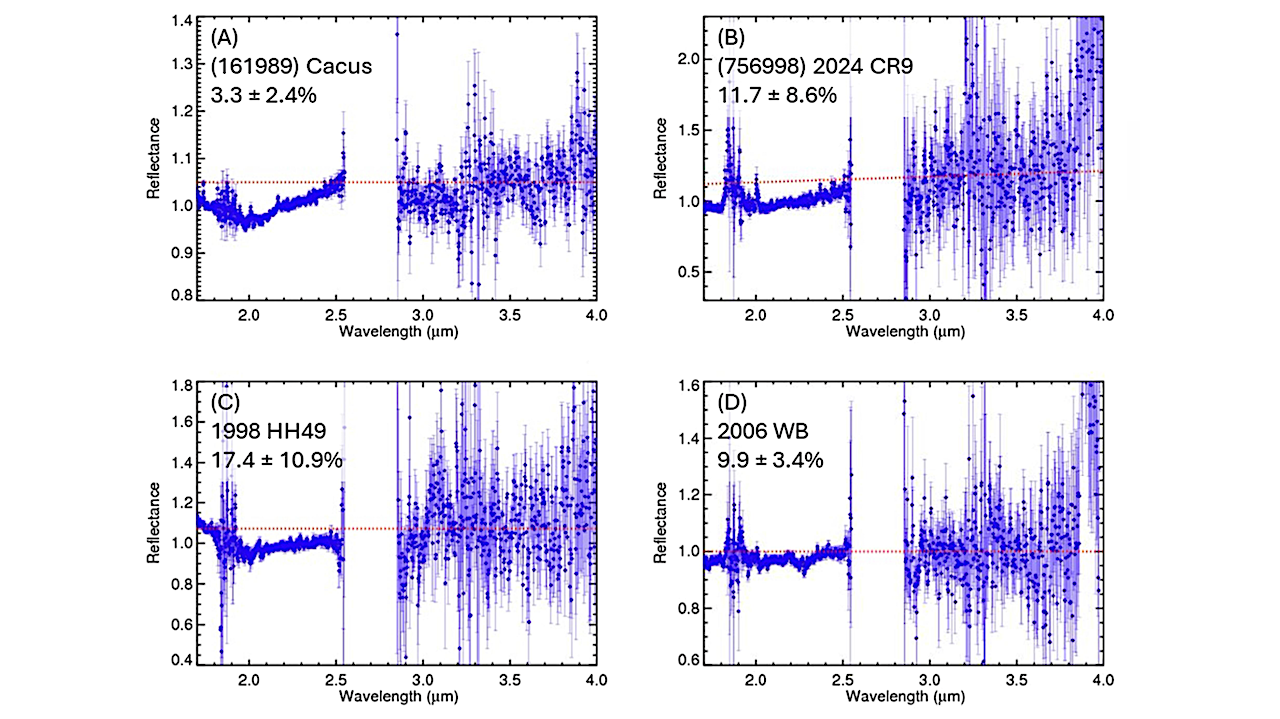
The MIT-Hawaii Near-Earth Object Spectroscopic Survey (or MITHNEOS) began its 3 μm observation campaign of NEOs in 2022 and has obtained spectral data of 15 predominantly nominally anhydrous (i.e., mostly S-complex or V-type) targets using NASA’s Infrared Telescope Facility’s near-infrared spectrometer, SpeX. Spectra were collected using both prism (0.7–2.52 μm) and long-wavelength cross-dispersed short (LXD_short; 1.67–4.2 μm) modes to accurately characterize asteroid spectral type and the 3 μm region.
Four of the 15 NEOs observed exhibit a 3 μm feature, exhibiting band shapes similar to those identified in a previous NEO survey, which found a trend between hydration band presence and large aphelion (i.e., Q > 2.06 au).
Combining our new observations with the preexisting database of NEO 2–4 μm data revealed that band depth increases with decreasing orbital inclination and that all NEOs with hydration bands have i < 27°, with most having i < 14°. We find that NEOs with low inclinations and large aphelia are the most likely bodies in near-Earth space to possess surficial OH/H2O.
- Hydration Features on Near-Earth Objects: Integrating New Data with Prior Results
The Planetary Science Journal via X-mol.net (open access) - Hydration Features on Near-Earth Objects: Integrating New Data with Prior Results, The Planetary Science Journal (open access)
Astrobiology, Astrogeology,