Detection Of Propadiene (CH2CCH2), Propene (C3H6) And Non-detection Of Propane (C3H8) In Jupiter’s Northern Polar Stratosphere
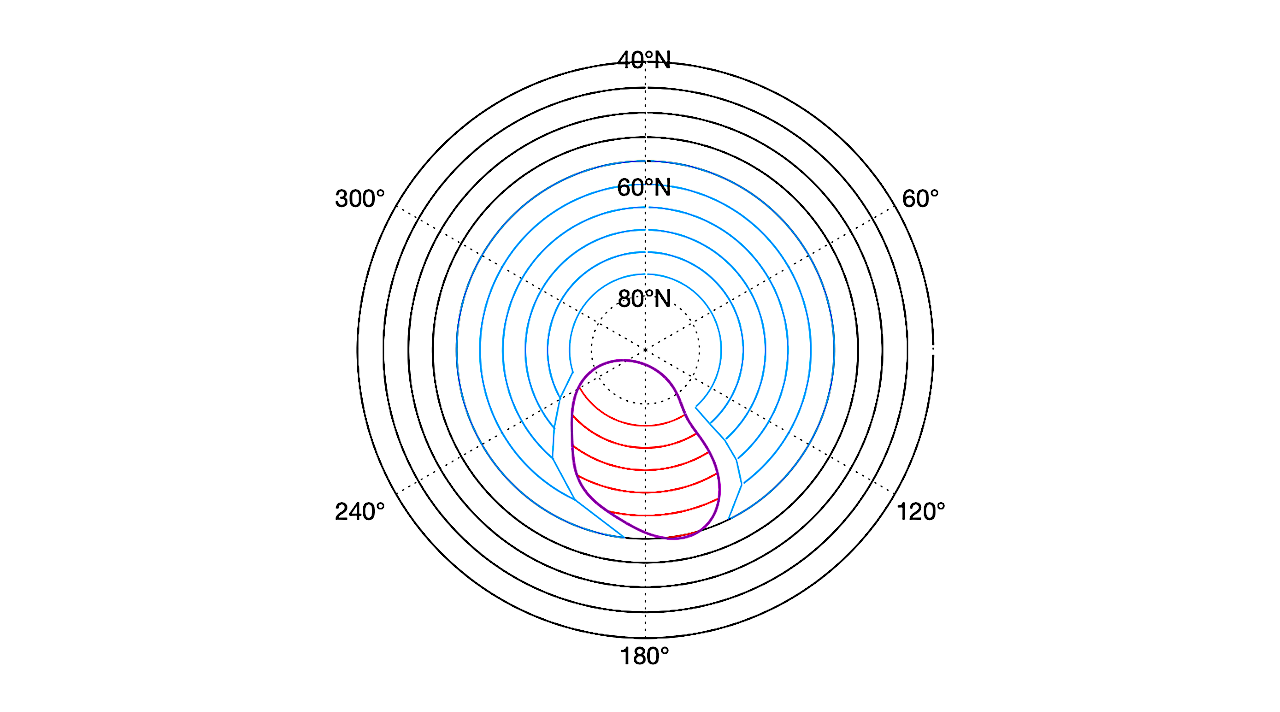
We report the first detection of stratospheric propadiene (CH2CCH2) and propene (C3H6) at Jupiter’s mid-to-high northern latitudes using IRTF-TEXES measurements recorded on March 5-6, 2025.
Using radiative transfer software to quantitatively test for the presence of propadiene and propene, we report a >12-σ detection of propadiene and a >17-σ detection of propene inside Jupiter’s northern auroral region (henceforth ‘NAR’), where the species are most concentrated.
For example, at 62∘N inside Jupiter’s NAR, we derive a 1-mbar propadiene abundance of 2.0 ± 0.2 ppbv, which is 40 ± 3 higher than abundances predicted by the Moses & Poppe (2017) photochemical model (henceforth ‘MP17’), and significantly higher than the 1.2-ppbv upper limit abundance derived at 42∘N (the lowest latitude sampled by the observations).
Similarly, we derive a 1-mbar propene abundance of 8.1 ± 0.5 ppbv at 62∘N inside Jupiter’s NAR, which is 28 ± 2 higher than the MP17 predicted abundance and higher than the 6-ppbv 1-mbar upper limit abundance derived at 42∘N.
The fact that propadiene and propene are most enriched inside Jupiter’s NAR strongly suggests that perturbations to the chemistry by auroral-related heating and exogenous ions/electrons are responsible for their significant enrichment. Spectral features of propane (C3H8) were not detected at any of the locations sampled by the data: 3-σ upper limits of 10 ppbv were derived at the 10-mbar level at 62∘N inside Jupiter’s NAR.
The non-detection of propane could, in part, be explained by the vertical sensitivity of its spectral features to deeper pressures, where there is negligible auroral-related heating. The results of this work advocate for development of ion-neutral chemistry models of Jupiter’s polar stratosphere.
James A. Sinclair, Thomas K. Greathouse, Rohini S. Giles, Keeyoon Sung, Conor A. Nixon, Nicholas A. Lombardo, Vincent Hue, Julianne I. Moses, Leigh N. Fletcher, Patrick G. J. Irwin, Glenn S. Orton
Subjects: Earth and Planetary Astrophysics (astro-ph.EP)
Cite as: arXiv:2605.19007 [astro-ph.EP] (or arXiv:2605.19007v1 [astro-ph.EP] for this version)
https://doi.org/10.48550/arXiv.2605.19007
Focus to learn more
Journal reference: Sinclair et al., 2026, Icarus 457, 117156
Related DOI:
https://doi.org/10.1016/j.icarus.2026.117156
Focus to learn more
Submission history
From: James Sinclair
[v1] Mon, 18 May 2026 18:30:07 UTC (754 KB)
https://arxiv.org/abs/2605.19007
Astrobiology, astrochemistry,