Uranus Orbiter and Probe: Mission Challenges and Concept Updates Since the Origins, Worlds, and Life Decadal Survey
Origins, Worlds, and Life: Planetary Science and Astrobiology in the Next Decade identified a Uranus Orbiter and Probe as the highest-priority strategic mission for the decade 2023–2032, as it enables broad cross-disciplinary science in the largely unexplored Uranian system.
The mission architecture evaluated by the Decadal Survey was a singular proof of concept demonstrating that a moderately instrumented mission could deliver Decadal-priority science with a reduced cost and risk posture by leveraging existing technologies to the maximum extent possible.
With revised assumptions since the Decadal, we have explored a large trade space including launch vehicles, propulsion options, cruise trajectories, available power sources, viable concept of operations, and science data return for later launch dates without a Jupiter gravity assist.
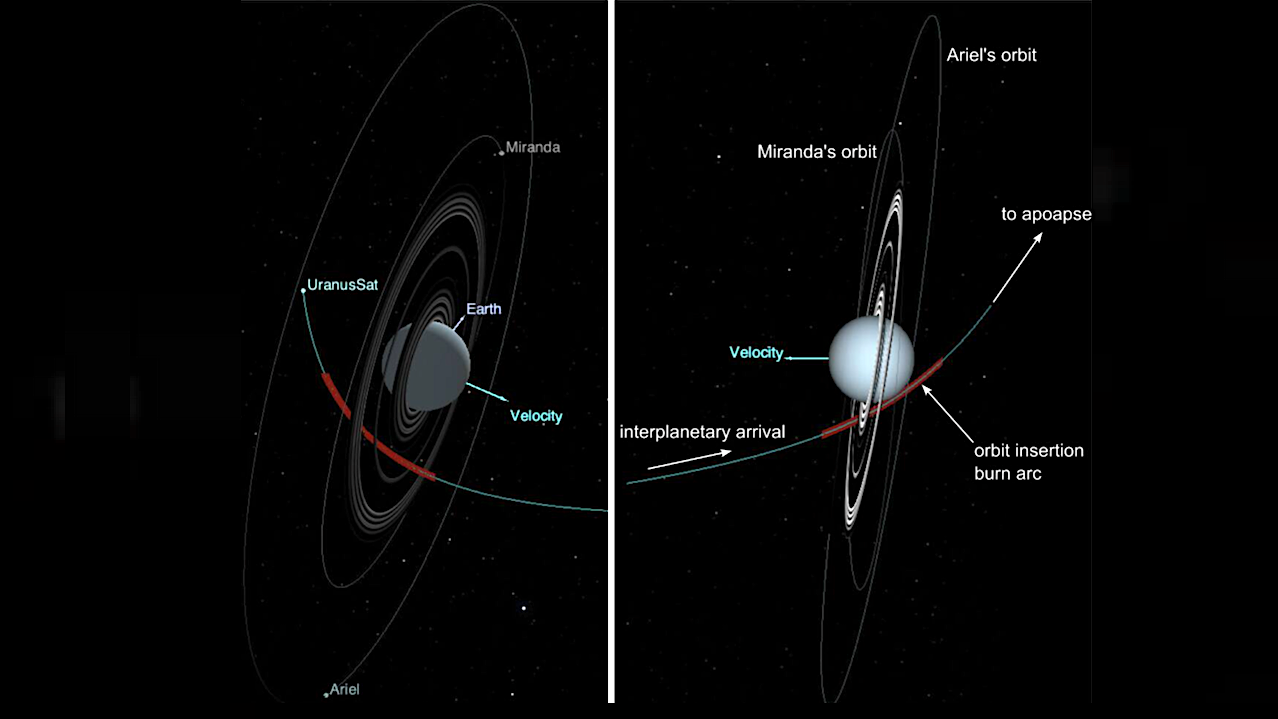
The most repeatable trajectory solutions employ either a commercially derived solar electric propulsion (SEP) transfer stage or the availability of a more capable launch vehicle under development, such as the SpaceX Starship. Orbit insertion has been moved farther from Uranus to acknowledge the remaining uncertainty in Uranian ring structure.
A streamlined, SEP-adaptable, orbiter design was developed using two Next Gen Radioisotope Thermoelectric Generators, and the probe design was matured, reducing the entry gravitational acceleration, and assuming the largest Decadal-recommended payload to provide margin for future instrument selections.
With this updated design, we also constructed a detailed concept of operations for three representative science cases, returning 13–15 Gbit of science data and spacecraft telemetry per ∼34 day orbit.
- Uranus Orbiter and Probe: Mission Challenges and Concept Updates Since the Origins, Worlds, and Life Decadal Survey, The Planetary Science Journal via x-mol.net
- Uranus Orbiter and Probe: Mission Challenges and Concept Updates Since the Origins, Worlds, and Life Decadal Survey, The Planetary Science Journal (open access)
Astrobiology,