Infrared Spectra Of Methane-containing Ice Mixtures For JWST Data Analysis
Context. Solid methane (CH4) is an important molecule in interstellar and planetary environments, serving as a precursor to complex organic compounds and a potential biosignature in exoplanetary studies. Despite its significance, laboratory data on low-temperature phase of methane below 10 K remain limited.
Aims. We aim to obtain spectra of methane in binary mixtures at 10 K and compare it to the spectra obtained at 6.7 K. These temperatures correspond to phases II and II* of pure methane and are representative of dark molecular clouds and protostars at early stages. We also aim to test the obtained data applicability to JWST data interpretation.
Methods. Laboratory reference spectra were obtained on the ISEAge setup via FTIR spectroscopy in transmission mode. A weighted χ2 minimization is used for the fitting.
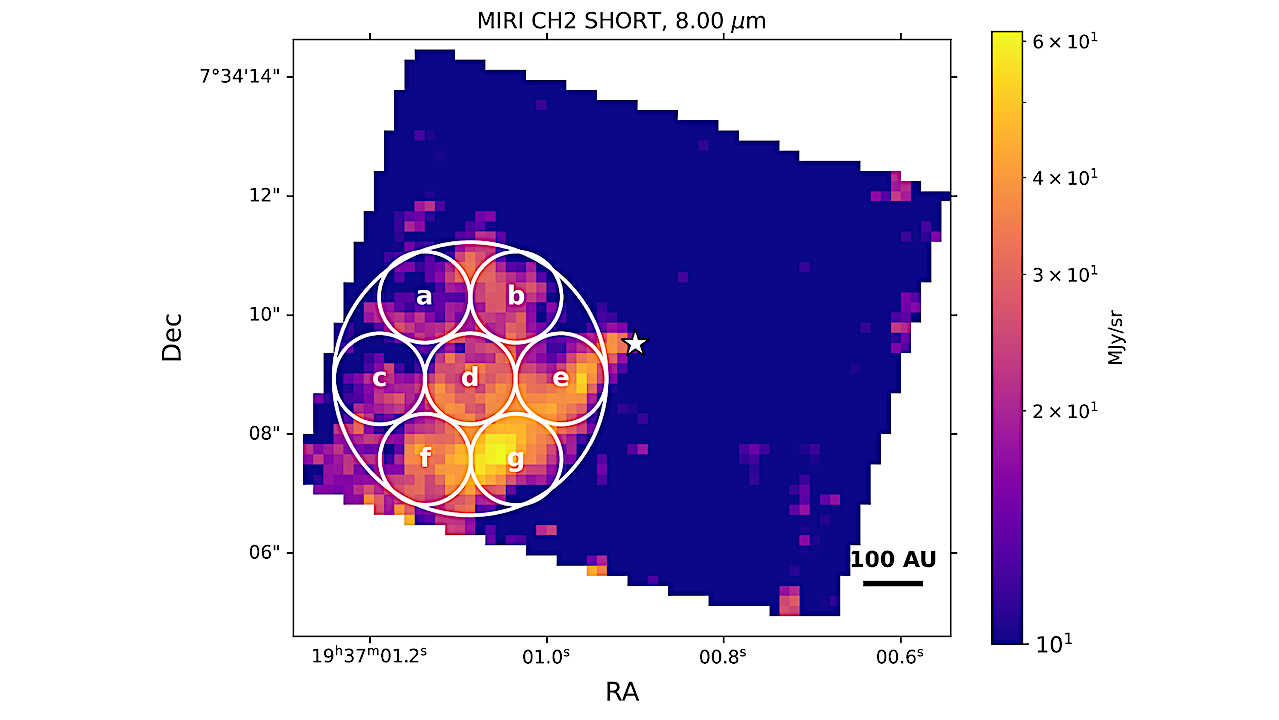
Results. We present infrared spectra with corresponding band strengths of pure methane and binary mixtures with methane: CH4:H2O,CH4:CO22, CH4:CH3OH, CH4:NH3 at 6.7 K and 10 K showing a 20% increase in mixtures compared to commonly used 10 K band strength value of pure methane. We also test the usability of the spectra on open JWST data by probing the spatial distribution of methane in B335. We also present additional experiments concerning the phase transition of methane between phase II* and phase II.
Conclusions. Our results reveal distinct spectral features for methane in non-H2O environments, enabling more accurate interpretation of JWST observations. The dataset of spectra, publicly available on Zenodo, can be used for fitting JWST data.
Varvara Karteyeva, Ruslan Nakibov, Igor Petrashkevich, Mikhail Medvedev, Anton Vasyunin
Comments: 9 pages, 4 figures, 2 tables, accepted to Astronomy&Astrophysics
Subjects: Solar and Stellar Astrophysics (astro-ph.SR); Earth and Planetary Astrophysics (astro-ph.EP); Astrophysics of Galaxies (astro-ph.GA)
Cite as: arXiv:2602.14604 [astro-ph.SR](or arXiv:2602.14604v1 [astro-ph.SR] for this version)
https://doi.org/10.48550/arXiv.2602.14604
Focus to learn more
Submission history
From: Varvara Karteyeva
[v1] Mon, 16 Feb 2026 10:09:02 UTC (362 KB)
https://arxiv.org/abs/2602.14604
Astrobiology, Astrochemistry,