Bennu And Ryugu Cconstituents From Samples IR Analyses And Potential Source Of Terrestrial Planets’ Ingredients
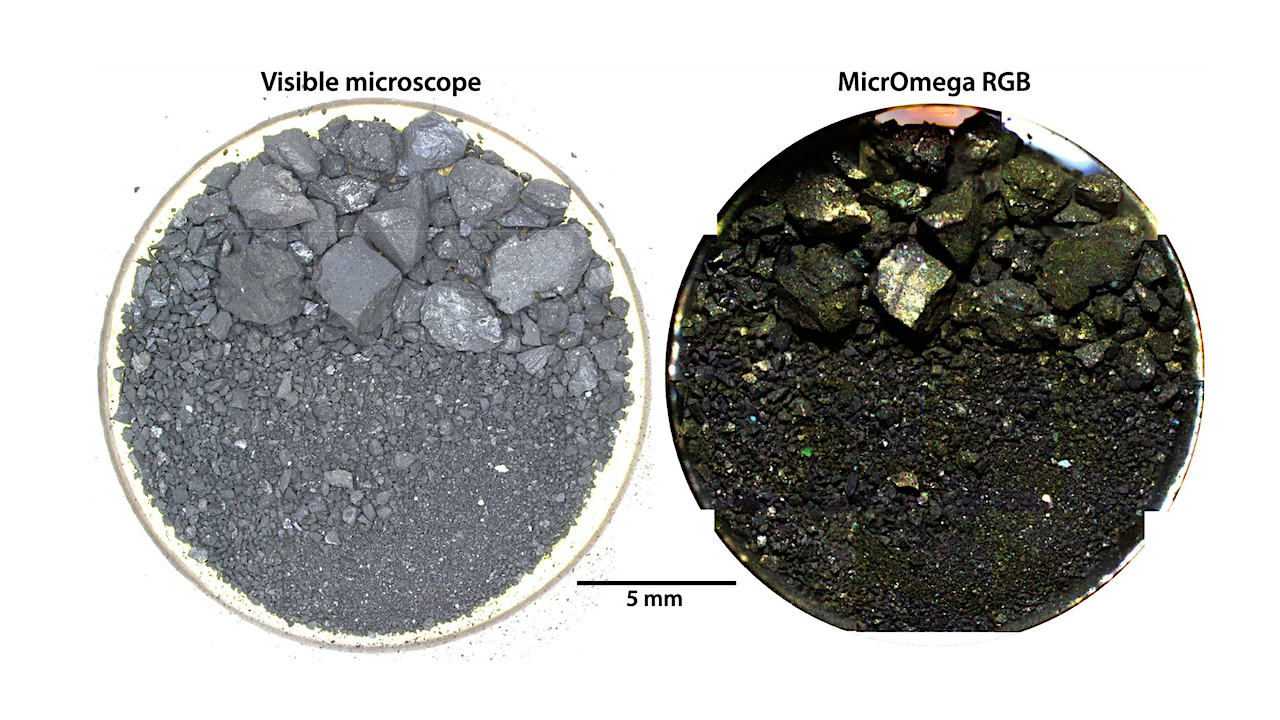
Samples collected on carbonaceous asteroids and preserved from terrestrial alteration are key witnesses of the early evolution of the Solar System.
Here we present the results of the characterization, by the near-IR hyperspectral microscope MicrOmega within the ISAS/JAXA curation center, of the samples returned from the Bennu asteroid by the OSIRIS-REx mission. We compare these samples to those from Ryugu, analyzed with the same instrument and at the same facility, using gram-scale quantities of material.
We demonstrate that Bennu and Ryugu samples exhibit similar near-IR diagnostic spectral properties, from the centimetre down to the sub-millimetre scale. A wide variety of compounds are detected within a similar phyllosilicate-rich matrix, including diverse carbonates, H2O-rich and NH-rich phases, and notably Hydrated Ammonium-Magnesium-Phosphorus-rich grains.
Rarely, anhydrous silicates are also observed. Despite some minor, although significant differences, our results indicate that the parent bodies of Ryugu and Bennu share similar formation and early evolution processes in the outer protoplanetary disk. Their main characteristics would, thus, define an entire class of objects which might have driven specific evolutionary pathways for terrestrial planets, including that which led to life on Earth.
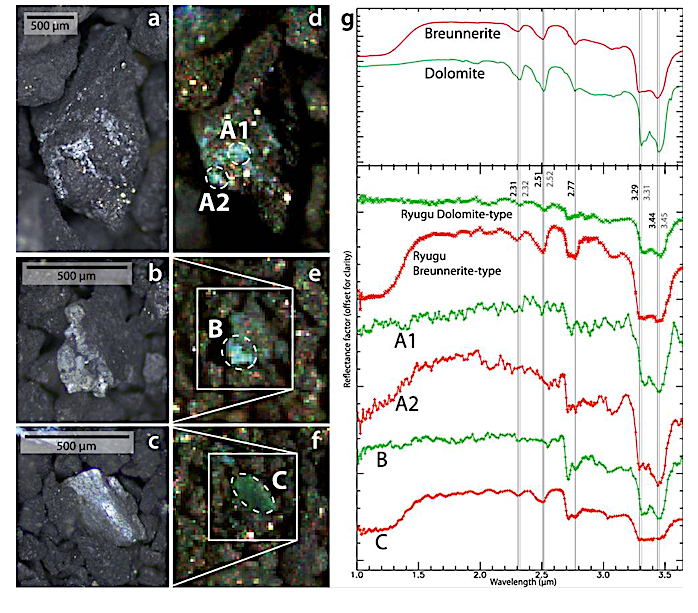
a–c Visible images show the context where these carbonate inclusions are detected. In MicrOmega RGB composite images of the same areas (d–f), carbonates appear in shades of green and blue (R: 3.34 µm, G: 2.50 µm, B: 1.20 µm). g Average MicrOmega spectra of the carbonate-rich regions highlighted by the dashed circles on the MicrOmega RGB images (A1 averages 19 pixels, A2: 10 pixels, B: 50 pixels, C: 89 pixels). Examples of carbonates identified in Ryugu pristine samples by MicrOmega under similar conditions11 are shown for comparison. Reference spectra of terrestrial carbonates are also displayed (dolomite BKR1CB017a spectrum from RELAB and a terrestrial breunnerite spectrum acquired at IAS, Orsay11) — Nature Communications via PubMed
Bennu and Ryugu constituents from samples IR analyses and potential source of terrestrial planets’ ingredients, Nature Communications via PubMed (open access)
Astrobiology, Astrogeology, Astrochemistry,