Supramolecular Interactions of Organometallic Origin Facilitating Astrochemical Reactions: An Electronic Structure Study Featuring Metal Cyanides versus Metal Isocyanides
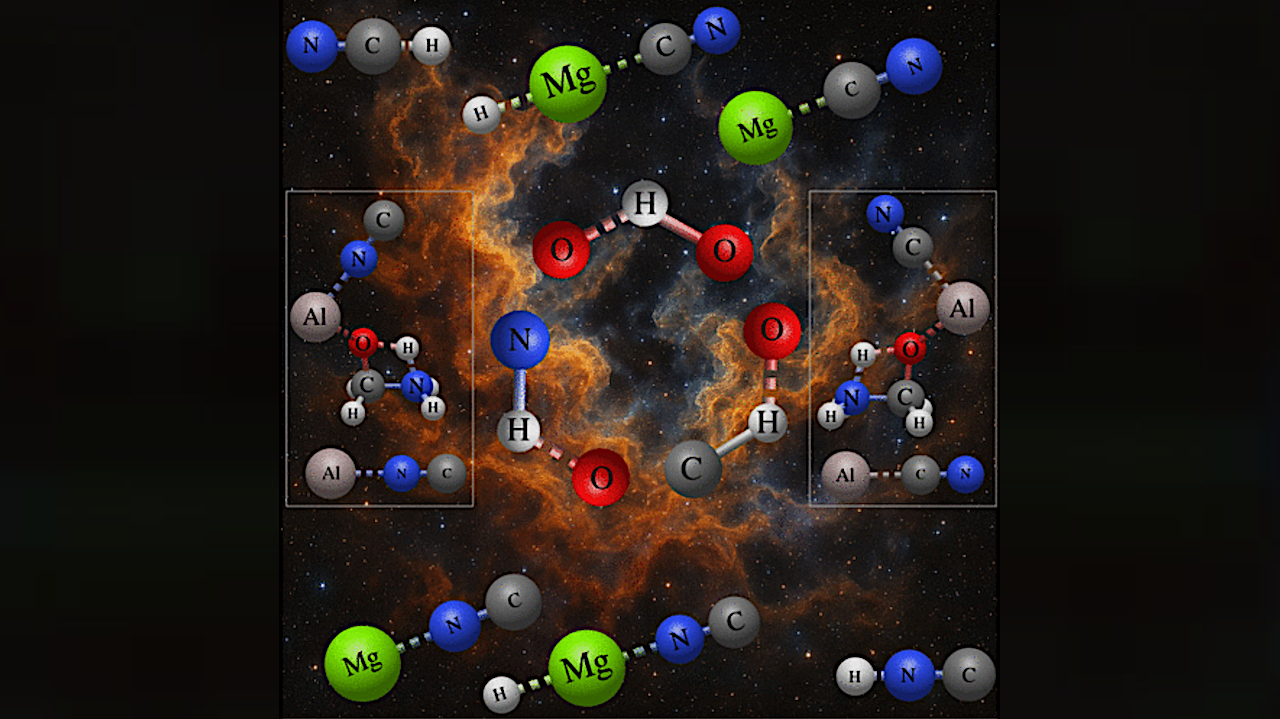
This work highlights how organometallic chemistry and supramolecular interactions can together drive astrochemically relevant reactions. For this purpose, MCN and MNC species (M = Mg(II), Mg(I), and Al(I)) detected in the interstellar medium (ISM) are chosen in this computational study employing coupled cluster theory (CCSD(T)) and density functional theory (DFT).
The MCN and MNC molecules aid in highlighting the role of key interactions arising due to organometallic and supramolecular chemistry in the proposed reactions, leading to the formation of important biomonomers like propylene oxide, aminomethanol, and formamide. Salient findings from here reveal that (a) M···N, M···C, and M···O interactions (arising due to organometallic chemistry) and (b) O···H, N···H, and C···H hydrogen bonding and dipole–dipole interactions involving C···O and C···N atoms (arising due to supramolecular interactions) affect the feasibility of the proposed astrochemical reactions. Ring formation in transition states guided by the weak noncovalent interactions also impact the barriers.
A comparison between the HCN/HNC chemistry, which is well-documented in the astrochemistry literature, and the MCN/MNC chemistry has also been made. In the context of organometallic astrochemistry, it is pointed out that the ratio of the abundance of MgNC and MgCN in the interstellar medium mirrors the established trends such as those seen in HCN versus HNC, in that both abundances are contrary to expectations based on relative thermodynamic stabilities.
The striking paucity of information about the interstellar column densities of AlCN and HMgCN in the literature has also been reported, and their (AlCN and HMgCN) detection in the ISM is recommended. Overall, this paper provides insights into organometallic and supramolecular chemistry’s potential role in astrochemistry and lists the key similarities and differences that supramolecular chemistry brings about in terrestrial and extraterrestrial environments, thereby paving the way for further investigations.
- Supramolecular Interactions of Organometallic Origin Facilitating Astrochemical Reactions: An Electronic Structure Study Featuring Metal Cyanides versus Metal Isocyanides, ACS Earth and Space Chemistry via X-mol.net
- Supramolecular Interactions of Organometallic Origin Facilitating Astrochemical Reactions: An Electronic Structure Study Featuring Metal Cyanides versus Metal Isocyanides, ACS Earth and Space Chemistry
Astrobiology, Astrochemistry,