Searching For Extragalactic Exoplanets: A Survey Of The Sagittarius Dwarf Galaxy Stream With TESS
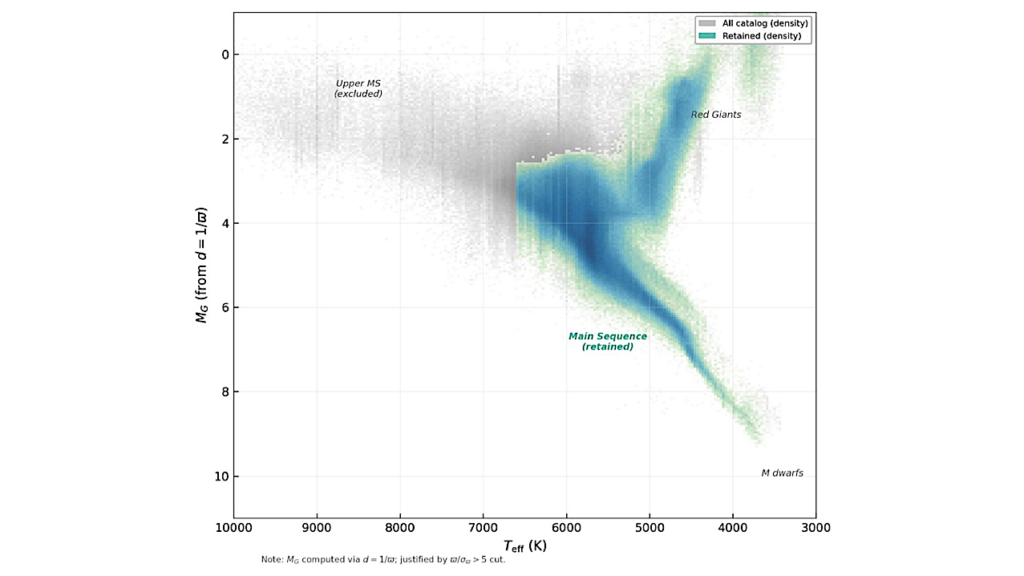
To date no exoplanets have been detected outside the Milky Way, and their extragalactic occurrence rates are poorly constrained. Using available data from TESS we perform the first transit survey of the Sagittarius dwarf galaxy stream using 15,176 main sequence stars identified as likely members.
We calculate an upper limit of <1.01% for hot Jupiters with radii of 1-2 RJup and periods of 0.6-10 days after detecting zero planets. We compare our calculated occurrence rate upper limits to the upper limits found in the Milky Way globular clusters M4 and 47 Tuc.
Our 1-σ occurrence rate upper limit of <0.37% for the Sagittarius dwarf galaxy stream, for planets with radii of 1.5-2 RJup and periods <10 days, is lower than the <0.57% upper limit measured in 47 Tuc. Similarly, our 2 sigma upper limit of <0.78% for planets with radii of 1.4-2 JJup and periods <8 days is below the <0.81% upper limit measured in M4.
We predict that a future analysis of TESS data with a high detection efficiency for hot Jupiter transit depths would require ηextragalactic ≥ 11,467 target stars to detect a planet of extragalactic origin.
Therefore, we predict that a future investigation of TESS data which includes additional extragalactic stellar streams will be able to either detect the first extragalactic origin planet or provide evidence that older, lower metallicity extragalactic environments may experience a lower hot Jupiter occurrence rate than is observed for the Milky Way.
William Schap, Jason Dittmann, Elizabeth Lada
Comments: accepted for publication in AJ, 16 pages, 8 figures
Subjects: Earth and Planetary Astrophysics (astro-ph.EP); Astrophysics of Galaxies (astro-ph.GA); Instrumentation and Methods for Astrophysics (astro-ph.IM); Solar and Stellar Astrophysics (astro-ph.SR)
Cite as: arXiv:2602.15105 [astro-ph.EP] (or arXiv:2602.15105v1 [astro-ph.EP] for this version)
https://doi.org/10.48550/arXiv.2602.15105
Focus to learn more
Related DOI:
https://doi.org/10.3847/1538-3881/ae4345
Focus to learn more
Submission history
From: William Schap
[v1] Mon, 16 Feb 2026 19:00:02 UTC (1,157 KB)
https://arxiv.org/abs/2602.15105
Astrobiology,