Martian Concretion Sizes Predicted From Two Independently Constrained Inputs: Atmospheric Dust Grain Size And Obliquity-forced Wetting Duration
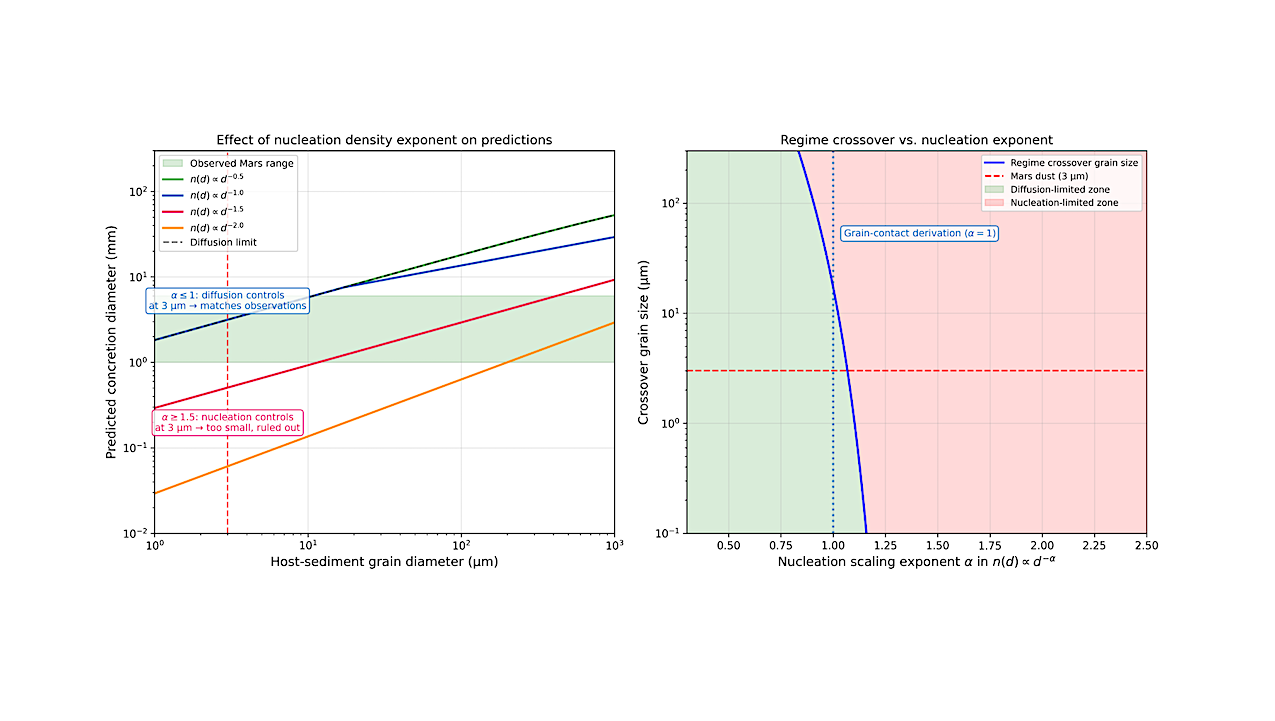
Diagenetic concretions have been identified at multiple widely separated sites on Mars, including Meridiani Planum (Opportunity), Gale crater (Curiosity), and Jezero crater (Perseverance).
Solid concretions at all sites fall within the millimetre size range (typically 1-6 mm diameter), despite differing cement mineralogies. The one substantial outlier — centimetre-to-decimetre-scale hollow concretions on Bradbury Rise — formed in coarser basaltic sandstone via a distinct mechanism.
I propose that this size convergence reflects a common physical control: the globally uniform fraction of ultra-fine (~3 um), amorphous, equant atmospheric dust incorporated into sediments at all sites. I derive the diagenetic timescale from Mars’ ~120 kyr obliquity cycle, which drives periodic subsurface wetting: each high-obliquity pulse (~10^4-10^5 yr) sets the available growth time. Using a diffusion-reaction model with nucleation competition, I show that the low effective diffusivity imposed by the fine dust matrix limits concretion growth to the observed millimetre scale, independent of local fluid chemistry.
Formation efficiency in dust-rich sediment exceeds 90%, making concretion formation essentially inevitable wherever liquid water contacts the dust. This mechanism depends on the non-phyllosilicate, equant-grain mineralogy of Martian dust, which maintains connected pore networks unlike terrestrial clays.
Growth is self-limiting: the first wetting pulse exhausts reactive phases in the depletion halo, so successive obliquity cycles produce new concretions in fresh sediment rather than enlarging existing ones. Each concretion records a single wetting episode. The narrow size distributions at all sites suggest that Martian concretion populations may constitute a sedimentary archive of the planet’s obliquity history.
Samuel Cody
Comments: 19 pages, 3 figures, 2 tables. Preprint; not yet peer-reviewed
Subjects: Earth and Planetary Astrophysics (astro-ph.EP)
Cite as: arXiv:2603.11143 [astro-ph.EP] (or arXiv:2603.11143v1 [astro-ph.EP] for this version)
https://doi.org/10.48550/arXiv.2603.11143
Focus to learn more
Submission history
From: Samuel Cody
[v1] Wed, 11 Mar 2026 17:06:29 UTC (964 KB)
https://arxiv.org/abs/2603.11143
Astrobiology,