Astrochemistry: JWST Locates Supernova Progenitor Was Surrounded By Carbon-rich Dust
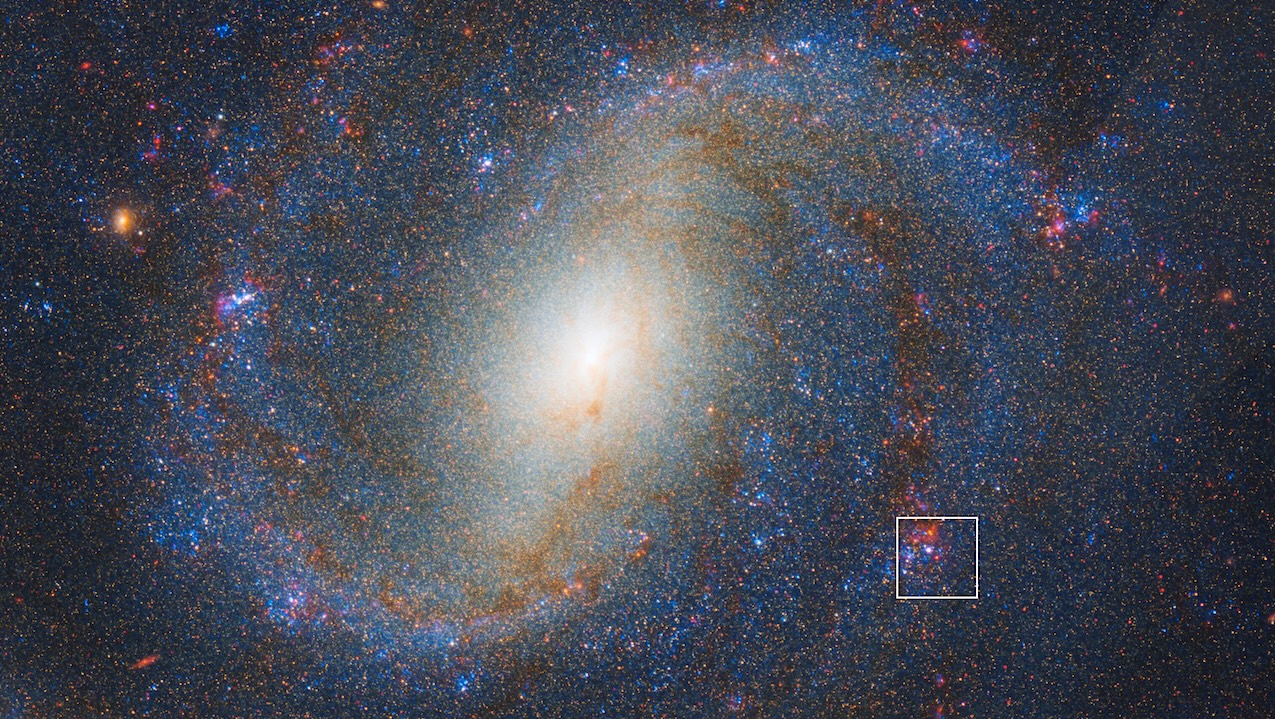
For the first time, astronomers have used images from the NASA/ESA/CSA James Webb Space Telescope to identify a supernova progenitor that could not be seen by any other telescope: a red supergiant that was located in a nearby galaxy. The supergiant’s surroundings were surprisingly dusty – dusty enough to render it invisible to the NASA/ESA Hubble Space Telescope.
Forty million years ago, a star in a nearby galaxy exploded, spewing material across space and generating a brilliant beacon of light. That light traveled across the cosmos, reaching Earth on 29 June 2025, where it was detected by the All-Sky Automated Survey for Supernovae. Astronomers immediately turned their resources to this new supernova, designated 2025pht, to learn more about it. But one team of scientists instead turned to archives, seeking to use pre-supernova images to identify exactly which star among many had exploded. And they succeeded.
Images of galaxy NGC 1637 taken by the James Webb Space Telescope showed a single red supergiant star located exactly where the supernova now shines. This represents the first published detection of a supernova progenitor by Webb. The results were published in the Astrophysical Journal Letters.
“We’ve been waiting for this to happen – for a supernova to explode in a galaxy that Webb had already observed. We combined Hubble and Webb data sets to completely characterize this star for the first time,” said lead author Charlie Kilpatrick of Northwestern University in the United States.
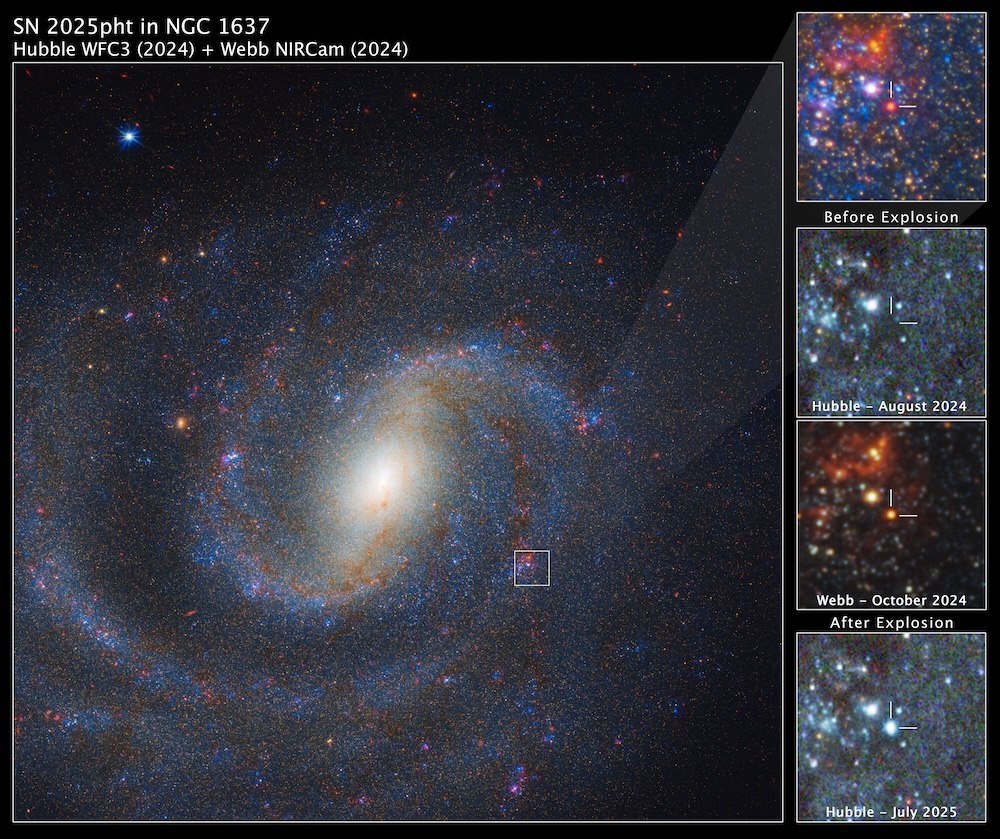
The main image at left shows a combined Webb and Hubble view of spiral galaxy NGC 1637, with the region of interest in the top right. The remaining three panels show a detailed view of a red supergiant star before and after it exploded. The star is not visible in the Hubble image before the explosion, but appears in the Webb image. The July 2025 view from Hubble shows the glowing aftermath of the explosion. Credit: NASA, ESA, CSA, STScI, C. Kilpatrick (Northwestern), A. Suresh (Northwestern); Image Processing: J. DePasquale (STScI) Larger image
The case of the missing red supergiants
By carefully aligning Hubble and Webb images taken of NGC 1637, the team was able to identify the progenitor star in images taken by Webb’s MIRI (Mid-Infrared Instrument) and NIRCam (Near-Infrared Camera) in 2024. They found that the star appeared surprisingly red – an indication that it was surrounded by dust that blocked shorter, bluer wavelengths of light.
“It’s the reddest, most dusty red supergiant that we’ve seen explode as a supernova,” said graduate student and co-author Aswin Suresh of Northwestern University.
This excess of dust could help explain a long-standing problem in astronomy that could be described as the case of the missing red supergiants. Astronomers expect the most massive stars that explode as supernovas to also be the brightest and most luminous. So, they should be easy to identify in pre-supernova images. However, that hasn’t been the case.
One potential explanation is that the most massive aging stars are also the dustiest. If they’re surrounded by large quantities of dust, their light could be dimmed to the point of undetectability. The Webb observations of supernova 2025pht support that hypothesis.
“I’ve been arguing in favor of that interpretation, but even I didn’t expect to see it as extreme as it was for supernova 2025pht. It would explain why these more massive supergiants are missing because they tend to be more dusty,” said Kilpatrick.
Carbon “burps”
The team was not only surprised by the amount of dust, but also by its composition. Applying computer models to the Webb observations indicated that the dust is likely carbon-rich, when astronomers would have expected it to be more silicate-rich. The team speculates that this carbon might have been dredged up from the star’s interior shortly before it exploded.
“Having observations in the mid-infrared was key to constraining what kind of dust we were seeing,” added Suresh.
The team now is working to look for similar red supergiants that may explode as supernovas in the future.
The Type II SN 2025pht in NGC 1637: A Red Supergiant with Carbon-rich Circumstellar Dust as the First JWST Detection of a Supernova Progenitor Star, The Astrophysical Journal Letters, (open access))
Astrobiology, Astrochemistry, Astronomy,