Observational Evidence For A Possible Link Between PAH Emission And Dust Trap Locations In Protoplanetary Disks
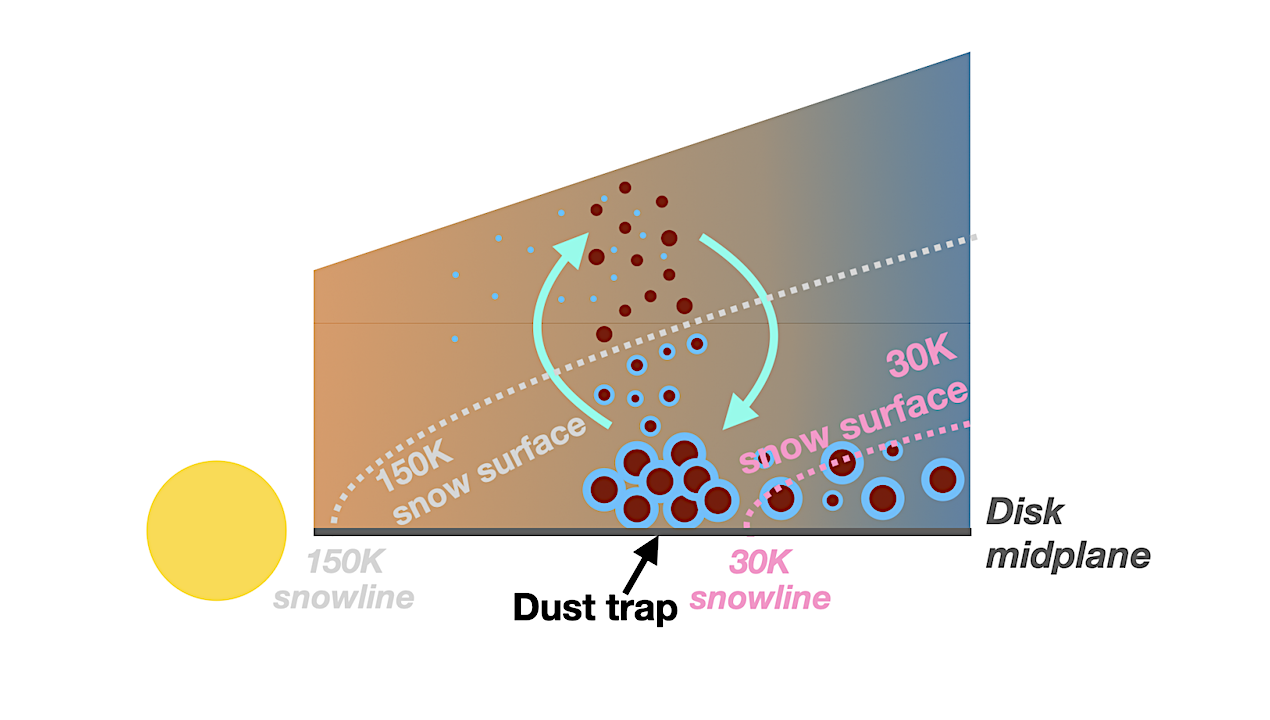
Polycyclic Aromatic Hydrocarbons (PAHs) are commonly detected in protoplanetary disks, but it is unclear what causes the wide range of intensities across the samples.
In this work, the measured PAH intensities of a range of disks are compared with ALMA dust continuum images, in order to test whether there is evidence that PAHs are frozen out on pebbles in dust traps and only sublimate under certain conditions. A sample is constructed from 26 T Tauri and Herbig disks located within 300 pc, with constraints on the 3.3 μm PAH intensity and with high-resolution ALMA continuum data. The midplane temperature is derived using a power-law or with radiative transfer modeling. The warm dust mass is computed by integrating the flux within the 30 K radius and convert to a dust mass.
A strong correlation with a Pearson coefficient of 0.88+/-0.07 between the 3.3 micron PAH intensity and the warm dust mass was found. The correlation is driven by the combination of deep upper limits and strong detections corresponding to a range of warm dust masses. Possible correlations with other disk properties like FUV radiation field or total dust mass are much weaker.
Correlations with PAH features at 6.2, 8.6 and 11.3 micron are potentially weaker, but this could be explained by the smaller sample for which these data were available. The correlation is consistent with the hypothesis that PAHs are generally frozen out on pebbles in disks, and are only revealed in the gas phase if those pebbles have drifted towards warm dust traps inside the 30 K radius and vertically transported upwards to the disk atmosphere with sufficiently high temperature to sublimate PAHs into the gas phase. This is similar to previous findings on complex organic molecules in protoplanetary disks and provides further evidence that the chemical composition of the disk is governed by pebble transport.
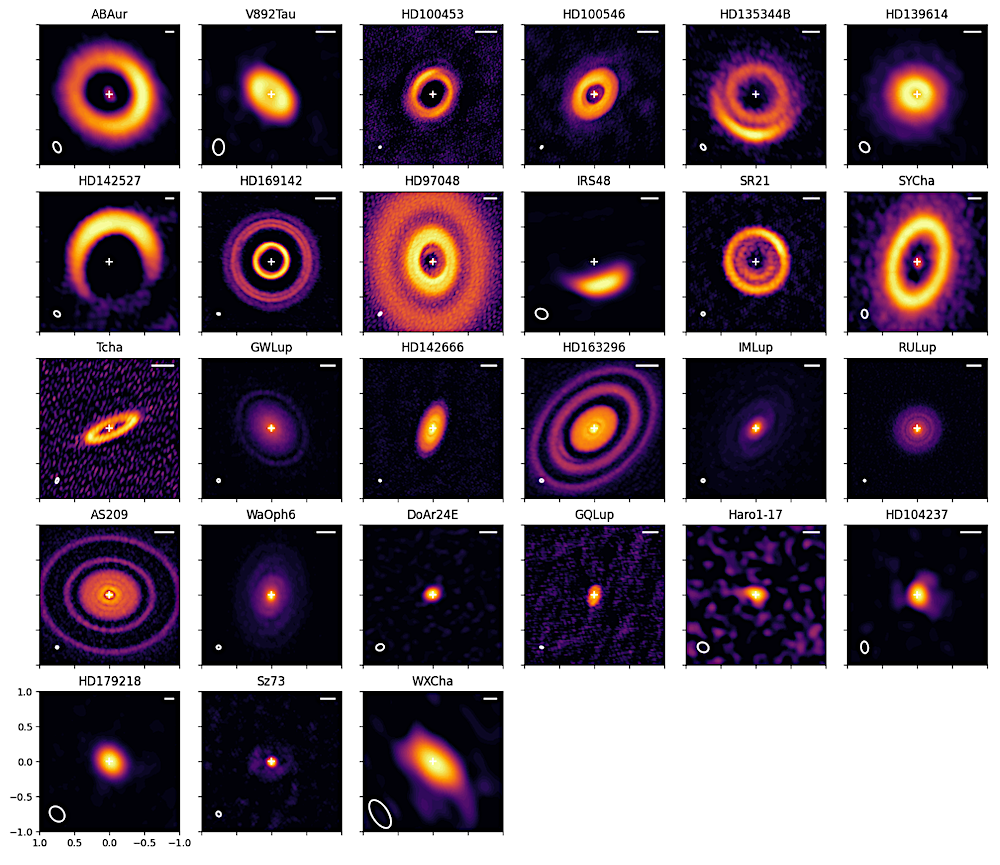
Gallery ALMA continuum images of the targets in this study. The images are shown with a arcsinh stretch to enhance faint features. The stellar position is indicated with a plus sign and the beam size is shown in the lower left corner of each image. The images are 2″×2″ except for HD142527, which is 4″×4″ due to the larger ring size. — astro-ph.EP
Nienke van der Marel (1), Niels F.W. Ligterink (2,3), Ryan van der Werf (1), Milou Temmink (1), Paola Pinilla (4), Bin Jia (1), Quincy Bosschaart (1) ((1) Leiden Observatory, the Netherlands, (2) Delft University of Technology, the Netherlands, (3) Center for Space and Habitability, Switzerland, (4) Mullard Space Science Laboratory, UK)
Comments: 10 pages, 6 figures, accepted for publication by A&A
Subjects: Earth and Planetary Astrophysics (astro-ph.EP)
Cite as: arXiv:2511.06935 [astro-ph.EP] (or arXiv:2511.06935v1 [astro-ph.EP] for this version)
https://doi.org/10.48550/arXiv.2511.06935
Focus to learn more
Submission history
From: Nienke van der Marel
[v1] Mon, 10 Nov 2025 10:34:07 UTC (1,775 KB)
https://arxiv.org/abs/2511.06935
Astrobiology,