Exploring Northeast Syrtis via Jezero Crater
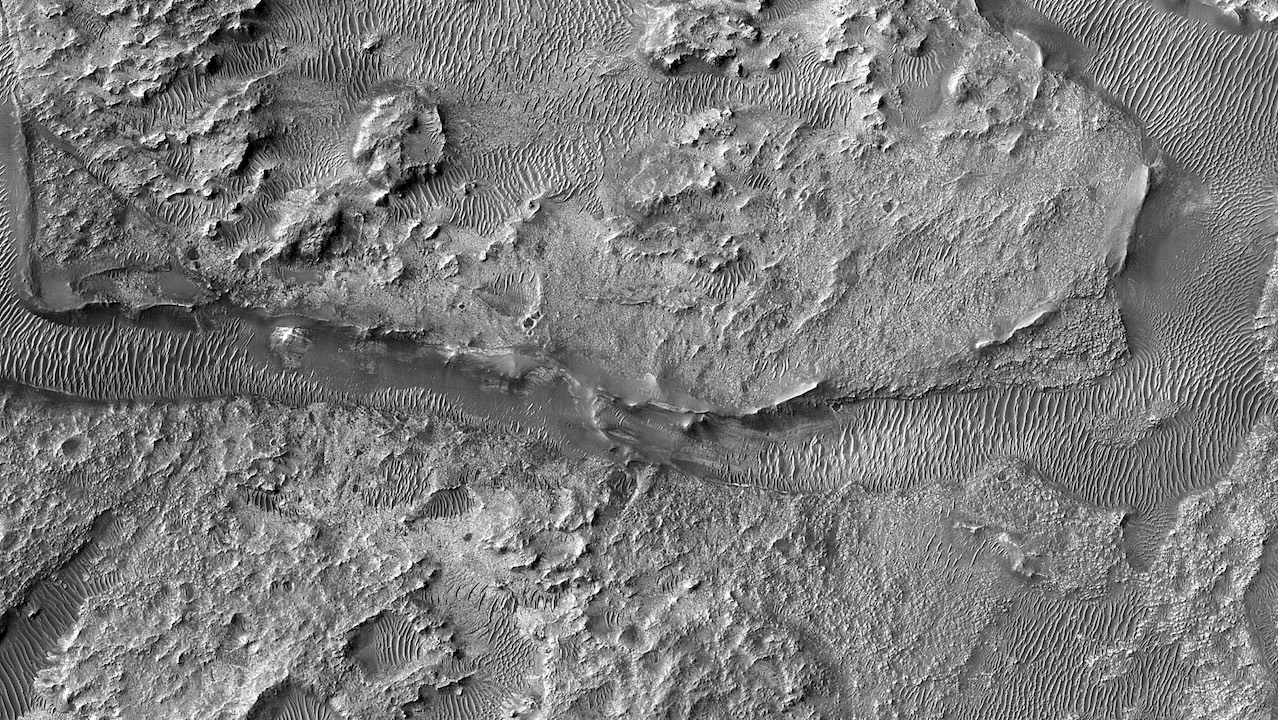
One of the final three candidate landing sites for the Mars 2020 mission was northeast Syrtis, along with Gusev Crater/Columbia Hills and the eventual landing site for the Perseverance rover, Jezero Crater. A key attraction of Syrtis was lithologic diversity spanning a broad interval of early Mars epochs in clear and readily accessible stratigraphic context throughout the landing ellipse.
Units of scientific interest include large, well-exposed blocks of megabreccia probably emplaced by the approximately 4 billion year-old Isidis impact, abundant clays and a high concentration of carbonates that could harbor evidence of past climate and of possible life (e.g. in an ancient, subsurface aquifer).
Fortunately, now that Perseverance has climbed to the rim of Jezero Crater, some elements of the envisioned northeast Syrtis landing site are starting to be explored by NASA. This cutout captures part of the ancient river channel that feeds into Jezero and created its iconic delta also studied by Perseverance to the east (See here for the rover’s location).
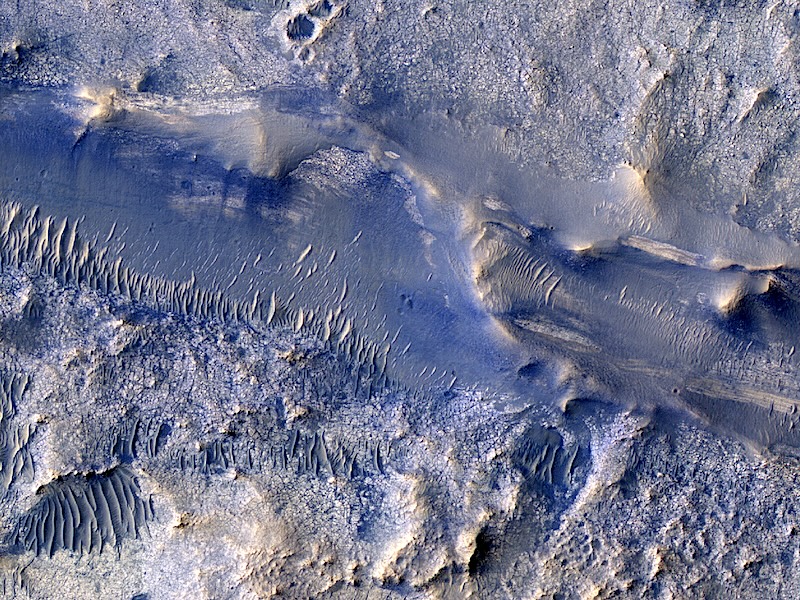
ID: ESP_054090_1985 date: 9 February 2018 altitude: 280 km larger image
Astrobiology, Mars,