ExoDNN: Boosting Exoplanet Detection With Artificial Intelligence. Application to Gaia Data Release 3
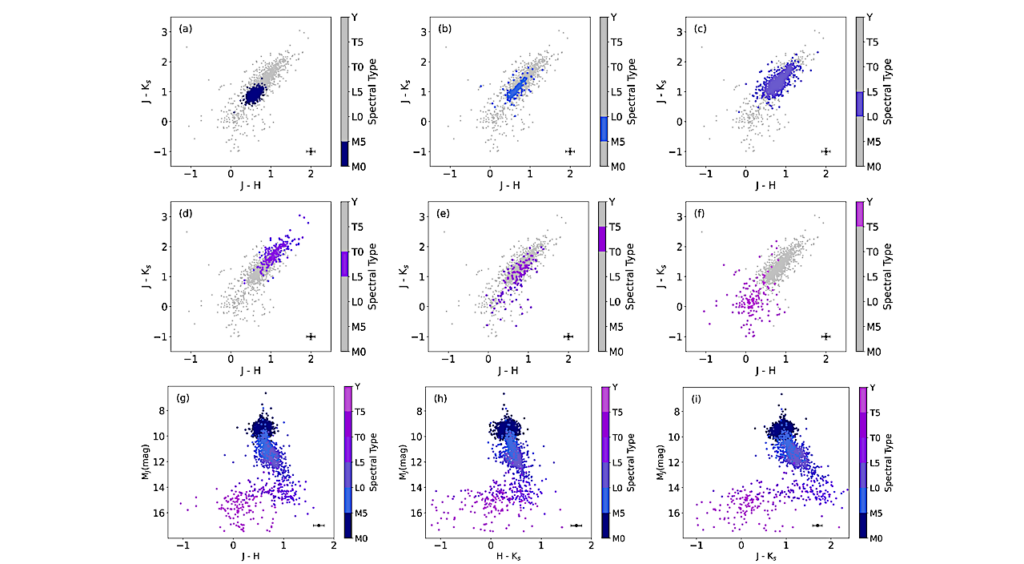
We combine Gaia Data Release 3 and artificial intelligence to enhance the current statistics of substellar companions, particularly within regions of the orbital period vs. mass parameter space that remain poorly constrained by the radial velocity and transit detection methods.
Using supervised learning, we train a deep neural network to recognise the characteristic distribution of the fit quality statistics corresponding to a Gaia DR3 astrometric solution for a non single star.
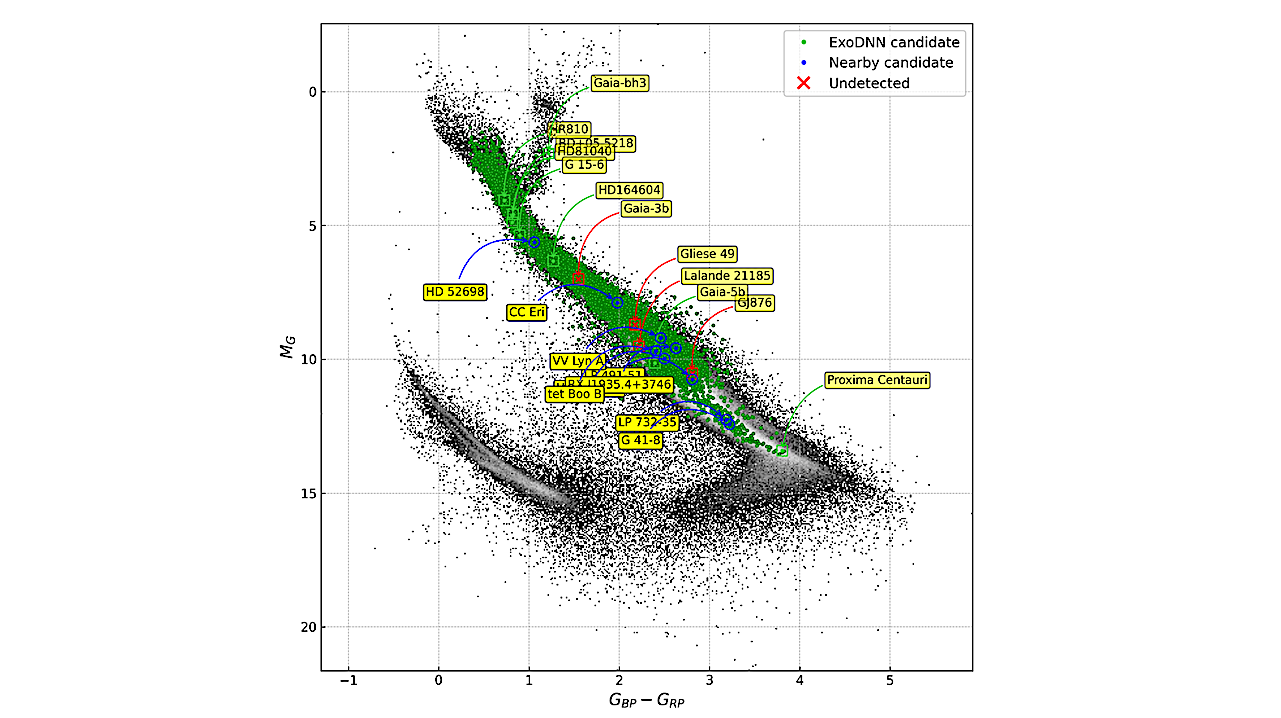
We generate a deep learning model, ExoDNN, which predicts the probability of a DR3 source to host unresolved companions based on those fit quality statistics. Applying the predictive capability of ExoDNN to a volume limited sample of F,G,K and M stars from Gaia DR3, we have produced a list of 7414 candidate stars hosting companions.
The stellar properties of these candidates, such as their mass and metallicity, are similar to those of the Gaia DR3 non single star sample. We also identify synergies with future observatories, such as PLATO, and we propose a follow up strategy with the intention of investigating the most promising candidates among those samples.
A. Abreu, J. Lillo-Box, A. M. Perez-Garcia, J. Sahlmann, J. H. J. de Bruijne, C. Cifuentes
Comments: 15 pages, 13 figures
Subjects: Earth and Planetary Astrophysics (astro-ph.EP); Instrumentation and Methods for Astrophysics (astro-ph.IM); Solar and Stellar Astrophysics (astro-ph.SR)
Cite as: arXiv:2602.02910 [astro-ph.EP] (or arXiv:2602.02910v1 [astro-ph.EP] for this version)
https://doi.org/10.48550/arXiv.2602.02910
Focus to learn more
Related DOI:
https://doi.org/10.1051/0004-6361/202555598
Focus to learn more
Submission history
From: Asier Abreu
[v1] Mon, 2 Feb 2026 23:36:24 UTC (14,816 KB)
https://arxiv.org/abs/2602.02910
Astrobiology, Astronomy, Stellar Cartograpny,