Saturn’s Moon Titan Could Have Formed in a Merger of Two Old Moons
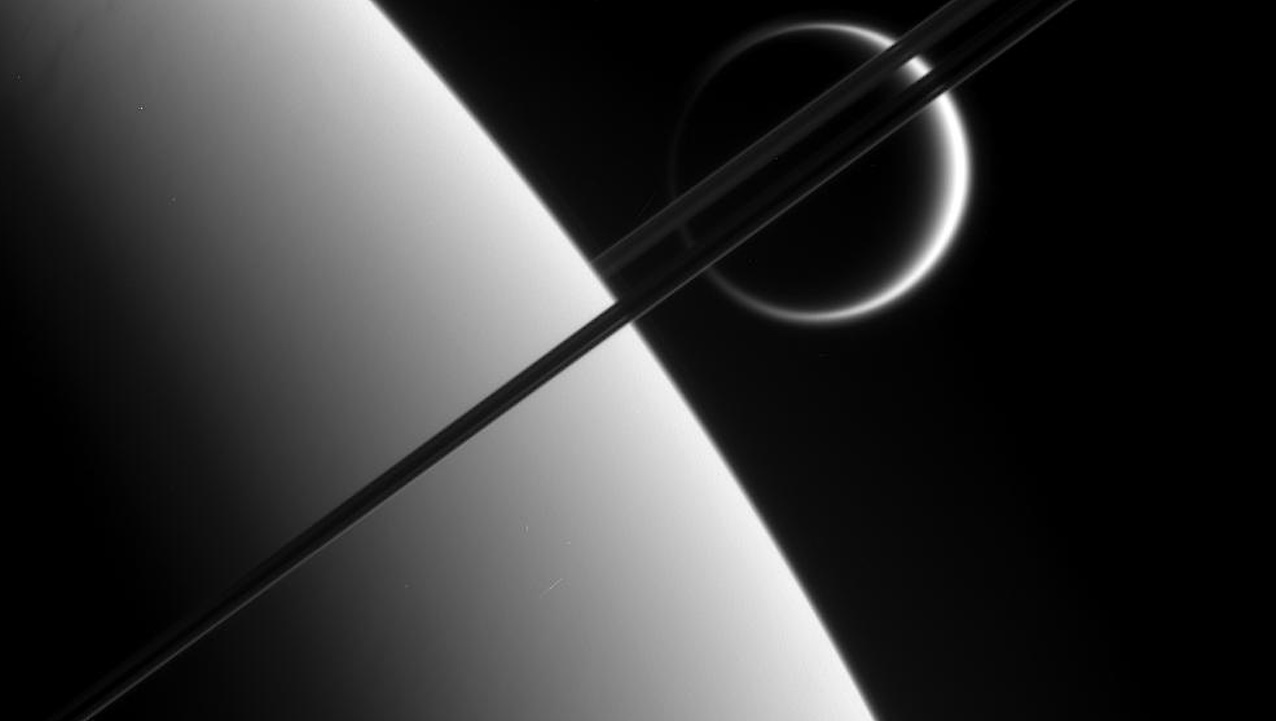
Recent research suggests that Saturn’s bright rings and its largest moon, Titan, may have both originated in collisions among its moons.
While Cassini’s 13-year mission expanded our understanding of Saturn, the discoveries of its young rings and Titan’s rapidly shifting orbit raised new questions.
Now, a study led by SETI Institute scientist Matija Ćuk proposes an explanation linking the formation of the moons and rings, centering on the possibility that Titan is the product of a moon merger.
Near the end of its mission, Cassini measured Saturn’s internal mass distribution, which governs the planet’s slow spin-axis wobble, or precession. For decades, scientists thought Saturn’s precession period matched Neptune’s, enabling the two planets’ gravitational interactions to gradually tilt Saturn and let us clearly see its rings.
Cassini’s final trajectory showed Saturn’s mass is slightly more concentrated at its center than expected, changing its precession rate so it no longer matches Neptune’s. To explain this, researchers at MIT and UC Berkeley proposed that Saturn once had an extra moon, which was ejected after a close encounter with Titan and broke up to form the rings.
The SETI Institute-led study used computer simulations to determine if an extra moon could get close enough to Saturn to form rings. The most likely outcome was a collision of the extra moon with Titan. Saturn’s small, misshapen, constantly tumbling moon Hyperion has its orbit locked with Titan’s.
“Hyperion, the smallest among Saturn’s major moons provided us the most important clue about the history of the system,” said Ćuk. “In simulations where the extra moon became unstable, Hyperion was often lost and survived only in rare cases. We recognized that the Titan-Hyperion lock is relatively young, only a few hundred million years old. This dates to about the same period when the extra moon disappeared. Perhaps Hyperion did not survive this upheaval but resulted from it. If the extra moon merged with Titan, it would likely produce fragments near Titan’s orbit. That is exactly where Hyperion would have formed.”
This provided the most important clue. In simulations where the extra moon became unstable, Hyperion was often lost and survived only in rare cases. The team recognized that the Titan-Hyperion lock is relatively young, only a few hundred million years old.
This dates to about the same period when the extra moon disappeared. Perhaps Hyperion did not survive this upheaval but resulted from it. If the extra moon merged with Titan, it would likely produce fragments near Titan’s orbit. That is exactly where Hyperion would have formed.
This new model suggests Titan formed from a merger between two earlier moons: a “Proto-Titan,” nearly as large as Titan itself, and a smaller “Proto-Hyperion.” This merger could explain Titan’s few impact craters, which would have been erased in the process. Titan’s eccentric orbit, now quickly becoming rounder, suggests a recent disturbance from Proto-Hyperion.
Before merging, Proto-Titan may have resembled Jupiter’s Callisto, cratered and lacking an atmosphere. The SETI Institute-led team also found that before its disappearance, Proto-Hyperion tilted the orbit of Saturn’s distant moon Iapetus, solving another longstanding mystery.
If Titan formed through a moon-moon merger, where do the rings of Saturn come from? Members of the SETI Institute team proposed over ten years ago that the rings are debris from collisions between medium-sized moons closer to Saturn. This idea was later supported by simulations from the University of Edinburgh and NASA Ames Research Center. These showed that most debris would reassemble into moons. A fraction of the debris would be scattered inward to form rings.
For years, it was thought this inner-moon collision was triggered by the Sun, but new research finds it is a further result of the Titan merger. Titan’s eccentric orbit can destabilize inner moons when their periods are a fraction of Titan’s—a situation known as orbital resonance, where orbits align, and gravitational influence increases. Although unlikely by chance, Titan’s expanding orbit sometimes creates these ratios.
The result for affected smaller moons could be catastrophic: their orbits elongate, sending them toward collisions with neighbors. While the timing of this second cataclysm is unclear, it must have occurred after Titan’s merger, consistent with the rings’ estimated age of about 100 million years.
NASA’s Dragonfly mission, arriving at Titan in 2034, may test this hypothesis. The nuclear-powered octocopter will analyze the surface’s geology and chemistry. Dragonfly could reveal evidence that Titan resulted from a massive moon collision half a billion years ago, suggesting Saturn’s moon was shaped by violence.
This study was accepted for publication in the Planetary Science Journal and the preprint is available on arXiv: https://arxiv.org/abs/2602.09281.
About the SETI Institute
Founded in 1984, the SETI Institute is a non-profit, multi-disciplinary research and education organization whose mission is to lead humanity’s quest to understand the origins and prevalence of life and intelligence in the Universe and to share that knowledge with the world. Our research encompasses the physical and biological sciences and leverages expertise in data analytics, machine learning and advanced signal detection technologies. The SETI Institute is a distinguished research partner for industry, academia and government agencies, including NASA and NSF.
Origin of Hyperion and Saturn’s Rings in A Two-Stage Saturnian System Instability
Astrobiology, Astrogeology,