Laying the Foundation for a Comprehensive View of Transiting Exoplanets with the Galactic Bulge Survey
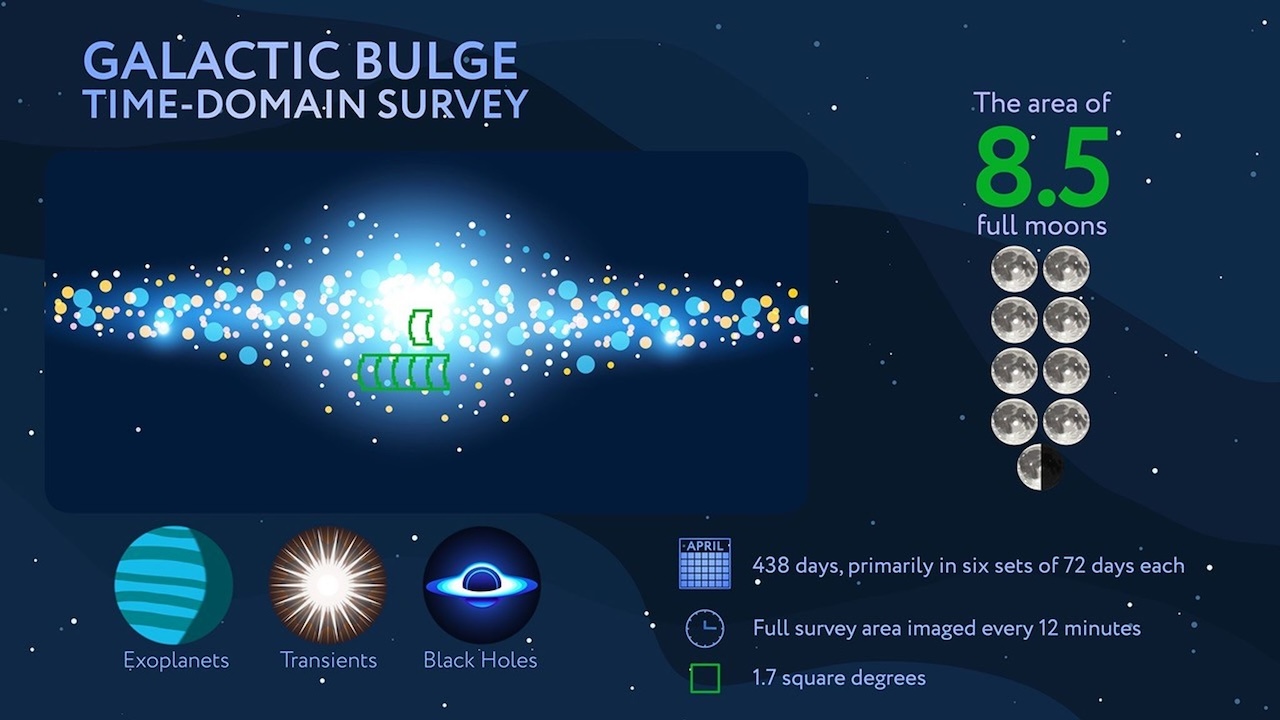
The primary science driver of the Roman Galactic Bulge Time-Domain Survey (GBTDS) is the detection and demographics of cold exoplanets via microlensing (Astro2010, Penny et al. 2019).
However, additional science can be extracted from this survey (Gaudi et al., 2019), including the potential to detect an unprecedented ~100,000 transiting exoplanets (Bennett & Rhie, 2002; Montet et al., 2017) and the transformative science this would enable.
We propose to investigate and build the infrastructure necessary to develop a transiting exoplanet science case with Roman that will benefit the astronomical community. Specifically, we will develop a GBTDS transiting exoplanet science case by:
- Developing accurate and precise pixel-level simulations of the GBTDS,
- Building a robust transit search and vetting infrastructure based on proven techniques developed for Kepler, K2, and TESS,
- Identifying and providing recommendations for GBTDS design trades that maximize the transiting planet science return, and
- Performing simulations of transiting exoplanet atmospheres to develop Roman’s potential for transformative atmosphere population studies.
This work will produce publicly-available pipelines to simulate GBTDS pixel-level data, generate light curves, detect transiting exoplanets and identify false positives, as well as simulation software for producing synthetic transit populations. We will work with the Roman project and other selected teams to leverage and augment their simulation tools. The proposed work must begin now in order to provide timely recommendations to the Roman project on survey design trades and prepare the community to maximize the science return of Roman’s first few years.
Astrobiology, Astronomy,