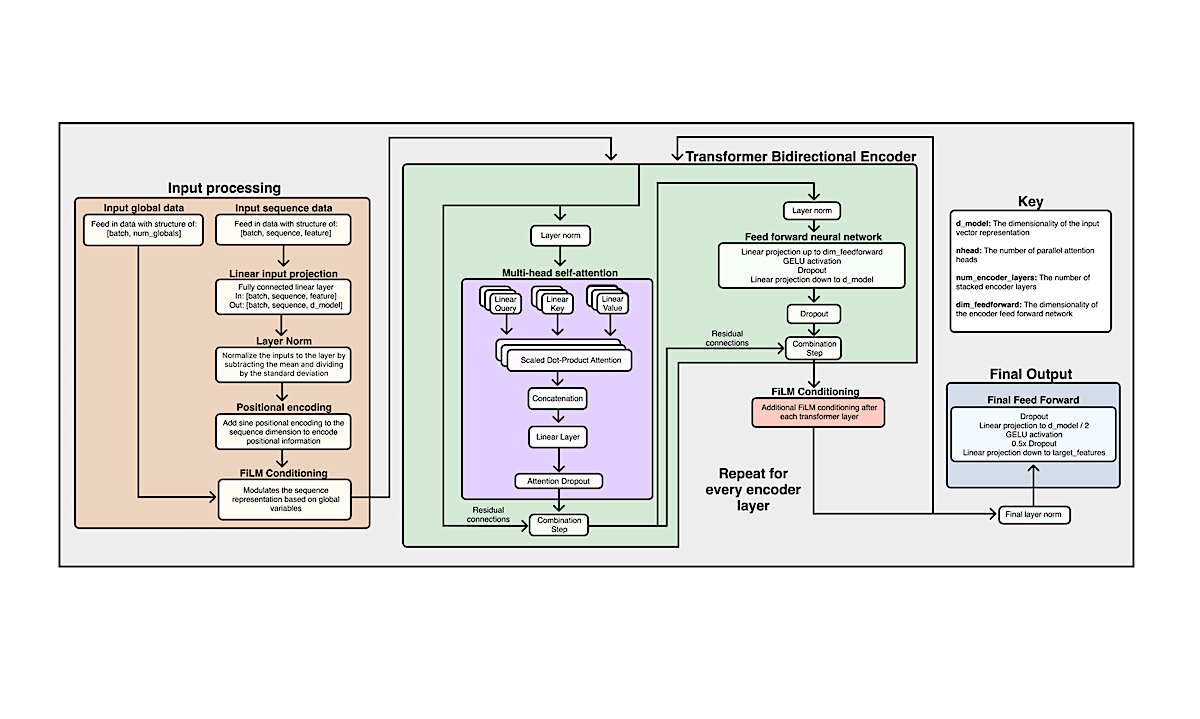
Radiative transfer calculations are essential for modeling planetary atmospheres. However, standard methods are computationally demanding and impose accuracy-speed trade-offs. High computational costs force numerical simplifications in large models (e.g., General […]
Machine learning
Bridging Machine Learning and Spectroscopy: A New Analysis for Astrochemical Target Selection
In the last few years, several approaches have used machine learning to reproduce the inventory and column densities of interstellar molecular sources.
Foundation Models for Astrobiology: Paper I — Workshop and Overview
Advances in machine learning over the past decade have resulted in a proliferation of algorithmic applications for encoding, characterizing, and acting on complex data that may contain many high dimensional […]
Machine Learning Revolution For Exoplanet Direct Imaging Detection: Transformer Architectures
Directly imaging exoplanets is a formidable challenge due to extreme contrast ratios and quasi-static speckle noise, motivating the exploration of advanced post-processing methods.
Accelerating Exoplanet Climate Modelling: A Machine Learning Approach To Complement 3D GCM Grid Simulations
With the development of ever-improving telescopes capable of observing exoplanet atmospheres in greater detail and number, there is a growing demand for enhanced 3D climate models to support and help […]
Towards the Habitable Worlds Observatory: 1D CNN Retrieval of Reflection Spectra from Evolving Earth Analogs
However, traditional atmospheric retrieval frameworks are too computationally intensive to explore the high-dimensional parameter spaces such missions will generate.
Life At The Extremes: Maximally Divergent Microbes With Similar Genomic Signatures Linked To Extreme Environments
Extreme environments impose strong mutation and selection pressures that drive distinctive, yet understudied, genomic adaptations in extremophiles.
Interpretable Machine Learning Biosignature Detection From Ocean Worlds Analogue CO2 Isotopologue Data
Future missions to icy ocean worlds (OW) such as Europa and Enceladus will evaluate the habitability and potential for biosignatures on these worlds.
The Astrobiology Data Ecosystem, Open Science, And The AI Era – NASA-DARES 2025 White Paper
DARES Alignment · Primary Topic: Identify Emerging Themes and Technologies· Secondary Topic(s): Review Recent Advancements, Strengthen Community
Foundation Models For Astrobiology – NASA-DARES 2025 White Paper
A white paper for the 2025 NASA Decadal Astrobiology Research and Exploration Strategy (DARES)