Posted inAI - Data - Apps - Cybernetics, Atmospheres, Climate, Weather, Biochemistry & Organic Chemistry, Biogeochemical Cycles & Geobiology, Biosignatures & Paleobiology, Fossils & Paleontology, Meteorites & Asteroids, Origin & Evolution of Life, Press Release

Chemical Evidence Of Ancient Life Detected In 3.3 billion-year-old Rocks

Pairing cutting-edge chemistry with artificial intelligence, a multidisciplinary team of scientists today published fresh chemical evidence of Earth’s earliest life – concealed in 3.3-billion-year-old rocks – and molecular evidence that […]

Posted inAI - Data - Apps - Cybernetics, Atmospheres, Climate, Weather, Biogeochemical Cycles & Geobiology, Gaia - Planetary Perspectives, Mapping, Geodesy, Cartography, Bathymetry, Press Release, Water/Hycean Worlds & Oceanography

AI World Model To Simulate The Earth System

Climate change is already reshaping global weather patterns and ecosystems around the world. In the long-term, its consequences could range from further substantial increases in the number of extreme weather […]

Posted inAI - Data - Apps - Cybernetics, Atmospheres, Climate, Weather, Biogeochemical Cycles & Geobiology, Exoplanets, -moons, -comets, Status Report

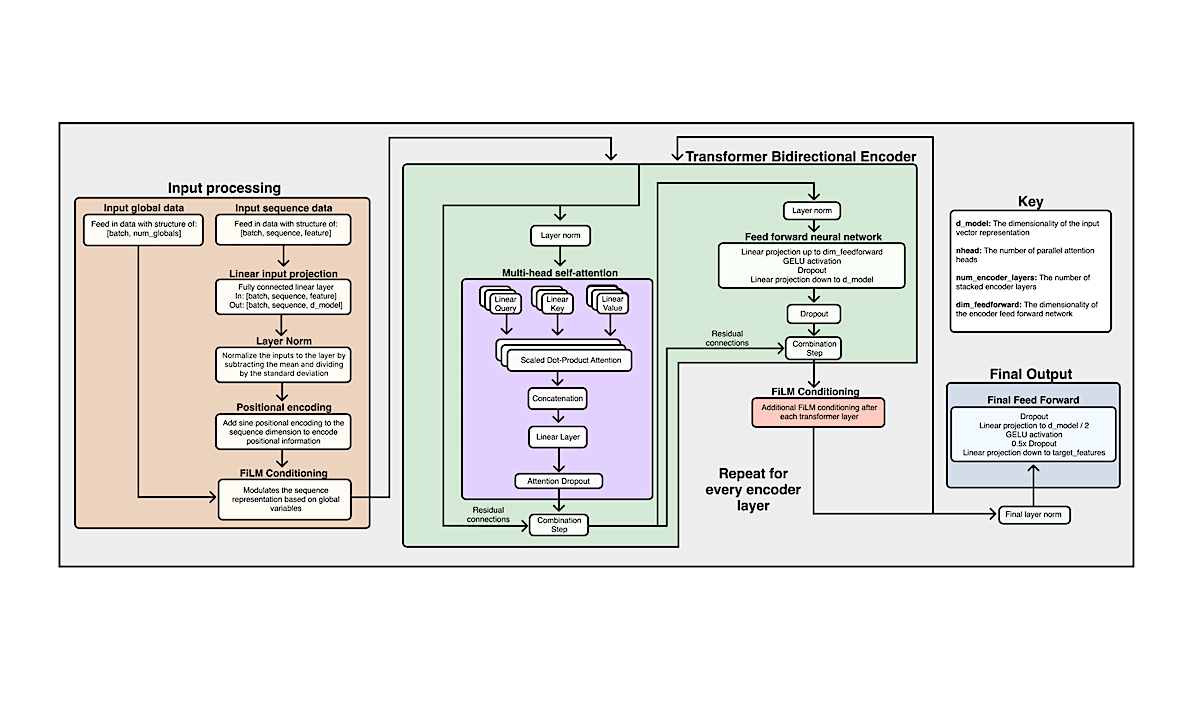
Accelerating Radiative Transfer For Planetary Atmospheres by Orders of Magnitude with a Transformer-Based Machine Learning Model

Radiative transfer calculations are essential for modeling planetary atmospheres. However, standard methods are computationally demanding and impose accuracy-speed trade-offs. High computational costs force numerical simplifications in large models (e.g., General […]

Posted inAI - Data - Apps - Cybernetics, Astronomy & Telescopes, Biosignatures & Paleobiology, Intelligence & Language, Interstellar, Press Release, SETI & Technosignatures

Revolutionary AI System Achieves 600× Speed Breakthrough in Detection of Signals from Space

In an exciting leap forward for astronomy, researchers at the Breakthrough Listen initiative, in partnership with NVIDIA, have achieved a groundbreaking advancement in the search for Fast Radio Bursts (FRBs), […]

Posted inAI - Data - Apps - Cybernetics, Citizen Science / Open Science, Education and Outreach, Genomics, Proteomics, Bioinformatics, Mapping, Geodesy, Cartography, Bathymetry, Nomenclature, Systematics, Natural History, Status Report

ReplicationBench: Can AI Agents Replicate Astrophysics Research Papers?

Frontier AI agents show increasing promise as scientific research assistants, and may eventually be useful for extended, open-ended research workflows.

Posted inAI - Data - Apps - Cybernetics, Analog Studies, Arctic / Antarctic / Alpine, Biosignatures & Paleobiology, Exploration Gear & Tech, Habitable Zones, Icy Worlds, Imaging & Spectroscopy, Mapping, Geodesy, Cartography, Bathymetry, Missions & Hardware, Press Release, ROVs/Submersibles/Diving, Sample Return, Tricorders & Sensors, Water/Hycean Worlds & Oceanography

An Autonomous Robotic Glider Will Circle And Explore Our Ocean Planet

Editor’s note: When we start to mount Astrobiology missions to explore ocean worlds we’ll need ways for our robotic submersibles to observe and interact with whatever life forms they may […]

Posted inBiosignatures & Paleobiology, Desert Worlds, Habitable Zones, Imaging & Spectroscopy, Mars, Missions & Hardware, Robotics/Rovers/UAVs, Sample Return, Status Report, Tricorders & Sensors

A Computer Vision Framework For Estimating Surface Habitability From Mars Using Convolutional Analysis

Identifying signs of life in extraterrestrial environments is one of the growing challenges in planetary science. Conventional approaches of detecting habitability rely heavily on direct contact with biosignatures or geological […]

Posted inAI - Data - Apps - Cybernetics, Biogeochemical Cycles & Geobiology, Biophysics, Biosignatures & Paleobiology, Imaging & Spectroscopy, Mars, Microbiology & Virology, Press Release

Artificial Intelligence-Enhanced Detection of Biogenicity Using Laboratory Specimens of Biologically and Microbially Induced Sedimentary Structures in a Controlled Experiment

The search for traces of life can be based on the detection of specific signatures produced by microorganisms on sedimentary rocks.

Gift this article