


The interpretation of the origin of observed exoplanets is usually done only qualitatively due to uncertainties of key parameters in planet formation models.
AI

Posted inAI - Data - Apps - Cybernetics, Astronomy & Telescopes, Biosignatures & Paleobiology, SETI & Technosignatures, Status Report
An Improved Machine Learning Approach for RFI Mitigation in FAST-SETI Survey Archival Data
The search for extraterrestrial intelligence (SETI) commensal surveys aim to scan the sky to detect technosignatures from extraterrestrial life.

Posted inAI - Data - Apps - Cybernetics, Astrobiology (general), Astrochemistry, Astrogeology, Astronomy & Telescopes, Nanotechnology & SynBio, Status Report, Tricorders & Sensors
NASA ROSES-25 Amendment 32: B.5 Research and Development of Initiatives of Advanced New Technologies Final Text and Due Dates
B.5 Research and Development of Initiatives of Advanced New Technologies (RADIANT) seeks innovative adaptations and applications of existing AI techniques, concepts, methodologies, etc. to demonstrate their feasibility and potential to […]

Posted inAI - Data - Apps - Cybernetics, Astronomy & Telescopes, Biosignatures & Paleobiology, Exoplanets, -moons, -comets, Habitable Zones, Imaging & Spectroscopy, Status Report
Machine Learning For Exoplanet Discovery: Validating TESS Candidates and Identifying Planets in the Habitable Zone
The high-precision photometry from NASA’s Kepler and TESS missions has revolutionized exoplanet detection, enabling the discovery of over 5500 confirmed exoplanets via the transit method and around 10000 additional candidates […]

Posted inAI - Data - Apps - Cybernetics, Astrogeology, Atmospheres, Climate, Weather, Biosignatures & Paleobiology, Status Report, Tricorders & Sensors
Organic Geochemical Evidence For Life In Archean Rocks Identified By Pyrolysis–GC–MS and Supervised Machine Learning
Significance Teasing out biochemical information from ancient organic-rich sediments, notably the timing of the emergence of photosynthesis relative to the inferred oxygenation of Earth’s atmosphere, remains a challenging opportunity. To […]

Posted inAI - Data - Apps - Cybernetics, Atmospheres, Climate, Weather, Biochemistry & Organic Chemistry, Biogeochemical Cycles & Geobiology, Biosignatures & Paleobiology, Fossils & Paleontology, Meteorites & Asteroids, Origin & Evolution of Life, Press Release
Chemical Evidence Of Ancient Life Detected In 3.3 billion-year-old Rocks
Pairing cutting-edge chemistry with artificial intelligence, a multidisciplinary team of scientists today published fresh chemical evidence of Earth’s earliest life – concealed in 3.3-billion-year-old rocks – and molecular evidence that […]

Posted inAI - Data - Apps - Cybernetics, Atmospheres, Climate, Weather, Biogeochemical Cycles & Geobiology, Gaia - Planetary Perspectives, Mapping, Geodesy, Cartography, Bathymetry, Press Release, Water/Hycean Worlds & Oceanography
AI World Model To Simulate The Earth System
Climate change is already reshaping global weather patterns and ecosystems around the world. In the long-term, its consequences could range from further substantial increases in the number of extreme weather […]
Posted inAI - Data - Apps - Cybernetics, Atmospheres, Climate, Weather, Biogeochemical Cycles & Geobiology, Exoplanets, -moons, -comets, Status Report
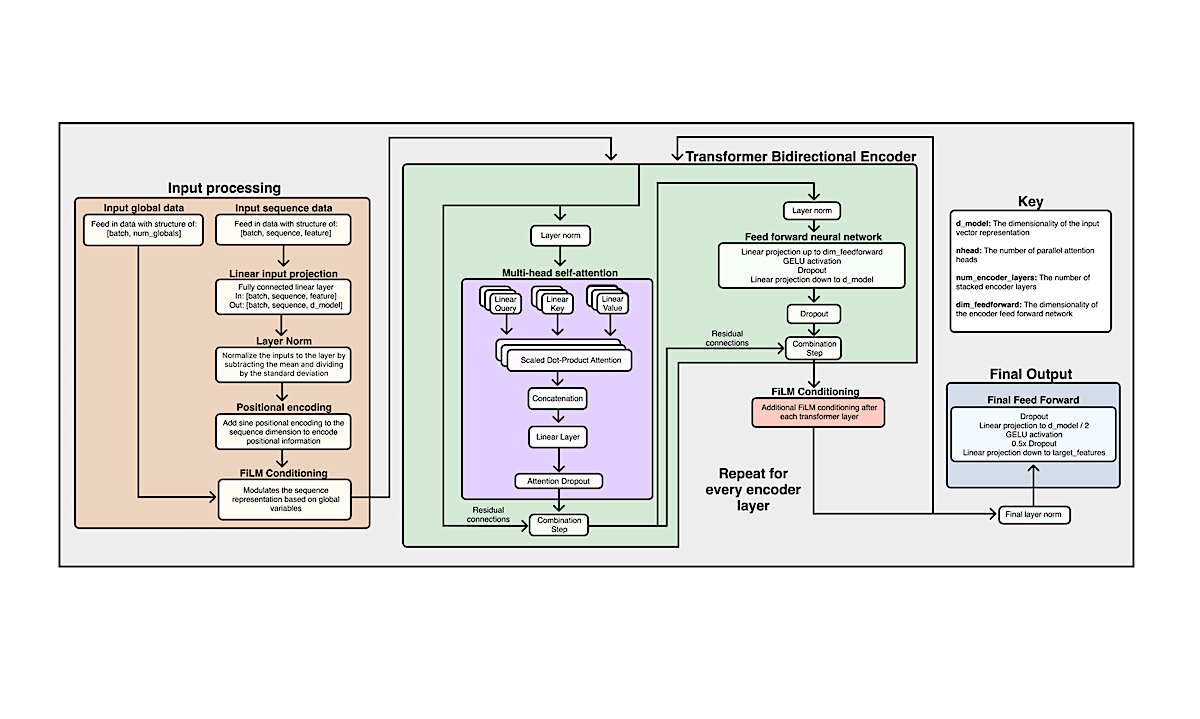
Accelerating Radiative Transfer For Planetary Atmospheres by Orders of Magnitude with a Transformer-Based Machine Learning Model
Radiative transfer calculations are essential for modeling planetary atmospheres. However, standard methods are computationally demanding and impose accuracy-speed trade-offs. High computational costs force numerical simplifications in large models (e.g., General […]

Posted inAI - Data - Apps - Cybernetics, Astronomy & Telescopes, Biosignatures & Paleobiology, Intelligence & Language, Interstellar, Press Release, SETI & Technosignatures
Revolutionary AI System Achieves 600× Speed Breakthrough in Detection of Signals from Space
In an exciting leap forward for astronomy, researchers at the Breakthrough Listen initiative, in partnership with NVIDIA, have achieved a groundbreaking advancement in the search for Fast Radio Bursts (FRBs), […]

Posted inAI - Data - Apps - Cybernetics, Citizen Science / Open Science, Education and Outreach, Genomics, Proteomics, Bioinformatics, Mapping, Geodesy, Cartography, Bathymetry, Nomenclature, Systematics, Natural History, Status Report
ReplicationBench: Can AI Agents Replicate Astrophysics Research Papers?
Frontier AI agents show increasing promise as scientific research assistants, and may eventually be useful for extended, open-ended research workflows.