Metamorphoses Of Carbon And Oxygen In Protoplanetary Discs: How Chemistry And Radial Drift Transform Inner Disc C/O Ratios
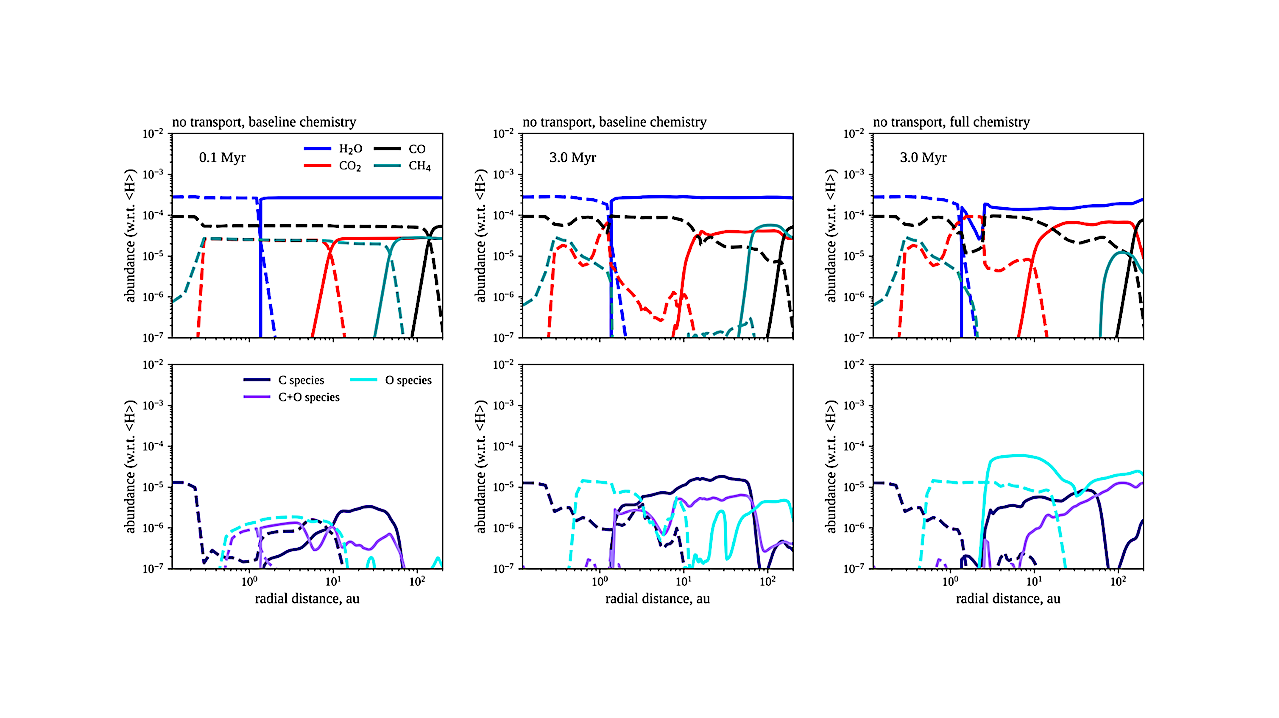
The chemical composition of a protoplanetary disc is sensitive to its thermal structure and dust properties, and can provide insights into the disc evolution.
Recent observations with the James Webb Space Telescope (JWST) reveal correlations of the inner disc compositions with disc size, accretion rate and stellar mass, explained by the key role of dust radial drift in redistributing primordial volatiles.
We explore how chemical reactions change the composition of ices carried with pebbles and how they affect the inner disc C/O ratios in a disc around a solar mass star. We consider different drift efficiencies set by dust fragmentation velocity and include dust traps at different locations.
We vary the incident cosmic ray ionisation rate ζ and the efficiency of cosmic ray dissociation of ices, and consider the effect of carbon grain destruction. We find that methane depletion within <1 Myr prevents the delivery of carbon-rich gas to the inner disc and yields C/O≲1 for ζ≥10−17 s−1.
Dust traps collect water and carbon-rich ices formed via methane destruction, further lowering the inner disc metallicity and C/O ratio. Cosmic-ray driven photodissociation of ices can convert water to O2 and carbon-bearing molecules to CO, allowing ices to escape the trap if ≳10% of the dissociated products can participate in surface reactions.
We discuss the observational implications and conclude that cosmic rays and their effect on ices are the key factors that determine the impact of chemistry on the inner disc composition.
Tamara Molyarova, Richard A. Booth, Catherine Walsh
Comments: 21 pages, 9 figures, accepted to MNRAS
Subjects: Earth and Planetary Astrophysics (astro-ph.EP); Solar and Stellar Astrophysics (astro-ph.SR)
Cite as: arXiv:2605.31091 [astro-ph.EP] (or arXiv:2605.31091v1 [astro-ph.EP] for this version)
https://doi.org/10.48550/arXiv.2605.31091
Focus to learn more
Submission history
From: Tamara Molyarova
[v1] Fri, 29 May 2026 09:59:33 UTC (6,141 KB)
https://arxiv.org/abs/2605.31091
Astrobiology, Exoplanet, Astrochemistry, Astrogeology,