Stereoselective Phosphorylation of d-Ribose as a Driver of Life’s Homochirality
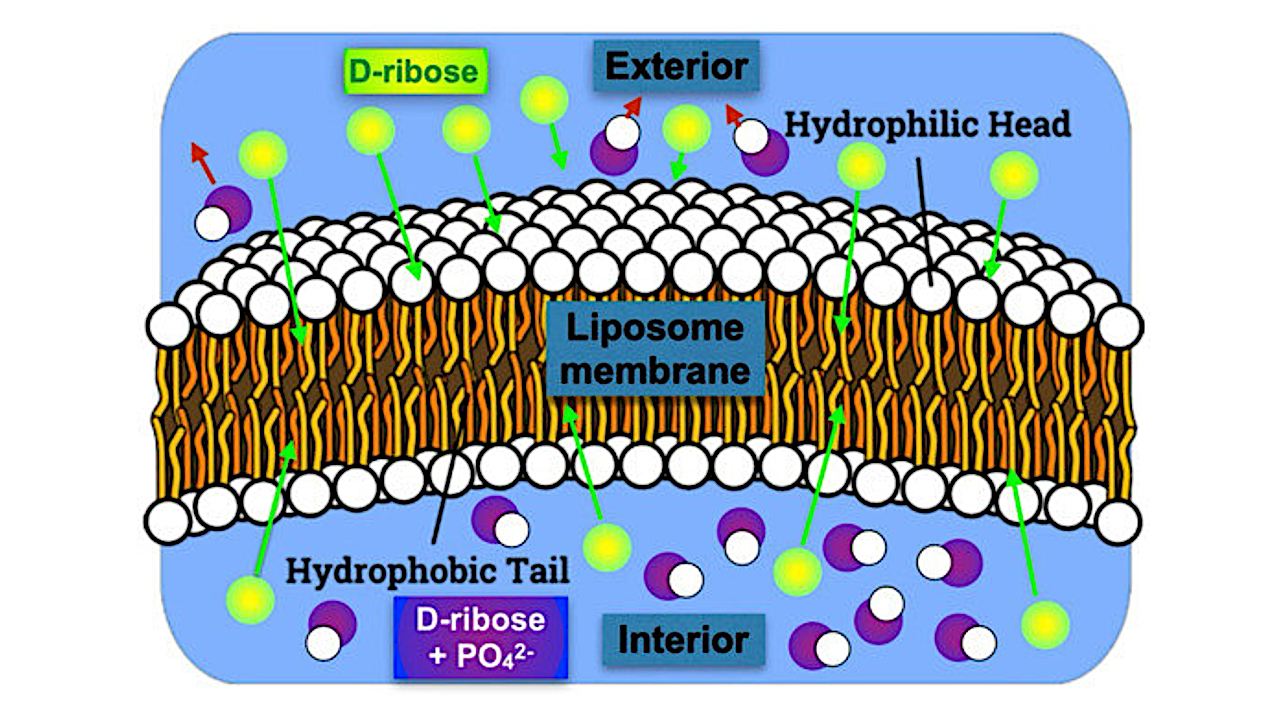
Life demonstrates remarkable homochirality of its major building blocks: nucleic acids, amino acids, sugars, and phospholipids. Phospholipid bilayer vesicles (liposomes) are formed at the water/air interface from Langmuir layers and contain ribose, a constituent of primordial water.
Although the primordial ribose was initially racemic, life, as we know it, is homochiral, with d-ribose and its derivatives as the predominant forms. The phospholipid membrane’s permeability to d-ribose, together with ribose’s interaction with the bilayer’s charged phosphate groups, leads to ribose phosphorylation, yielding d-ribose-5-phosphate. Once inside, the d-ribose-5-phosphate molecules cannot cross the membrane.
A similar path also exists for l-ribose, but with a lower rate. Therefore, overall, this process is enantioselective, favoring the buildup of d-ribose over l-ribose. Through liposome fusion, fission, and self-replication, this eventually leads to the Darwinian evolution of these structures and to the conversion of d-ribose-5-phosphate into complex functional molecules, such as ribozymes and RNA, and eventually into DNA, all of which inherit d-ribose’s chirality.

A depiction of liposome formation and evolution. Liposomes formed on the surface of the Archean water pools are destroyed by solar UV unless they acquire two adaptive traits—the heavy content that sinks the liposomes to the bottom of the pool and facilitates protection from UV, and the formation of resilient autocatalytic membrane composition that ensures liposomal survival, fusion, fission, and mutation of the components, thus providing liposomes adaptation and persistence. — Life
Stereoselective Phosphorylation of d-Ribose as a Driver of Life’s Homochirality, Vladimir M. Subbotin and Gennady Fiksel Life demonstrates remarkable homochirality of its major building blocksLife 2026, 16(5), 846; DOI: 10.3390/life16050846 (open access)
Astrobiology,