Spatial Confinement And Boundary Constraints Governing Biological Chirality: A Simulation Study
Biological systems exhibit marked molecular asymmetry, with proteins based predominantly on L-amino acids and nucleic acids and carbohydrates largely composed of D-sugars.
Explanations for homochirality include asymmetric photochemistry, autocatalytic amplification, stochastic symmetry breaking and mineral-surface stereoselectivity, but these mechanisms only partially address the influence of finite geometry and collective spatial interactions on stereochemical stabilization.
Inspired by recent developments in condensed-matter physics, we investigated whether coherent chirality could emerge from the interplay among nonlinear stereochemical amplification, stochastic fluctuations and boundary-dependent spatial constraints. We developed a reaction-diffusion simulation in which local stereochemical populations evolved within finite two-dimensional domains under spatial coupling and weak geometrical bias fields.
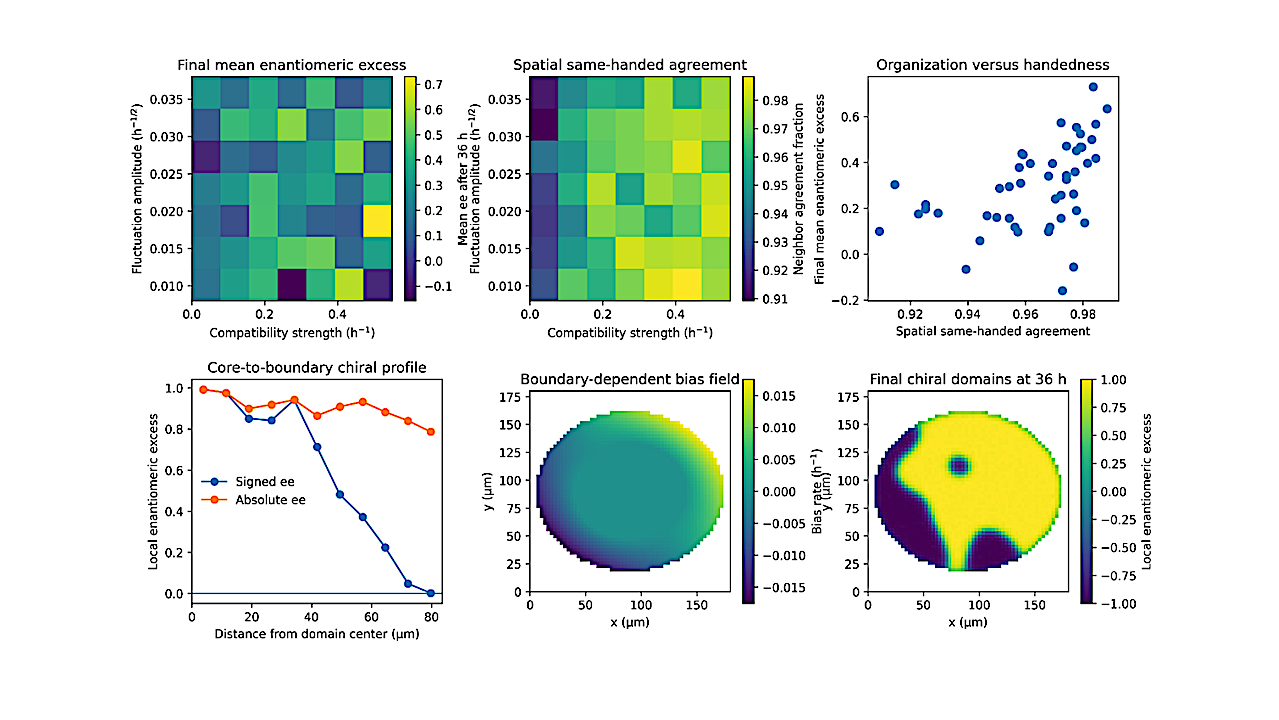
Our model combined bistable autocatalytic dynamics, nearest-neighbor interactions and suppression of locally inconsistent stereochemical configurations in order to quantify temporal evolution of enantiomeric excess, same-handed neighbor agreement and radial stereochemical organization under varying interaction strengths and fluctuation amplitudes.
Our results showed progressive formation of chiral domains, segregation of opposite-handed regions and geometry-dependent modulation of local stereochemical organization. Spatial coupling increased local coherence and modified persistence of mixed stereochemical states, while finite boundaries influenced radial organization and anisotropic stabilization of molecular populations.
Potential applications include geometrically controlled asymmetric synthesis, confined stereoselective catalytic systems, adaptive chiral materials and characterization of heterogeneous stereochemical distributions in microstructured reaction environments.
Arturo Tozzi
Comments: 10 pages, 2 figures
Subjects: Other Quantitative Biology (q-bio.OT)
Cite as: arXiv:2605.24582 [q-bio.OT] (or arXiv:2605.24582v1 [q-bio.OT] for this version)
https://doi.org/10.48550/arXiv.2605.24582
Focus to learn more
Submission history
From: Arturo Tozzi
[v1] Sat, 23 May 2026 13:46:44 UTC (747 KB)
https://arxiv.org/abs/2605.24582
Astrobiology, Astrochemistry, Genomics,