Parameterizing Slantwise Convection In Icy Moon Oceans
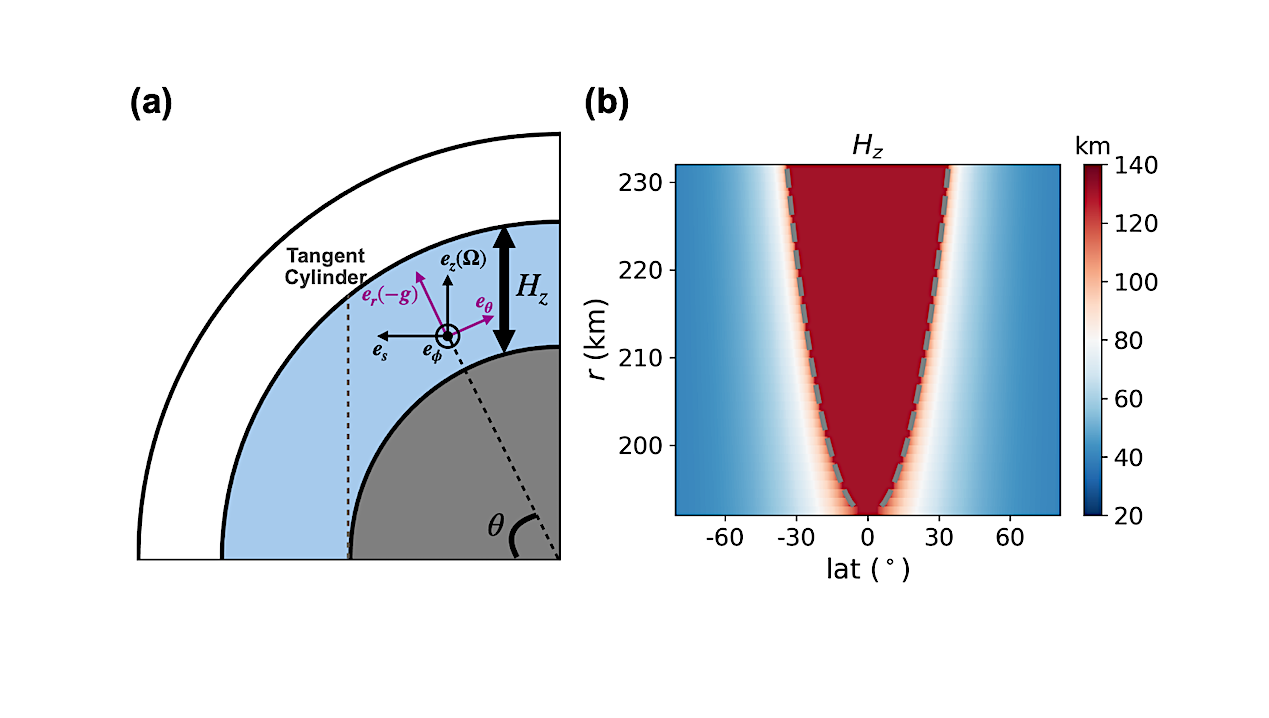
Convection in icy moon oceans is strongly influenced by rotation, organizing into slantwise columnar structures aligned with the planetary rotation axis. They generate significant meridional heat transport, which can affect the ice shell topography, a primary observable of these moons.
However, global ocean simulations cannot resolve convection under realistic icy moon conditions, and traditional convection schemes cannot represent slantwise convection. Here, we develop a slantwise convection scheme and implement it in a global ocean model. We perform benchmark tests in a global spherical shell by comparing parameterized fluxes with convection-resolving simulations.
The scheme reproduces the meridional heat transport inside the tangent cylinder, where slantwise convection dominates. The resulting meridional heat transport significantly modifies the surface heat flux, producing variations comparable to the imposed bottom heating magnitude.
Although the simulations with parameterized convection cannot fully reproduce the temperature structure, likely due to an inability to reproduce the temperature gradients near the boundaries, they capture the bulk interior vertical temperature gradient. The new scheme allows unresolved slantwise convection to be represented in global ocean simulations for icy moons.
It is also applicable to other rapidly rotating oceans with small natural Rossby number (Ro∗≪1), including deep ocean worlds on exoplanets.
Yaoxuan Zeng, Malte F. Jansen
Subjects: Earth and Planetary Astrophysics (astro-ph.EP); Fluid Dynamics (physics.flu-dyn)
Cite as: arXiv:2606.22547 [astro-ph.EP] (or arXiv:2606.22547v1 [astro-ph.EP] for this version)
https://doi.org/10.48550/arXiv.2606.22547
Focus to learn more
Submission history
From: Yaoxuan Zeng
[v1] Sun, 21 Jun 2026 15:07:21 UTC (2,860 KB)
https://arxiv.org/abs/2606.22547
Astrobiology, exoplanet,