Dynamic Controls On Subsurface Water Chemistry And Habitability On Icy Moons
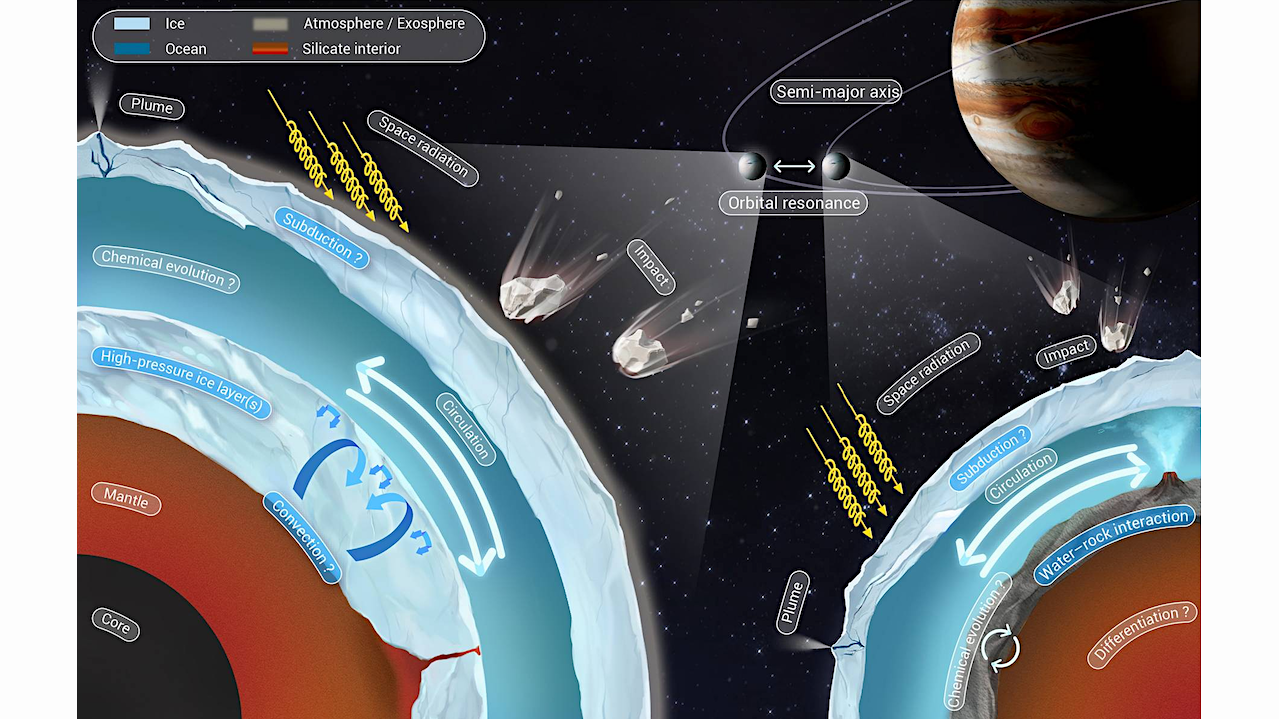
Icy moons are natural satellites whose surfaces contain a substantial fraction of frozen materials, most notably water ice.
They lie beyond the snow line and orbit gas or ice giant planets, such as Jupiter, Saturn, Uranus, and Neptune. Recent observations and theoretical studies have indicated that several icy moons host regional or global subsurface liquid water oceans that likely persist for 107–109 years.
Moreover, various organic matter and bioessential nutrients have been detected on icy shells or within plumes from several icy moons, implying potentially habitable ocean chemistry. Consequently, ocean-bearing moons become tantalizing targets for the search for extraterrestrial habitable environments and potential biosignatures.
- Dynamic controls on subsurface water chemistry and habitability on icy moons, The Innovation via PubMed (open access)
- Dynamic controls on subsurface water chemistry and habitability on icy moons, The Innovation(open access)
Astrobiology,