Revisiting The Exo-Mercury Candidate GJ 367 b With ESPRESSO And A Self-Consistent Tidal Distortion Model
We report revised mass and radius measurements for GJ 367 b, an ultra-short-period (7.7 hr) sub-Earth in a multi-planet system orbiting a nearby (~9 pc) M dwarf host. Previous mass and radius measurements have suggested GJ 367 b has an anomalously high bulk density, close to that of solid iron.
The existence of such an iron-rich planet is in tension with established planet formation scenarios. We utilized newly available TESS short-cadence photometry to constrain the radius of GJ 367 b to 0.736 +/- 0.035 R_Earth.
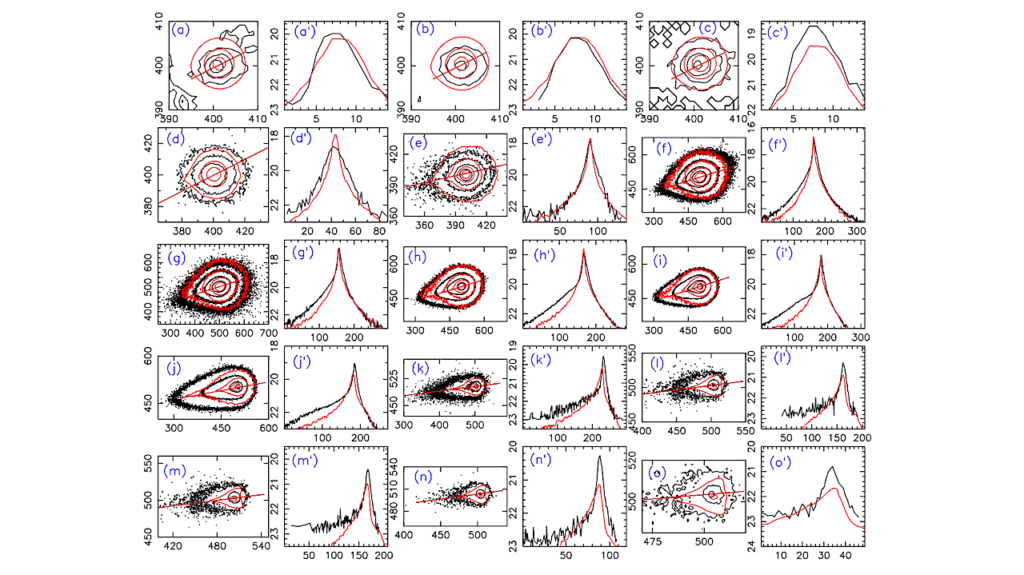
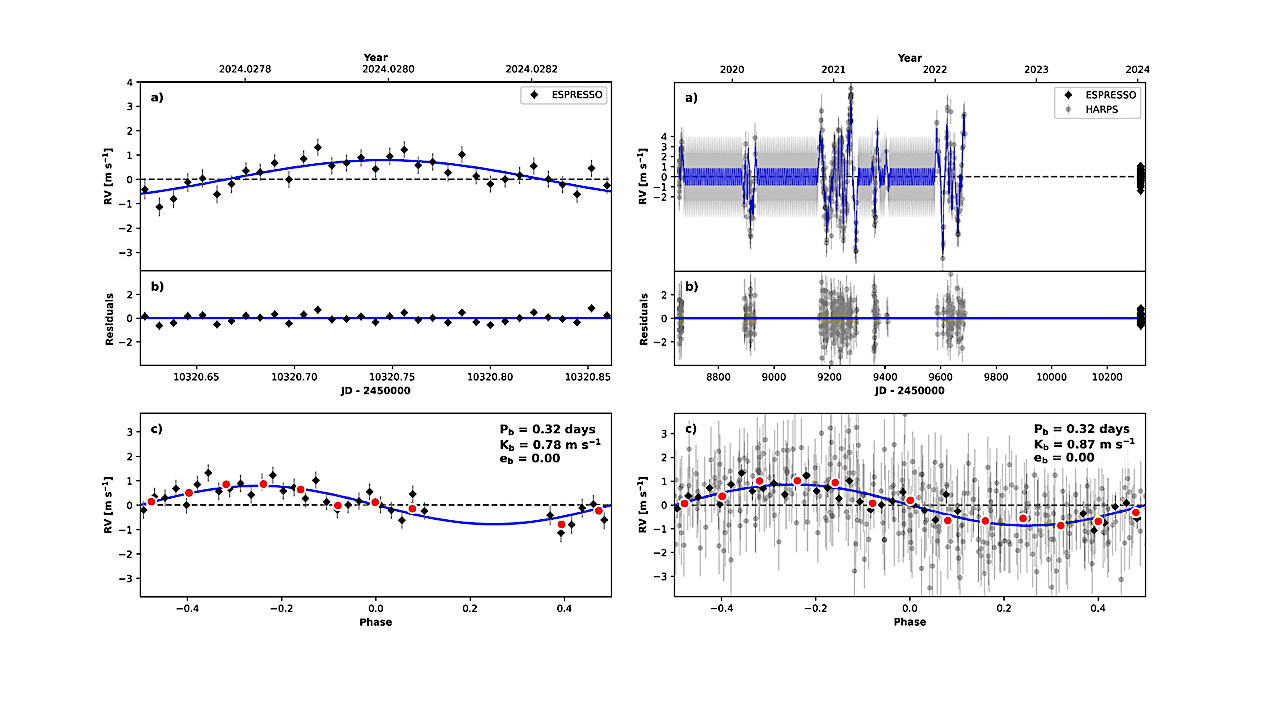
We consider observational and modeling effects such as photometric dilution, stellar activity, and tidal distortion to account for possible inaccuracies in the star and planet radius measurements. From our radial velocity (RV) analysis using VLT/ESPRESSO data covering nearly the full orbit in a single night, we find a mass of 0.503 +/- 0.078 M_Earth, corresponding to a bulk density of 6.9 +1.6/-1.4 g cm-1.
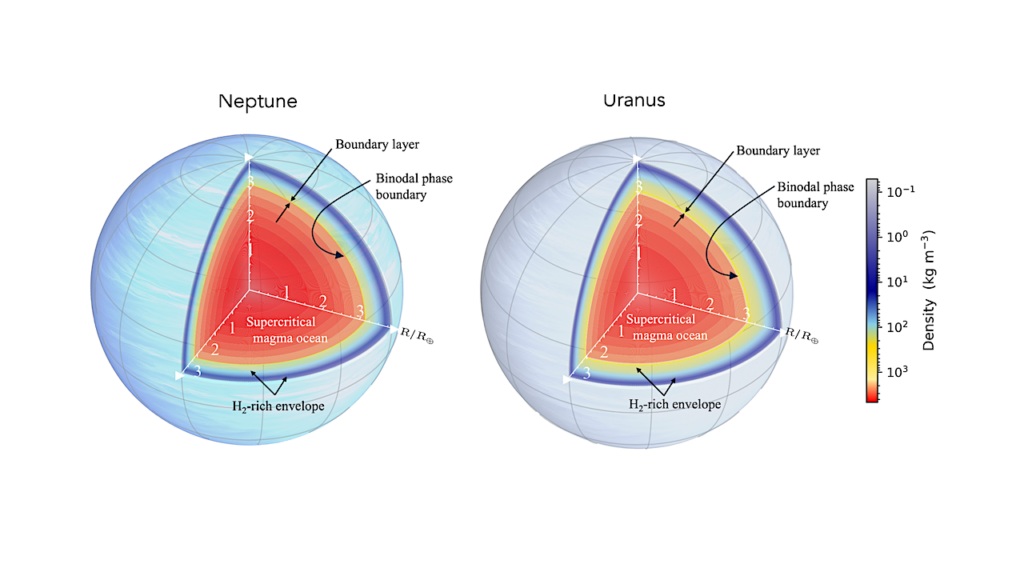
We present a new tidal distortion and interior composition modeling framework to assess the iron mass fraction of GJ 367 b. Considering several different interior composition assumptions and radial aspect ratios, we find an iron fraction of ~50-70%, which is broadly consistent with that of Mercury and not as iron rich as previously suggested.
Rena A. Lee, Fei Dai, Ellen M. Price, Te Han, Davide Gandolfi, Mathias Zechmeister, Guðmundur Stefánsson, Jiayin Dong, Simon H. Albrecht, Kristine W.F. Lam, Federica Chiti, Jennifer L. van Saders, Daniel Huber, Heather A. Knutson, Karen A. Collins, Michael Zhang, Leslie A. Rogers, Eleonora Armano, Casey L. Brinkman, Nicholas Saunders, Daniel Hey
Comments: accepted to ApJ
Subjects: Earth and Planetary Astrophysics (astro-ph.EP)
Cite as: arXiv:2606.18355 [astro-ph.EP] (or arXiv:2606.18355v1 [astro-ph.EP] for this version)
https://doi.org/10.48550/arXiv.2606.18355
Focus to learn more
Submission history
From: Rena Lee
[v1] Tue, 16 Jun 2026 18:03:17 UTC (2,947 KB)
https://arxiv.org/abs/2606.18355
Astrobiology,