Detection Of CO, H2O, And OH In WASP-18b With JWST/NIRISS Using Direct-Extracted Spectra And Cross-Correlation
The James Webb Space Telescope (JWST) has revolutionized the characterization of exoplanetary atmospheres, offering unprecedented sensitivity to probe their chemical and physical properties.
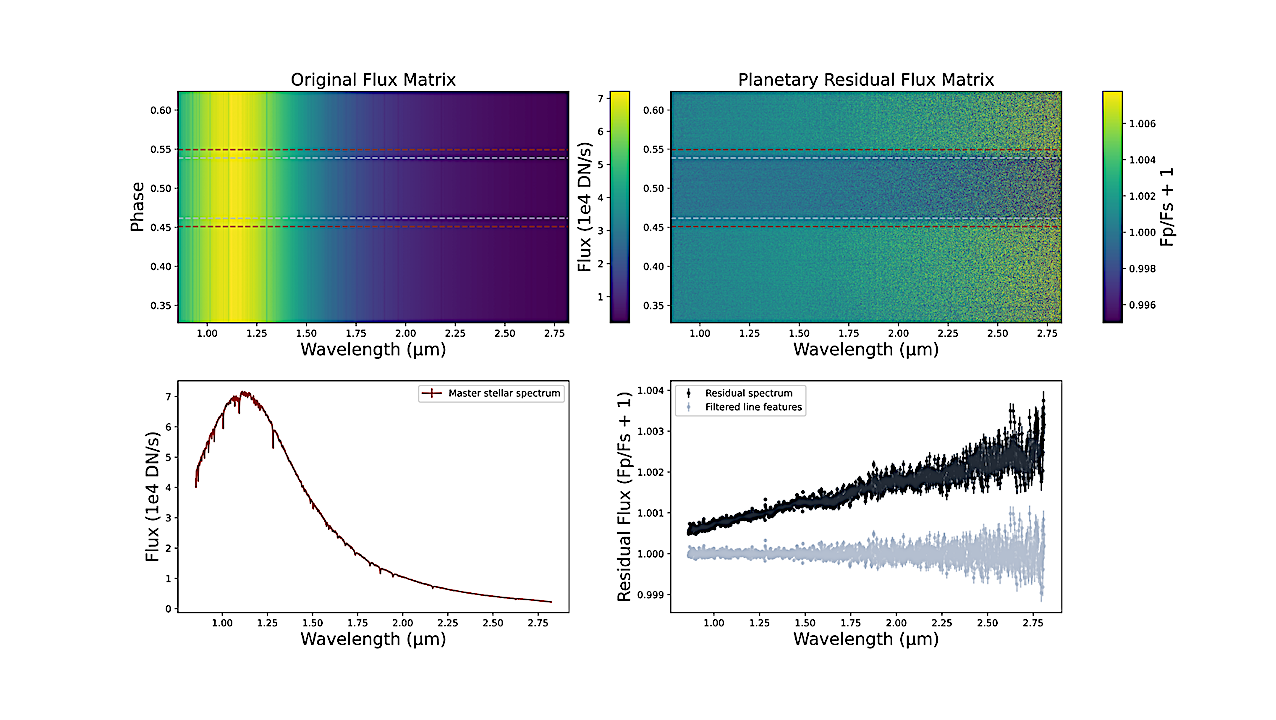
Recently, a growing trend has emerged to obtain atmospheric information directly from pixel-level planetary spectra. In this work, we re-analyzed the WASP-18b NIRISS/SOSS dataset by employing a direct extraction method. This new method preserves the spectral information at the native instrumental resolution, thereby enabling the application of cross-correlation techniques and providing atmospheric retrievals with enhanced precision and richer information content.
With this methodology, we report detections of CO at 4.4σ significance, H2O at 3.4σ, and OH at 7.8σ, where CO and OH were previously unseen. Building on these unambiguous detections, our subsequent retrieval analysis significantly improves the constraints on atmospheric abundances.
Our results demonstrate that the cross-correlation technique effectively extracts molecular signals from medium-resolution JWST data, enhancing detection sensitivity. By revisiting JWST archival data with cross-correlation and retrieval analysis, we can achieve a more comprehensive survey of planetary atmospheric chemistry, thereby placing precise constraints on key parameters such as planetary metallicity and C/O ratio.
Qinglin Ouyang, Fei Yan, Shuo Liu, Boyue Guo, Guo Chen, Enric Pallé, Yuanheng Yang, Wei Wang, Meng Zhai, Qian Chen
Comments: Accepted for publication in ApJ
Subjects: Earth and Planetary Astrophysics (astro-ph.EP); Instrumentation and Methods for Astrophysics (astro-ph.IM)
Cite as: arXiv:2605.30871 [astro-ph.EP] (or arXiv:2605.30871v1 [astro-ph.EP] for this version)
https://doi.org/10.48550/arXiv.2605.30871
Focus to learn more
Submission history
From: Qinglin Ouyang
[v1] Fri, 29 May 2026 05:50:57 UTC (4,660 KB)
https://arxiv.org/abs/2605.30871
Astrobiology, Exoplanet,