A JWST Transmission Spectrum Of The Temperate Sub-Neptune TOI-732 c
In recent years, JWST has facilitated detections of carbon-bearing molecules in the atmospheres of temperate sub-Neptunes orbiting M dwarfs, ushering in a new era in the characterization of this intriguing planetary regime.
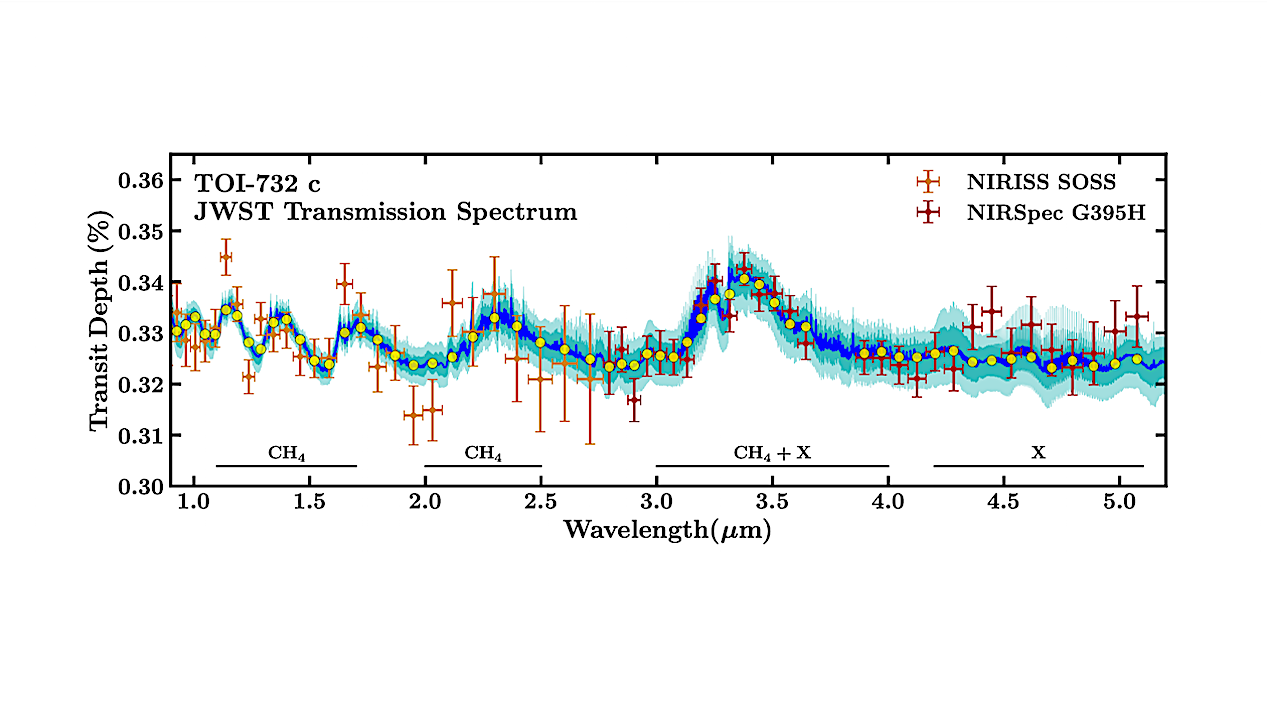
We report the transmission spectrum of the temperate sub-Neptune TOI-732 c, observed with JWST NIRISS, NIRSpec G395H and MIRI LRS between 0.9-12 μm. The observations provide evidence for methane (CH4) in a H2-rich atmosphere, at a volume mixing ratio of ∼1%, and non-detection of NH3 and HCN, along with nominal constraints on other prominent molecules H2O, CO and CO2, which are typically expected in H2-rich atmospheres.
We conduct a comprehensive survey of 250 chemical species and find moderate to strong evidence (up to lnB∼5.9, 3.9σ) for additional absorption due to one or more complex molecules including higher-order hydrocarbons and/or sulfur-bearing molecules. The spectral features are strongly degenerate among these molecules and with methane, which we find at lnB=3.2−8.8 (up to 3.0−4.6σ) significance.
Two complex molecules are preferred with at least moderate evidence (lnB≳2.5) in both the near- and mid-infrared, while several others show such evidence in at least one of the two wavelength ranges. The preferred molecules are found in trace quantities on Earth, with no significant sources identified in other planetary atmospheres, requiring future work to assess their physical plausibility in this planet.
Future observations are required to resolve the degeneracies and place more robust constraints on these species. We highlight the need for further theoretical and experimental work to robustly characterize the atmospheric and internal composition of TOI-732 c and similar sub-Neptunes.
Frances E. Rigby, Nikku Madhusudhan, Subhajit Sarkar, Lorenzo Pica-Ciamarra, Måns Holmberg, Julianne I. Moses
Comments: Accepted for publication in ApJL
Subjects: Earth and Planetary Astrophysics (astro-ph.EP)
Cite as: arXiv:2512.15844 [astro-ph.EP] (or arXiv:2512.15844v1 [astro-ph.EP] for this version)
https://doi.org/10.48550/arXiv.2512.15844
Focus to learn more
Submission history
From: Madhusudhan Nikku
[v1] Wed, 17 Dec 2025 19:00:00 UTC (2,645 KB)
https://arxiv.org/abs/2512.15844
Astrobiology, Exoplanet,